Rokid智能眼镜

Search documents
浙江余杭力争“十五五”时期GDP突破5000亿元
Zhong Guo Jing Ji Wang· 2026-02-27 14:24
Economic Growth - Yuhang District aims to exceed a GDP of 500 billion yuan during the 14th Five-Year Plan, with core digital economy industries' added value surpassing 350 billion yuan and cultural industries' added value exceeding 300 billion yuan [1] - In the previous year, Yuhang's GDP reached 356.8 billion yuan, maintaining the top position in the province, with fiscal revenue of 83.9 billion yuan [1] Innovation and Technology - Yuhang plans to leverage its advantage of over 3,200 national high-tech enterprises to promote the return of manufacturing and production for innovative companies like Rokid, which saw a 580% year-on-year increase in smart glasses sales during the Spring Festival [1] - The district aims to develop advanced manufacturing clusters, targeting the creation of more hundred-billion and trillion-level industry clusters [1] Project Development - Major projects such as the Yuhang International Sports Center and the Yuhang Cultural and Art Center are progressing rapidly, with construction activities continuing during the Spring Festival [2] - The opening of the Hangzhou Yintai Center and the acceleration of projects like the Zhejiang Concert Hall and Yuhang Grand Theater are also highlighted [2] Cultural Industry - The upcoming fourth "Liangzhu Forum" and the acceleration of significant projects like the Liangzhu Museum Phase II are set to enhance the cultural industry [2] - Yuhang plans to integrate culture with technology, tourism, and people's livelihoods, promoting new cultural products such as games and short dramas by 2026 [2]
“科技年货”助力浙江春节消费 智能产品迎选购高峰
Zhong Guo Xin Wen Wang· 2026-02-24 12:10
Core Insights - The consumption during the Spring Festival in Zhejiang has been significantly boosted by new trends such as "AI + consumption" and IP consumption, with key monitored commercial enterprises reporting an 8.2% year-on-year sales growth [1] - Demonstration pedestrian streets experienced an 11.6% increase in revenue year-on-year, while UnionPay's entertainment consumption total amount rose by 9.2% [1] Group 1: Technology and Consumer Trends - The "Spring Festival Gala effect" has continued to drive interest, with the search volume for "Yushut Technology" increasing over three times following the program "Wu BOT" [2] - Smart products, referred to as "technology New Year goods," have seen a surge in sales, particularly in Hangzhou's digital life district, where sales of Rokid smart glasses increased by 5.8 times year-on-year [2] Group 2: Tourism and Cultural Impact - The popularity of the TV drama "Tai Ping Nian" has turned several tourist attractions in Hangzhou into must-visit landmarks, with Qianwang Shrine receiving over 100,000 visitors during the holiday, marking a 45% increase year-on-year [2] - The city has introduced themed buses and customized routes to attract fans of the drama, enhancing the cultural tourism experience [2] Group 3: Dining and Culinary Trends - UnionPay's dining consumption in Zhejiang rose by 10.8% during the Spring Festival, with key dining enterprises seeing a more than threefold increase in reservations for New Year's Eve dinners [2] - Traditional "Hangzhou cuisine" brands have launched affordable meal packages, while rural hotels introduced specialty dishes, contributing to new growth points in dining consumption [2]


用搭载GPT-5.2的眼镜做题,是一种什么体验?
Guan Cha Zhe Wang· 2025-12-27 05:21
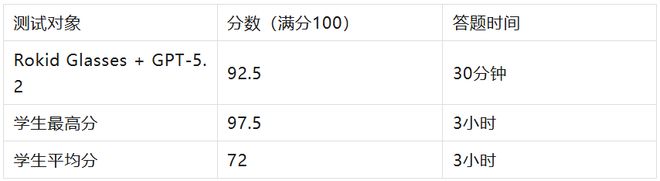
Core Insights - The experiment conducted by Hong Kong University of Science and Technology demonstrated that the Rokid smart glasses equipped with OpenAI's GPT-5.2 model scored 92.5 out of 100 in a final exam, which is lower than the highest student score of 97.5 but significantly higher than the class average of 72 [1][2][3]. Technical Performance - The GPT-5.2 model showed strong understanding and application of specialized knowledge, scoring full marks on multiple-choice and single-page questions, but struggled with cross-page questions, indicating limitations in maintaining coherent understanding across different contexts [4][5]. - The model's performance highlighted its inability to effectively integrate information dispersed across multiple pages, revealing a core limitation in current AI systems regarding global cognition and working memory [4][5]. Educational Assessment Challenges - The experiment prompted discussions in the education sector about the need to rethink assessment methods, as AI tools challenge the traditional assumption that students independently apply knowledge [7]. - Experts suggest that educational evaluation should shift focus from knowledge reproduction to problem definition, innovative solution design, and the ability to collaborate with AI tools [7][8]. Ethical and Equity Considerations - The proliferation of AI-assisted learning tools raises concerns about educational equity, as access to quality AI resources may initially benefit well-resourced schools and students, potentially widening the educational gap [9]. - Institutions are revising academic integrity policies to clarify the acceptable use of AI, emphasizing that AI should serve as an auxiliary tool rather than a means for academic dishonesty [9][11]. Regulatory and Policy Recommendations - The research team advocates for immediate action from educators and policymakers to establish reasonable regulatory frameworks that ensure technology serves ethical purposes [11]. - The goal is to balance technological advancement with moral considerations, ensuring that educational technology fosters innovation while maintaining academic integrity [11].
用搭载GPT-5.2的AI眼镜做题,是一种什么体验?
Guan Cha Zhe Wang· 2025-12-27 05:20
Core Insights - The experiment conducted by Hong Kong University of Science and Technology demonstrated that the Rokid smart glasses equipped with OpenAI's GPT-5.2 model scored 92.5 out of 100 in a computer networking exam, outperforming the class average of 72 but falling short of the highest student score of 97.5 [1][2] Group 1: Technical Performance - The GPT-5.2 model showed strong understanding and application of specialized knowledge, but it did not achieve a perfect score, primarily losing points on questions requiring information integration across multiple pages [3][4] - The model scored 29 out of 29 on multiple-choice questions, 18 out of 18 on single-page answers, and 45.5 out of a possible score for cross-page answers, highlighting its limitations in maintaining coherent understanding and reasoning across different contexts [4][3] - The experiment revealed that AI systems struggle with tasks requiring long-term dependencies and multi-step reasoning, indicating a need for improvements in memory modules and document understanding architectures [3][4] Group 2: Educational Assessment Reformation - The experiment has sparked discussions in the education sector regarding the need to rethink assessment methods, as AI tools challenge the traditional assumption that students independently apply knowledge [6][7] - Experts suggest shifting assessment focus from knowledge reproduction to problem definition and innovative solution design, emphasizing the learning process over final answers [7][8] - There is a call to cultivate human-AI collaboration skills and design assessments that integrate knowledge from multiple disciplines [8][7] Group 3: Ethical and Equity Considerations - The proliferation of AI-assisted learning tools raises concerns about educational equity, as high-quality AI resources may primarily benefit well-resourced schools and students, potentially widening educational gaps [8][9] - Academic integrity frameworks are also under review, with institutions like Tsinghua University establishing guidelines for the appropriate use of AI in academic settings [9][11] - The research team emphasizes the need for immediate action from educators and policymakers to create regulatory mechanisms that ensure technology serves educational purposes ethically and effectively [11][9]

A Decade of Intelligent Innovation: Reaching New Heights, The 10th Design Intelligence Award Ceremony Held at the China Academy of Art
TMX Newsfile· 2025-12-25 07:48
Core Insights - The 10th Design Intelligence Award (DIA) ceremony highlighted the importance of industrial design in enhancing product value and competitiveness in Chinese manufacturing, as emphasized by Vice Governor Lu Shan [4] - The award has evolved into an internationally recognized platform for industrial design, showcasing innovative works and fostering collaboration between education, industry, and technology [8][9] - This year's award attracted participation from 52 countries, with a focus on emerging technologies and industries, reflecting global design diversity and cross-cultural exchange [20][17] Group 1: Award Ceremony Highlights - The ceremony was attended by over 600 guests, including government officials, academics, and industry leaders, showcasing the event's significance [2] - Vice Governor Lu Shan presented the grand prize to Huawei's Harmony ecosystem, emphasizing the award's role in promoting high-quality industrial design [5][4] - The event featured speeches from notable figures, including Xu Jiang and Yu Xuhong, who discussed the award's evolution and its impact on global design [7][10] Group 2: Award Achievements and Participation - Over the past decade, the DIA has received more than 65,000 entries from 87 countries, with a participation rate of 84% from leading innovative nations [20] - This year, the award focused on ten key scenarios, including smart health and intelligent visualization, and announced the "Top Ten Cases of the Decade" [20] - The introduction of the "Innovation Incubation Award" aims to facilitate the transformation of innovative projects from laboratories to market, involving prestigious universities and pioneering companies [41] Group 3: Future Directions and Collaborations - The award aims to continue fostering the integration of art and technology, promoting interdisciplinary talent and addressing global challenges through design [12][14] - A strategic cooperation agreement was signed between the Cumulus Association and the China Academy of Art to enhance international collaboration in design education and research [15][18] - The "Development Declaration for the New Decade of the DIA" outlines principles for connecting academic, industrial, and social innovation ecosystems, emphasizing the role of design in addressing humanity's common challenges [30][31]
京东科技购物智能体JoyGlance亮相亦庄,携手Rokid诠释“所见即所购”
Zhong Jin Zai Xian· 2025-12-01 06:51
Core Insights - The 11th China Virtual Reality Industry-Academia-Research Conference and XR Smart Terminal Industry Ecosystem Conference was held in Beijing, showcasing the launch of JoyGlance, the industry's first shopping intelligent agent by JD Technology [1][2] - JD's data indicates that 70% of XR devices sold online come from JD, highlighting the platform's dominance in the market during promotional periods [1] - JoyGlance integrates JD's comprehensive digital supply chain and multimodal large model technology, enabling a seamless shopping experience that allows users to complete purchases in just 5 seconds [1] Group 1 - The JoyGlance application demonstrates unique value in scenarios where users' hands are occupied, such as exercising or doing household chores, allowing for natural interaction without relying on traditional mobile operations [1] - The application provides financial-grade security, transforming the concept of "seeing is buying" into a practical application [1] Group 2 - JD Technology aims to enhance the usability of smart glasses, transitioning them from being merely functional to user-friendly [2] - Future plans include extending the capabilities of JoyGlance to smart cars, watches, and home robots, indicating a vision for limitless smart shopping experiences [2]
中信证券:重申网龙“买入” 评级 大幅提高目标价至 21 港元
Zhi Tong Cai Jing· 2025-11-25 06:19
Core Viewpoints - The company's main business has reached a bottom, and the investment business is expected to yield returns, with the current stock price having a high margin of safety [1] - The company emphasizes shareholder returns, having announced a HKD 600 million shareholder return plan, with a current dividend yield (TTM) close to 9%, making it attractive [1] Group 1: Game Business - The core IP "Magic Domain" has shown stable improvement in revenue, and the company expects this trend to continue into 2026 [2][3] - A new version of "Magic Domain" has completed development and is awaiting approval for launch, which is anticipated to bring additional revenue [3] - Overall, the company expects good profit growth in its game business by 2026, driven by cost reduction and efficiency measures [3] Group 2: Mynd.AI Business - The company is focusing on reducing losses in the Mynd.AI business, with a good growth rate in SaaS business expected [4] - The integration of AI voice assistant technology aims to enhance classroom interaction, promoting automation in teaching [4] - The company anticipates achieving EBITDA breakeven in Q4 2025 and profitability in 2026 for the Mynd.AI business [4] Group 3: Investment Business - The company has strategically invested in Hangzhou ShuaiKu Network, becoming its largest shareholder with a 46% stake, which has shown strong revenue growth [5] - A strategic investment of USD 20 million in Rokid has been made, with significant sales growth reported in the AR glasses segment [5] - The company has entered into an exclusive partnership with Zhongke Wenge to promote AI services outside mainland China, enhancing its international presence [6] Group 4: Profit Forecast and Valuation - The company has revised its EPS forecasts for 2025-2027 to HKD 0.78, 1.45, and 1.77 respectively, reflecting the stabilization of the game business and growth in the investment sector [7] - The estimated net profit for the game and application service business in 2026 is projected to be HKD 870 million, with a valuation of HKD 8 billion based on an 8x PE ratio [7][8] - The Mynd.AI business is expected to generate revenue of HKD 1.95 billion in 2026, with a valuation of HKD 1.08 billion based on a 0.7x PS ratio [8]


中信证券:重申网龙(00777)“买入”评级 大幅提高目标价至21港元 投资业务迎来收获期
智通财经网· 2025-11-25 03:03
Core Viewpoints - The company's main business has passed its bottom, and the investment business is expected to yield returns, with the current stock price having a high margin of safety [1] - The company emphasizes shareholder returns, having announced a HKD 600 million shareholder return plan, with a current dividend yield (TTM) close to 9%, making it attractive [1] Group 1: Game Business - The company's game business is showing signs of stabilization and improvement, particularly with its core IP "Magic Domain" [2][3] - After strategic adjustments in Q4 2024, the revenue from "Magic Domain" is expected to continue its upward trend into 2026, with a new version of the game ready for launch pending approval [3] - The overall expectation is for the game business profits to see good growth by 2026, supported by cost reduction and efficiency measures [3] Group 2: Mynd.AI Business - The Mynd.AI business is focused on reducing losses and advancing AI+education initiatives, with a new product launch expected to drive revenue growth [4] - The integration of AI voice assistant technology aims to enhance classroom interaction, potentially leading to better educational outcomes [4] - The company anticipates reaching EBITDA breakeven for Mynd.AI by Q4 2025 and achieving profitability by 2026 [4] Group 3: Investment Business - The company has strategically invested in emerging sectors, including a 46% stake in Hangzhou Shuai Ku Network, which has shown strong revenue growth [5] - A strategic investment of USD 20 million in Rokid, a leading AR technology company, is expected to enhance revenue streams, with Rokid's sales showing significant growth [5] - The partnership with Zhongke Wenge aims to promote AI services internationally, further expanding the company's market reach [6] Group 4: Profit Forecast and Valuation - The company has revised its EPS forecasts for 2025-2027 to HKD 0.78, 1.45, and 1.77 respectively, reflecting the stabilization of the game business and growth in the investment sector [7] - The estimated net profit for the game and application services business in 2026 is projected at HKD 870 million, with a valuation of HKD 8 billion based on an 8x PE ratio [7][8] - The Mynd.AI business is expected to generate revenue of HKD 1.95 billion in 2026, with a valuation of HKD 1.08 billion based on a 0.7x PS ratio [8]
智能眼镜新战事
Bei Jing Shang Bao· 2025-11-16 15:49
Core Insights - The competition in the smart glasses market is intensifying, especially with the upcoming "Double 11" shopping festival and new product launches [1][3] - Rokid has achieved significant sales milestones during "Double 11," becoming the top-selling brand in the smart glasses category, with a 1000% increase in sales on JD.com and an overall growth of 800%, surpassing 50 million yuan in sales [3][4] - The user demographic for smart glasses is shifting from tech enthusiasts to a broader audience, with significant representation from sectors like government, agriculture, education, and construction [4][6] Sales Performance - Rokid's sales forecast for the year was initially set at 100,000 to 150,000 units, but within five days of launching a new product, sales exceeded 40,000 units, indicating a strong market demand [4][5] - The company faced supply challenges during "Double 11," leading to a three-shift production schedule to meet demand, highlighting the rapid growth in the smart glasses sector [4][5] Strategic Partnerships - Rokid's collaboration with BOLON aims to balance technology and user comfort, focusing on lightweight and aesthetically pleasing designs that integrate seamlessly into daily life [5][6] - The partnership with traditional eyewear channels is expected to broaden the reach of smart glasses, making them accessible to a wider audience beyond tech-savvy consumers [6] Market Dynamics - Major tech companies like Baidu and Alibaba are entering the smart glasses market, intensifying competition, but Rokid believes there is still a window for smaller companies to establish a foothold [7] - Rokid's focus on smart glasses since its inception gives it an advantage over larger companies that have not yet fully committed to this market [7] Future Outlook - The global smart glasses market is projected to see significant growth, with an expected shipment of 4.065 million units in the first half of 2025, and a compound annual growth rate of 55.6% in the Chinese market from 2024 to 2029 [8] - Rokid aims to achieve a shipment target of over 1 million units next year, reflecting confidence in the market's potential and the company's growth trajectory [8]

百镜大战新战事:大厂进场,Rokid all in
Bei Jing Shang Bao· 2025-11-16 03:04
Core Insights - The smart glasses industry is experiencing intense competition, particularly highlighted by Rokid's recent success during the "Double 11" shopping festival, where it achieved the highest sales in the category, with a 1000% increase in sales on JD.com and an overall growth of 800%, surpassing 50 million yuan in sales [1][2][5] Group 1: Market Performance - Rokid's smart glasses have gained significant market recognition, indicating a shift from technology exploration to widespread adoption, with the CEO expressing excitement about the beginning of the "AI era terminal transformation" [2][5] - The user base for Rokid's products is diversifying, with a decrease in tech professionals from nearly 50% to only 16%, while sectors like government, agriculture, education, and construction are increasing, indicating a broader market penetration [6][8] - Rokid's initial sales forecast for the year was 100,000 to 150,000 units, but within five days of launching a new product, sales exceeded 40,000 units, demonstrating a strong and growing demand [6][12] Group 2: Strategic Partnerships - Rokid's collaboration with BOLON aims to make smart glasses more appealing as everyday items, emphasizing comfort and aesthetics alongside technology [7][8] - The partnership with traditional eyewear brands is seen as a way to reach a wider audience, with over a thousand retail stores now offering smart glasses, thus integrating them into everyday consumer experiences [8] Group 3: Competitive Landscape - Major players like Baidu and Alibaba are entering the smart glasses market, intensifying competition, but Rokid believes that these companies are not fully committed yet, leaving room for smaller companies to establish a competitive edge [9][10] - Rokid's focus on smart glasses since its inception positions it as a leader in the industry, with a commitment to invest heavily in this sector, unlike larger companies that may not prioritize it as a core business [10][12] Group 4: Future Outlook - The global smart glasses market is projected to see significant growth, with an expected shipment of 4.065 million units in the first half of 2025, a 64.2% increase year-on-year, and a forecasted compound annual growth rate of 55.6% in the Chinese market from 2024 to 2029 [10][11] - Rokid aims to achieve a shipment target of over one million units next year, reflecting confidence in the market's potential and the company's ability to meet demand [12]