教育行业投融资

Search documents
56 起、26 亿、天使轮扎堆……2025教育投资的钱都流向了哪里?
3 6 Ke· 2026-01-05 12:51
Core Insights - The education industry in 2025 has not experienced a significant decline in the primary market, with numerous financing and acquisition events occurring across various sectors such as AI education, vocational training, educational hardware, and corporate training. However, capital is not simply continuing to invest but is redefining the boundaries of investable opportunities through more specific and cautious selections [1] Group 1: Financing Structure - The financing rounds in the education sector are characterized by a dual-track structure, with early-stage explorations and stock consolidation. In the first nine months of 2025, angel round financing accounted for nearly 70% of the total, while A rounds and later stages were limited, indicating a focus on product or model validation [7][8] - By the end of 2025, the structure of financing rounds began to change, with a decrease in the proportion of angel rounds, which were redistributed to mergers, strategic investments, and a few later rounds, indicating a more diversified approach to capital participation [10][12] Group 2: Financing Scale and Structure - The financing scale in the education sector is highly concentrated, with most transactions falling within the range of hundreds of thousands to several million yuan, sufficient for product development and initial market validation but inadequate for nationwide expansion [13][14] - Large-scale financing events are limited and concentrated in projects that do not solely rely on educational services, indicating a shift in capital towards projects with broader industrial applications [14] Group 3: Business Areas - Capital is systematically avoiding core teaching elements and is instead focusing on peripheral aspects of education, such as standardized services in college application assistance and interview coaching, which present lower regulatory risks [15] - Educational hardware projects are also following this trend, emphasizing attributes that enhance user experience rather than directly replacing traditional teaching methods [15] Group 4: Regional Distribution - Education financing is increasingly aligning with demand locations, moving away from a concentration in first-tier cities to regions like Jiangsu, Guangdong, and Zhejiang, where projects are closely tied to local industry needs [16] Group 5: Investor Structure - The participation of industrial capital and local guiding funds has significantly increased in the education sector, reflecting a shift towards resource-driven investment strategies rather than purely valuation-driven approaches [17][18]


2025上半年中国教育行业融资风向报告,创投圈的钱都去哪了?
3 6 Ke· 2025-07-30 09:05
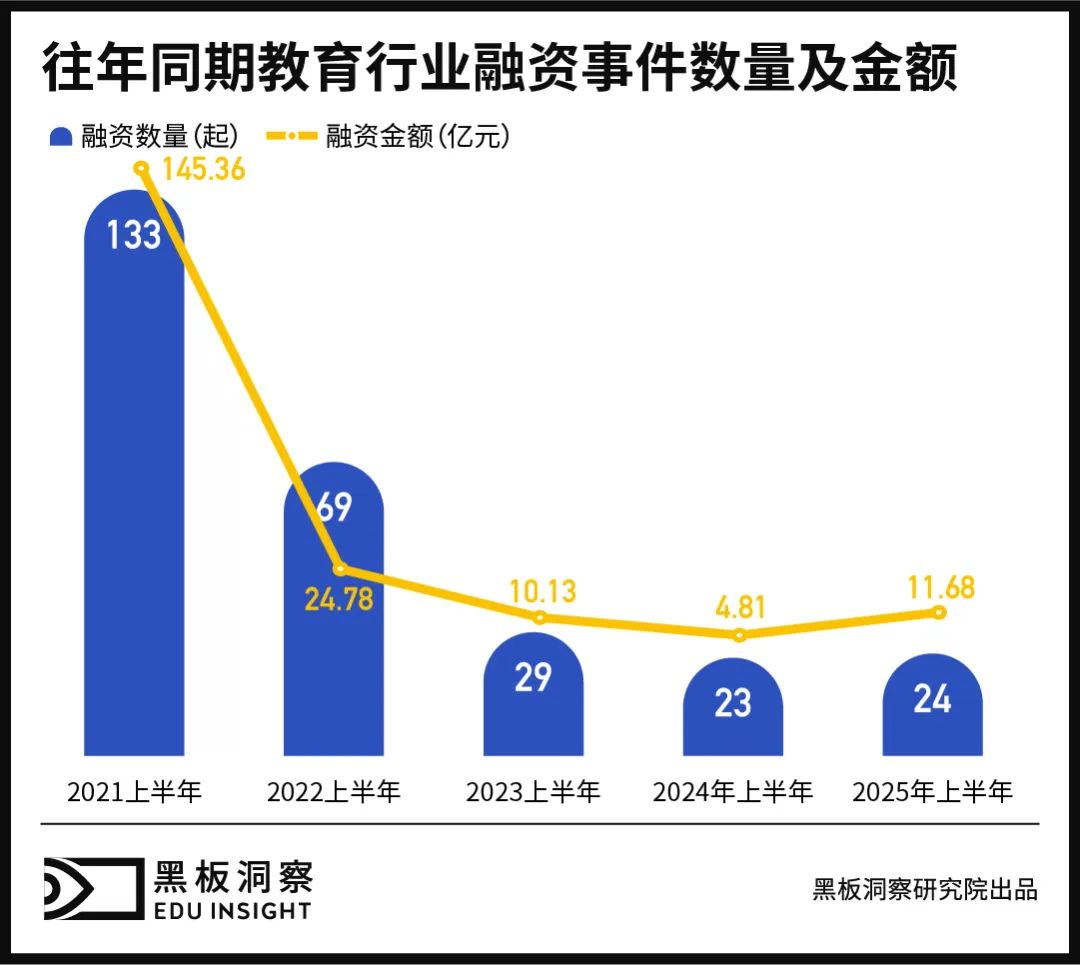
Core Insights - The education industry is experiencing a new pattern of "stable total volume and structural reconstruction" in investment and financing in the first half of 2025, driven by regulatory stabilization, demand transformation, and technological innovation [1][3] - A total of 24 financing events occurred in the first half of 2025, with an overall financing scale exceeding 1.168 billion yuan, surpassing the total amount for the entire year of 2024, indicating a marginal recovery in capital confidence and a focus on "certain tracks" [1][3] - Key investment directions include vocational education, AI empowerment, and quality education, reflecting a shift towards sectors with essential demand and growth potential [1][14] Financing Overview - The education industry's financing heat has been declining over the past five years, with a drop from 133 financing events and 14.536 billion yuan in the first half of 2021 to only 23 events and 481 million yuan in 2024 [3] - In the first half of 2025, although only 24 events were recorded, the financing amount rebounded to 1.168 billion yuan, marking a local recovery with "stable volume and increased amount" [3] Monthly Financing Trends - The financing events in the first half of 2025 were relatively evenly distributed monthly, with a notable spike in June, which accounted for 80.2% of the total financing amount for the half-year [6] - The overall financing frequency remained low, but the concentration of capital significantly increased, with a clear preference for high-certainty targets [6] Financing Rounds Distribution - Early-stage projects dominated the financing rounds, with angel rounds accounting for two-thirds of the events (16 occurrences), indicating sustained interest in innovative projects at the startup stage [9] - There were also 2 mergers and acquisitions and 1 equity investment, suggesting ongoing industry consolidation [9] Regional Financing Distribution - The financing distribution showed a pattern of "strong East, weak West," with Beijing leading with 5 events, followed by Guangdong and Jiangsu with 3 each, highlighting the continued advantage of first-tier and strong provincial cities in resource and capital supply [10] - Regions like Hubei, Hunan, Shanghai, and Zhejiang remained active, while western and central provinces showed minimal activity, indicating significant regional disparities [10] Sector-Specific Financing Distribution - Financing in the first half of 2025 was heavily concentrated in vocational education and enterprise services, which together accounted for over 90% of the total financing amount, reflecting capital's ongoing optimism towards "employment capability enhancement" and "educational toolization" [14] - Other sectors like quality education, study abroad, K12, and early childhood education had limited financing events, indicating challenges in consumer-end project financing [14] Top Financing Events - The top financing events included: - Tianyu Fei Training, an aviation training service company, acquired for 799 million yuan [16] - Cool Xuan Technology, a corporate training service platform, acquired for 180 million yuan [16] - Changxiang World, an art training intelligent service provider, raised 7 million USD in an angel round [16] Conclusion - The education industry's investment and financing landscape in the first half of 2025, while still at a low level, shows signs of structural recovery, with capital shifting focus towards vocational education and enterprise services [17] - The investment logic is transitioning from consumer-driven flow to supply-side value, indicating a move towards a quality-first, long-term oriented reconstruction cycle [17]