
数字信任基础设施

Search documents
深圳金融创新大赛展示第2期:深港跨境数据验证平台——以技术创新破局湾区数据流通难题(一等奖项目)
Xin Lang Cai Jing· 2026-02-09 11:06
Core Viewpoint - The Shenzhen-Hong Kong Cross-Border Data Verification Platform has been launched to address the challenges of cross-border data flow in the Guangdong-Hong Kong-Macao Greater Bay Area, enhancing financial services and facilitating economic integration [1][14]. Group 1: Pain Points in Cross-Border Data - High barriers exist due to complex compliance processes for the cross-border transmission of sensitive personal information, leading to high costs and long timelines [3][16]. - There is a lack of secure and efficient infrastructure for cross-border data flow, resulting in data transmission challenges [3][16]. - Trust issues arise from traditional methods where users carry original data across borders, making it difficult to ensure data integrity and reliability [3][16]. Group 2: Platform Innovation - The platform utilizes blockchain technology (FISCO BCOS) and distributed data transmission protocols (DDTP) to enable secure and traceable cross-border verification without transferring original data [5][18]. - Users can autonomously carry their data and authorize its use, ensuring control over their personal information and preventing misuse [20][25]. Group 3: Social Value and Impact - Since its trial run, the platform has covered 15 application scenarios, connecting over 21 institutions and processing more than 2,300 transactions [7][20]. - It has facilitated over 260 million HKD in financing for mainland SMEs in Hong Kong and significantly reduced verification times for educational documents from hours to seconds [20][25]. - The platform has received recognition from multiple national authorities and is included in significant strategic initiatives in both Hong Kong and mainland China [10][23]. Group 4: Future Prospects - The model of the platform is being replicated for the Shenzhen-Singapore Cross-Border Data Verification Platform, potentially benefiting over 2,000 investment enterprises [12][25]. - The platform aims to continue expanding its capabilities and applications, contributing to the high-quality development of the Greater Bay Area and enhancing digital cooperation between China and ASEAN countries [12][25].


张礼立:数字信任基础设施正在夯实新质生产力基座
Jing Ji Guan Cha Bao· 2026-01-31 05:32
Core Insights - Trust is evolving from a social sentiment to a foundational infrastructure in the digital age, where verification is prioritized over mere belief [1][2] - Digital trust infrastructure is essential for stable, low-friction, and sustainable collaboration in complex production systems, transforming uncertainty into manageable conditions [2][11] Group 1: Digital Trust Infrastructure - Digital trust infrastructure allows trust to be built upon existing frameworks rather than starting from scratch, akin to roads and power grids [1] - It serves as a public foundation that enables collaboration across longer supply chains and more frequent transactions [1][10] Group 2: Accounting as a Common Language - Accounting is not merely a backend task but a key to entering rule systems, enabling stable collaboration through defined metrics and verifiable facts [3][4] - Effective accounting practices enhance visibility into fluctuations, anomalies, and costs, thereby improving decision-making [4] Group 3: Verification Mechanisms - Verification is not just about producing reports but involves creating sustainable operational mechanisms that ensure ongoing validation and accountability [5][10] - The quality of verification is determined by transparency and predictability, with a focus on establishing clear responsibilities and corrective actions [5][9] Group 4: Standards and Traceability - Standards, certifications, and traceability must be interconnected to form a cohesive digital trust infrastructure that facilitates collaboration [6][7] - Effective traceability emphasizes responsibility engineering, enabling quick identification of issues and reducing friction in collaboration [7][8] Group 5: Mutual Recognition - Mutual recognition is crucial for cross-regional and cross-industry collaboration, requiring a systematic approach to align differing standards and data boundaries [8][9] - Successful mutual recognition does not aim to eliminate differences but rather to articulate and operationalize them clearly [9] Group 6: AI and Trust Mechanisms - In the AI era, embedding models within trustworthy mechanisms is essential to prevent uncertainty from undermining collaboration [10][11] - The development of digital trust infrastructure can enhance industry resilience, reduce transaction friction, and facilitate green transitions [10][12]
e签宝23年的进化史:从电子签名到数字信任基础设施
Tai Mei Ti A P P· 2025-12-05 09:20
Core Insights - e签宝 has evolved from a simple electronic signature tool to a comprehensive digital trust infrastructure, leveraging AI technology to redefine trust relationships and risk management in business [2][12][17] Group 1: Technological Evolution - e签宝 has undergone three significant transformations since its inception in 2002, including the development of China's first commercial electronic signature code, the launch of the first electronic seal software, and the introduction of an AI-driven contract management system [2][12] - The company has developed a proprietary AI model and intelligent agents that are specifically tailored for complex legal scenarios, ensuring high accuracy and reliability in contract processing [9][11] - e签宝's AI capabilities are built on over 240 billion real signing, reviewing, and compliance actions, creating a unique data asset that drives continuous improvement and model training [3][5][7] Group 2: Business Model Transformation - The company has shifted from a transaction-based SaaS model charging per signature to a value-driven platform that offers risk management and compliance services [14] - e签宝's AI solutions have penetrated various sectors, including government, finance, and manufacturing, providing automated contract management for over 6 billion users and 630,000 paying customers [14][16] - The introduction of a lightweight AI contract package aims to democratize access to advanced contract management tools for small and medium-sized enterprises, promoting digital equity [14][22] Group 3: Global Expansion and Compliance - e签宝 has established independent data centers in Hong Kong, Singapore, and Frankfurt, enabling compliance with local laws and multi-language support for cross-border contracts [15][16] - The company is positioned to compete with international giants like DocuSign and Adobe Sign by providing a secure and efficient trust framework for Chinese enterprises going global [16][20] - e签宝's vision includes creating a global signing network that adheres to the legal standards of 102 countries, ensuring trust and compliance in international transactions [17][20] Group 4: Future Vision - The company aims to build a robust digital trust infrastructure that supports the digital economy, aligning with national strategic needs and global challenges [17][18] - e签宝's commitment to "technology for good" emphasizes transparency and collaboration within the industry, contributing to the establishment of standards and reducing compliance costs [18][19] - The global electronic signature market is projected to grow significantly, with e签宝 poised to leverage this growth by providing accessible and efficient signing solutions [20][22]
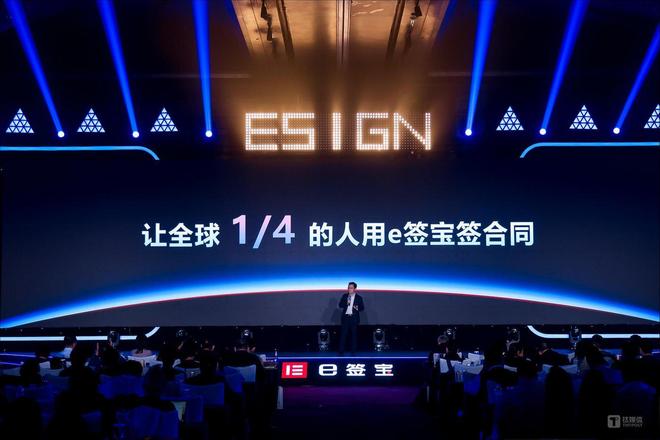
从“工具出海”到“生态出海”:中国SaaS第一次把数字基础设施卖到欧美“后院”,e签宝如何改写世界电子签名版图?
Mei Ri Jing Ji Xin Wen· 2025-09-15 07:34
Core Insights - e签宝 has achieved a significant milestone by ranking as "Asia Pacific's No. 1 and Global No. 6" in the electronic signature market, marking a historic breakthrough for Chinese digital infrastructure capabilities abroad [1][2] - The company has transitioned from being a "single tool provider" to an "ecosystem builder," reflecting the evolution of Chinese SaaS enterprises in the global market [2][3] - e签宝's strategic establishment of its international business headquarters in Hong Kong is aimed at leveraging the region's legal framework and connectivity to enhance its global operations [2] Market Position and Strategy - The electronic signature market exhibits a strong head effect, with the top ten companies holding over 50% of the market share, traditionally dominated by Western firms [2] - e签宝 has signed agreements with 16 countries and regions, providing services to 97 countries, thus creating a cross-regional "trust network" [2] - The company has captured a 35% market share in China's electronic signature market, particularly excelling in sectors with high security demands such as government and finance [3] Data Security and Compliance - e签宝 is addressing the challenges posed by U.S. regulations that allow government access to overseas server data, establishing a localized data security system to mitigate risks for Chinese enterprises [4][5] - The choice of storing electronic signature services in Hong Kong data centers helps companies avoid compliance risks associated with cross-border data flow [5] Technological Advancements - The introduction of the "Smart Contract Agent" represents a paradigm shift in the industry, evolving electronic signatures from mere signing tools to comprehensive contract management systems [6] - e签宝's AI-driven platform can identify contract risks and provide compliance solutions tailored to various legal jurisdictions, enhancing its value proposition in cross-border transactions [6] Industry Impact and Future Outlook - e签宝's success reflects a collective awakening among Chinese SaaS companies, indicating a shift towards establishing a new digital trust order led by Chinese enterprises [7] - The company’s achievements suggest that the barriers to global market entry for Chinese software are being overcome, with the potential for a new standard in digital infrastructure that is not solely defined by Silicon Valley [7]