
数据库迁移

Search documents
GBASE面对面:国产数据库迁移实例与生态建设详解
Sou Hu Cai Jing· 2026-02-13 04:32
Core Insights - The interview discusses the migration practices, ecosystem development, and core competitiveness of GBase 8s database, highlighting specific case studies from Guizhou Power Grid and Fudan University [1] Migration Challenges - The Guizhou Power Grid migration faced significant challenges due to Oracle compatibility, with nearly 300,000 lines of PLSQL that needed to be supported by the new data server. Efficiency was also a concern, requiring validation of execution results and optimization if performance was lacking [3][4] - The Fudan University case involved migrating a critical campus card system, which required stable operation during a key pressure test coinciding with the start of the school year. The deployment of RTSync for reverse synchronization ensured smooth performance during this critical period [4] Ecosystem Development - GBase 8s ecosystem development is phased, starting with narrow project compatibility and expanding as product compatibility improves. Initial focus was on external ecosystem tools like migration and synchronization tools, followed by database driver enhancements across various programming languages [5] - The current emphasis is on adapting various development frameworks, with approximately 30 different products being engaged, indicating a growing market opportunity for GBase 8s despite the complexity of adaptation [5] Core Competitiveness - GBase 8s's core competitiveness lies in its mature and stable shared storage cluster, validated by long-term operational cases and substantial data management capabilities [6] - The company prioritizes front-end business continuity, ensuring stable operations and user-friendly recovery processes, which enhances the overall user experience [6][7]

性能提升超35倍,金仓数据库助基金TA系统效能倍增
Jin Tou Wang· 2025-11-28 00:43
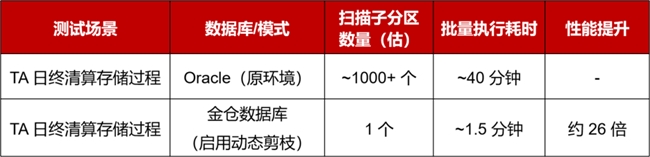
Core Insights - The article highlights the significant performance improvements achieved by a leading fund company through the migration from Oracle database to Kingbase database, particularly in the context of the increasingly competitive fund industry [1][2][3] Group 1: System Performance Enhancements - The Kingbase database effectively addressed two critical issues: "massive data processing delays" and "transaction detail query lags," resulting in a substantial enhancement in system performance [1] - In the end-of-day clearing process, the Kingbase database utilized "dynamic partition pruning" technology, which allowed the system to automatically identify date parameters and process only the relevant partitions, drastically reducing memory usage and processing time [1] - Actual performance testing showed that the clearing time was reduced from 40 minutes with Oracle to just 1.5 minutes with Kingbase, achieving an efficiency improvement of approximately 26 times [2] Group 2: Query Optimization - The Kingbase database implemented an intelligent query optimization mechanism that merged repeated query operations and prioritized index usage, leading to a significant reduction in query response times [2][3] - For example, the response time for retrieving the latest 10 transactions dropped from 2.8 seconds with Oracle to 80 milliseconds with Kingbase, representing an improvement of about 35 times [3] - This transition from Oracle to Kingbase is characterized as a comprehensive upgrade of the fund company's core system processing capabilities, rather than a simple replacement [3] Group 3: Industry Implications - The successful migration demonstrates the potential for financial institutions to enhance user experience and system efficiency while maintaining compliance, positioning Kingbase as a trusted partner in the digital transformation of the asset management industry [3]

MongoDB (MDB) 2025 Conference Transcript
2025-09-03 20:32
Financial Data and Key Metrics Changes - MongoDB reported a strong quarter with Atlas growth reaccelerating to 29% [9][12] - Internal execution improvements were highlighted as key drivers of performance rather than AI [12][14] - Customer acquisition numbers are growing healthily, indicating improved efficiency in acquiring and servicing small and medium-sized markets [14] Business Line Data and Key Metrics Changes - The company has shifted more go-to-market resources upmarket, leading to better returns and sales productivity [12][13] - Strategic workloads are growing faster, particularly in large traditional enterprises in the US and Europe [21][22] Market Data and Key Metrics Changes - The relational market is consolidating, with many customers migrating from legacy platforms to MongoDB due to high technical debt and the need for modern applications [49][50] - There is a pent-up demand for migration from legacy applications, driven by the challenges of running on outdated platforms [49] Company Strategy and Development Direction - MongoDB aims to leverage AI and automation tools to facilitate migrations from relational databases [51][52] - The company is focused on maintaining a balance between driving growth and improving margins, with ongoing investments in efficiency [55][56] Management's Comments on Operating Environment and Future Outlook - Management expressed confidence in the market potential and the company's position to capitalize on the AI wave [83] - The enterprise market is still in early stages of AI adoption, with many companies yet to realize the transformative potential of AI [43][42] Other Important Information - The acquisition of Voyage is seen as a strategic move to enhance embedding models and attract AI customers [66] - MongoDB's self-serve model is highlighted as an efficient way to drive growth and customer engagement [61] Q&A Session Summary Question: What drove the strength in the quarter? - Management attributed the strong performance to internal execution rather than AI, with a focus on moving resources upmarket [12][14] Question: What types of workloads have been acquired recently? - Recent workloads are strategic and varied, with a focus on high-growth applications rather than a single thematic use case [19][20] Question: How does MongoDB view competition with Postgres? - Management noted that the rise of Postgres is due to the consolidation of the relational market, but emphasized MongoDB's advantages in handling modern workloads [30][35] Question: What is the outlook for AI customers? - Many new customers identify as AI companies, indicating a positive trend for future growth, although the market is still developing [40][41] Question: How is MongoDB addressing migration from legacy systems? - The company is developing automation tools to facilitate migration, leveraging AI to streamline the process [51][52] Question: What are the goals for efficiency and growth? - Management aims to optimize spending to drive growth while continuing to invest in the business [55][56]
