
文化共享

Search documents
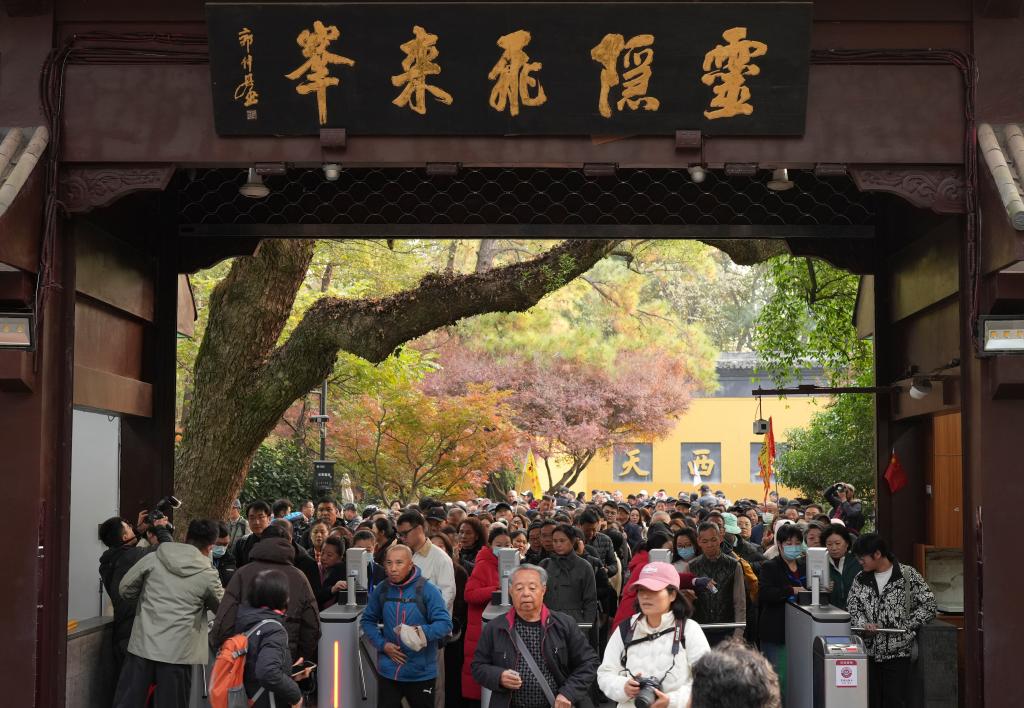
杭州灵隐寺免费开放 文化共享吸引更多目光
Xin Hua Wang· 2025-12-01 21:24
Core Viewpoint - The Lingyin Temple and Feilai Peak scenic area in Hangzhou has officially implemented a free admission policy, aiming to attract more visitors and promote cultural sharing [1][2]. Group 1: Free Admission Policy - Starting December 1, the entire Lingyin Feilai Peak scenic area, including famous cultural sites such as Lingyin Temple, Yongfu Temple, and Taoguang Temple, is now open to the public for free [1]. - The free admission policy is expected to enhance visitor experience and increase foot traffic to the area, which has historical significance and cultural heritage [2][6]. Group 2: Cultural Significance - Feilai Peak features over 390 stone carvings across 115 niches, showcasing exquisite artistry that integrates local culture and aesthetics, making it a unique cultural treasure of Jiangnan [2]. - The site has historical relevance, with inscriptions from notable figures like Bai Juyi and Su Shi, contributing to its rich cultural narrative [2]. Group 3: Visitor Experience - The free admission has led to an increase in visitors, including both tourists and locals, who are eager to explore the historical and artistic value of the site [4][5]. - The management emphasizes that free admission does not equate to a lack of management, as they will implement smart reservation and timed entry systems to maintain order and enhance visitor experience [6].

从帝王禁苑到人民博物院:故宫百年,何以“新生”?
Zhong Guo Xin Wen Wang· 2025-10-10 03:07
Core Perspective - The Palace Museum in Beijing celebrates its 100th anniversary, marking a significant transformation from a royal palace to a cultural institution accessible to the public [1][3]. Group 1: Transformation of Identity - The transition from a "symbol of power" to a "shared cultural space" began on October 10, 1925, when the Palace Museum was established, allowing public access to what was once a forbidden area [3]. - The essence of this transformation reflects a fundamental change in cultural heritage ownership and participation, evolving from a private royal collection to a public cultural asset [3][4]. - Over the past century, the concept of "sharing" has deepened, with over 80% of the museum now open to the public and the introduction of a "digital Palace Museum" allowing global audiences to engage with its treasures [3][5]. Group 2: Cultural Vitality - The Palace Museum has evolved from a "warehouse of artifacts" to a "living cultural entity," emphasizing not just preservation but also the creation of new cultural narratives [5]. - Initiatives like the documentary "I Repair Cultural Relics in the Palace Museum" showcase contemporary craftsmanship, while cultural products integrate classical aesthetics into modern life [5]. - Various exhibitions, lectures, and educational programs breathe life into static artifacts, fostering emotional connections with contemporary audiences [5]. Group 3: Globalization and Cultural Exchange - The museum's journey over the past century reflects a gradual emergence onto the world stage, transforming from "China's Palace Museum" to "the world's Palace Museum" [6][7]. - The internationalization process involves both inviting global civilizations into the museum and showcasing its artifacts and exhibitions worldwide, facilitating dialogue between Chinese and other cultures [7]. - As a UNESCO World Heritage site, the Palace Museum represents not only China's historical memory but also a shared cultural heritage for humanity, offering a model for balancing tradition and modernity in a globalized context [7]. Group 4: Future Prospects - Looking ahead, the Palace Museum faces both challenges and opportunities, including the need for enhanced artifact protection amid increasing visitor numbers and the balance between commercial development and cultural preservation [8]. - The future vision includes becoming a "super cultural IP," fostering innovative cultural experiences through the integration of technology and humanities [8]. - The museum aims to be a more influential platform for cultural dialogue, showcasing contemporary China's vitality and confidence while continuing to tell ancient Chinese stories [8][9].