
文化工程

Search documents
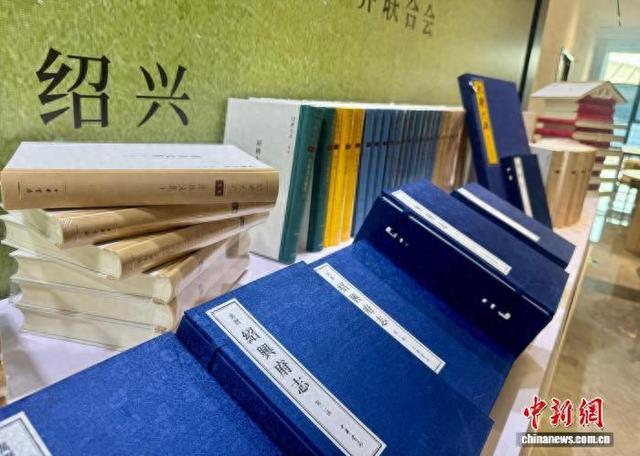
《绍兴大典》摸排海外文献千余种 将收录美国等馆藏著作
Xin Lang Cai Jing· 2026-02-09 15:11
Core Viewpoint - The "Shaoxing Dadian" project aims to compile and publish a comprehensive collection of literature related to Shaoxing, with a focus on preserving and promoting the city's rich cultural heritage over a ten-year period [3][4]. Group 1: Project Overview - The "Shaoxing Dadian" project was initiated in October 2022 and plans to publish approximately 1,200 volumes of literature over ten years, covering works from the pre-Qin period to the founding of New China [3]. - The compilation team has identified over 6,000 related works, including more than 1,000 overseas documents primarily located in the United States, Japan, and Taiwan [1][3]. Group 2: Publication Progress - So far, the project has published 120 types of deluxe editions totaling 329 volumes and 10 types of traditional editions totaling 81 volumes, mostly sourced from mainland China [3]. - The team is prioritizing the survey and publication of overseas collections, which may have been lost due to historical reasons or have been disseminated through cultural exchanges [3][4]. Group 3: Academic and Cultural Significance - The project is seen as a significant cultural initiative that not only aims to protect and preserve valuable literature but also to ensure the continuity of Chinese civilization [4]. - Local authorities emphasize the importance of maintaining high academic and publication standards to ensure the historical integrity of each volume [4].

推动屯堡文化在新时代焕发新光彩
Xin Lang Cai Jing· 2025-12-21 11:27
Core Viewpoint - The article emphasizes the importance of promoting and preserving Tunpu culture as a vital part of Guizhou's identity and economic development, linking it to national narratives and modern governance strategies [1][7]. Group A: Cultural Significance and Historical Context - Tunpu culture is integral to Guizhou's history, reflecting the province's strategic role in national development since its establishment during the Ming Dynasty [1]. - The culture serves as a "time-space bridge" connecting the central plains and southwestern China, showcasing a unique blend of Jiangnan and Qian culture through living heritage [1]. Group B: Innovative Cultural Integration - The 2025 Tunpu Cultural Conference aims to create an innovative platform for cultural, industrial, governance, and communication integration, enhancing the synergy between Guizhou's cultural heritage and economic growth [2]. - Future initiatives may include developing a "Tunpu-Qian Culture Corridor" and a ticketing system for cultural experiences to increase visitor engagement and extend their stay [2]. Group C: Value System and Governance - The essence of Tunpu culture is encapsulated in the four values: loyalty, courage, harmony, and integration, which can guide governance practices and community cohesion [3]. - Implementing these values into governance frameworks can enhance community trust and promote national unity, while also encouraging youth engagement in cultural practices [3]. Group D: Cultural Supply and Academic Integration - The article discusses the need for a shift from academic research to cultural engineering, aiming for a systematic, data-driven approach to cultural supply [4]. - Initiatives include developing educational programs and standardizing cultural practices to create a sustainable cultural economy in Guizhou [5]. Group E: Community Engagement and Inclusivity - Emphasizing the importance of community involvement, the article suggests mechanisms for local participation in cultural development, ensuring that benefits reach the grassroots level [6]. - The establishment of evaluation systems and youth engagement programs aims to maintain cultural authenticity while fostering a sense of belonging among younger generations [6]. Group F: Strategic Cultural Development - The Tunpu Cultural Conference addresses historical questions about Guizhou's identity and outlines a clear path for future development, integrating culture with economic strategies [7]. - The article posits that by leveraging cultural strengths, Guizhou can enhance its economic landscape and contribute to a broader narrative of cultural confidence and provincial development [7].
“‘功在当今,利在千秋’的系统工程”(深入学习贯彻习近平新时代中国特色社会主义思想)
Ren Min Wang· 2025-07-29 22:23
Group 1 - The core idea emphasizes the importance of cultural construction as a soft power that enhances comprehensive competitiveness, with a focus on implementing the "Eight Major Projects" in Zhejiang's cultural development [1][2][10] - The "Eight Major Projects" include various initiatives such as cultural quality projects, cultural research projects, and cultural industry promotion projects, all designed to strengthen the cultural foundation of the province [1][2][4] - The strategic planning and top-level design are crucial for the successful implementation of these cultural projects, ensuring that they are interconnected and systematically coordinated [2][4] Group 2 - The implementation of the "Eight Major Projects" requires tangible support and clear measures to ensure that cultural construction is taken seriously alongside economic and social development [2][5] - A collaborative mechanism involving various departments and local governments is essential for the successful execution of cultural projects, emphasizing the need for collective effort and resource coordination [4][5] - The establishment of a robust management system and operational mechanism is necessary to facilitate the ongoing development and success of cultural projects, ensuring accountability and effective resource allocation [5][6] Group 3 - Continuous commitment to cultural projects is highlighted as a long-term goal, with an emphasis on maintaining momentum across different administrative terms [7][10] - The cultural research project serves as a prime example of effective organization and collaboration, involving numerous experts and institutions to produce significant academic contributions [6][9] - The financial investment in cultural projects has shown substantial growth, with cultural spending in Zhejiang increasing from 2.765 billion yuan in 2003 to 5.660 billion yuan in 2007, reflecting a strong commitment to cultural development [9]