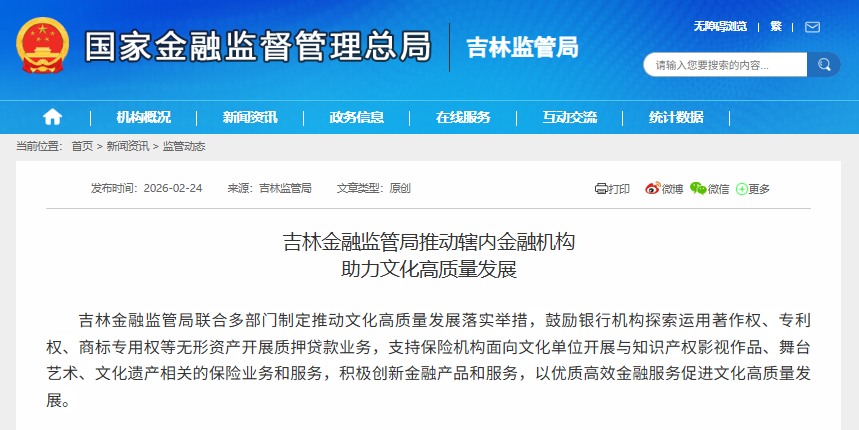
文化高质量发展

Search documents
吉林金融监管局:支持保险机构开展文化遗产等相关的保险业务和服务
Jin Rong Jie· 2026-02-24 08:24
Core Viewpoint - The Jilin Financial Regulatory Bureau, in collaboration with multiple departments, has developed measures to promote high-quality cultural development by encouraging banks to explore the use of intangible assets such as copyrights, patents, and trademarks for pledge loan services [2] Group 1: Financial Services Innovation - Banks are encouraged to utilize intangible assets for pledge loan services, which could enhance financing options for cultural enterprises [2] - Insurance institutions are being supported to offer services related to intellectual property, including insurance for film works, performing arts, and cultural heritage [2] - The initiative aims to foster innovative financial products and services to support the high-quality development of the cultural sector [2]

北京平谷:真金白银赋能文化高质量发展
Zhong Guo Qing Nian Bao· 2025-12-11 12:39
Core Viewpoint - The Pinggu District of Beijing has introduced measures to promote high-quality cultural development, focusing on the integration of agriculture, culture, tourism, sports, and commerce, with a maximum single reward of 3 million yuan for eligible projects [1][2]. Group 1: Support Directions - The measures focus on five key support areas: accelerating cultural project implementation, supporting the full-cycle development of cultural enterprises, building "cultural + industry" scenarios, striving for national cultural brand recognition, and promoting cultural prosperity [1][2]. - The policy emphasizes the integration of culture across various sectors, aiming to enhance cultural support functions in areas such as agriculture, logistics, and leisure [1][3]. Group 2: Financial Incentives - Specific financial rewards are outlined, including up to 3 million yuan for investments in rural leisure complexes and 100,000 yuan for achieving revenue targets in large cultural consumption events [2]. - Additional rewards include 100,000 yuan for first-release economies, 50,000 yuan for educational tourism, and 200,000 yuan for creating national-level tourist attractions [2]. Group 3: Evaluation and Implementation - The district will implement an "immediate enjoyment" service for rewards related to high-quality development, cultural products, and heritage recognition, allowing for seamless access to incentives [2]. - A multi-dimensional evaluation system will be established, involving industry experts to ensure selected projects meet high-quality and growth potential standards [2]. Group 4: Future Development - Pinggu District aims to enhance financial services, streamline approval processes, and ensure talent support to create a stable and predictable business environment, leveraging cultural "soft power" to drive regional development [3].
【省文化和旅游厅】陕西省第二批优秀群众文化品牌项目名单发布
Shan Xi Ri Bao· 2025-10-19 22:57
Core Insights - The announcement of the second batch of excellent mass cultural activity brand projects in Shaanxi Province signifies a solid step towards building a modern public cultural service system and promoting high-quality cultural development [1][2] Group 1: Project Overview - A total of 30 cultural activity brand projects have been selected, showcasing a wide range of forms and a trend of diverse integration [1] - Selected projects include local cultural performances like Yuyang Shuchang and Anse Qianren Chorus, as well as traditional folk festival activities such as the Yellow River New Year celebration and Luonan Guyu cultural heritage events [1] - Projects aimed at enhancing public artistic literacy and reading habits, such as "Everyone Learns Art, Everyone Has Art," and innovative mechanisms like volunteer services and rural public cultural service initiatives are also included [1] Group 2: Impact and Community Engagement - Many of the selected brand projects have been ongoing for over ten years, establishing a strong grassroots foundation [1] - Events like the Tongchuan Summer Cultural Activities, initiated in 1993, have become iconic cultural events in the region, while the Longzhou Shehuo and Daoqing performances, started in 2008, serve as important carriers of local intangible cultural heritage [1] - Projects like the Lakeside Music Festival and Night Tour of Huanglong provide valuable practical examples of deep integration between public culture and tourism [1] Group 3: Future Directions - The provincial government plans to continue deepening brand development, enhancing experience promotion, and resource support to create a replicable and promotable model of mass cultural activities in Shaanxi [2] - The focus will be on enriching the spiritual and cultural lives of the people and contributing to the construction of a culturally strong province [2]
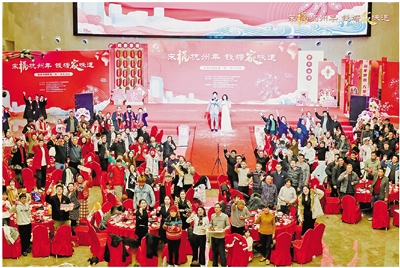
可感可及,最是文化润民心——钱塘区推动优质文化资源全民共享
Hang Zhou Ri Bao· 2025-07-10 02:52
Core Insights - The article highlights the cultural transformation and development in Qiantang District, emphasizing the integration of local and external cultural influences to enhance community engagement and satisfaction [3][4][5]. Group 1: Cultural Development Initiatives - Qiantang District aims to become a model for innovative cultural development, focusing on five key areas including cultural service enhancement and resource integration [4]. - The district has launched several cultural events and initiatives, such as the "Cultural + Technology" and "Cultural + Tourism" reforms, to promote cultural innovation and community involvement [4][9]. Group 2: Community Engagement and Activities - The establishment of cultural festivals and events, like the "Three March" ethnic cultural arts festival, has significantly improved community cohesion and participation [6]. - The introduction of cultural ambassadors and artists into rural areas has enriched local cultural life, with initiatives like the creation of the "New Farmer" IP character enhancing cultural relevance [7][9]. Group 3: Economic Impact of Cultural Initiatives - The cultural initiatives in Qiantang District have led to substantial economic benefits, with the cultural industry generating an additional output value of 80 million yuan and attracting 150,000 tourists [7]. - The district's focus on integrating culture with local economies is evident in the establishment of cultural community projects within industrial parks, aimed at enhancing both cultural and economic vitality [14]. Group 4: Future Vision and Goals - The district envisions a future where cultural initiatives will continue to flourish, likening the current efforts to planting seeds for future growth [8]. - The ongoing development of cultural spaces and community engagement activities is expected to create a vibrant cultural ecosystem that supports both residents and visitors [13][14].