新物理规律

Search documents
江门中微子实验发布首个重大科学成果
Nan Fang Ri Bao Wang Luo Ban· 2025-11-20 07:50
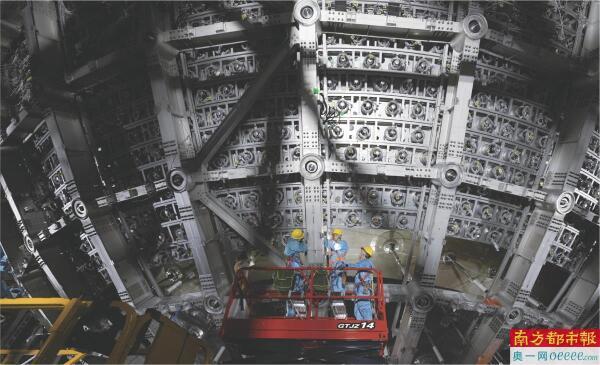
Core Insights - The Jiangmen Neutrino Experiment has achieved significant scientific results by measuring two key parameters of neutrino oscillation with a precision improvement of 1.5 to 1.8 times compared to the previous best international levels, surpassing over a decade of efforts from similar foreign experiments [1][2] Group 1: Experiment Overview - The Jiangmen Neutrino Experiment, located 700 meters underground in Guangdong, officially began operations on August 26 and is the world's first next-generation large-scale, high-precision neutrino detection facility [1] - The core detector is equipped with 20,000 tons of liquid scintillator and 45,000 photomultiplier tubes, capable of capturing extremely weak neutrino signals [1] Group 2: Scientific Achievements - Researchers achieved breakthroughs in measuring the two key parameters of neutrino oscillation—mixing angle θ12 and mass-squared difference Δm²₂₁—using only 59 days of effective data from the device [1] - The experiment confirmed the long-standing discrepancy between reactor neutrino and solar neutrino measurements, providing clues for exploring new physical laws [2] Group 3: Future Prospects - The device has a designed lifespan of 30 years and can be upgraded to become the world's most sensitive experiment for neutrinoless double beta decay, exploring whether neutrinos are their own antiparticles [2] - The Jiangmen Neutrino Experiment is a model of international collaboration in large-scale basic scientific research, involving over 700 researchers from 75 institutions across 17 countries [2]
“超级眼睛”捕捉“幽灵粒子”测量精度提升1.5至1.8倍
Nan Fang Du Shi Bao· 2025-11-19 23:12
Core Insights - The Jiangmen Neutrino Experiment (JUNO) has achieved significant milestones in neutrino physics, measuring two key oscillation parameters with unprecedented precision, surpassing international standards by 1.5 to 1.8 times in just two months [5][6][7]. Group 1: Experiment Overview - The Jiangmen Neutrino Experiment is designed to detect neutrinos, often referred to as "ghost particles," and is set to officially begin data collection on August 26, 2025 [5][6]. - The experiment's core detector, located 700 meters underground, has a total mass of 20,000 tons and includes a 41.1-meter diameter stainless steel shell and a 35.4-meter diameter acrylic sphere [8][9]. - The project has been in development for over a decade, receiving support from the Chinese Academy of Sciences and international collaborations [10][11]. Group 2: Scientific Achievements - The first results from JUNO indicate that the detector's performance metrics have met or exceeded design expectations, enabling advanced research in neutrino physics [9][12]. - The experiment aims to determine the mass hierarchy of three types of neutrinos and to explore potential new physics beyond the current particle physics standard model [7][9][14]. - JUNO's measurements have confirmed discrepancies in previous solar neutrino experiments, suggesting the possibility of new physical laws [7][15]. Group 3: Future Implications - JUNO is expected to lead the field of neutrino physics for the coming years, with a design lifespan of 30 years and potential upgrades for further experiments [9][12]. - The experiment will not only focus on neutrino mass ordering but also on precise measurements of oscillation parameters and studies of solar, supernova, atmospheric, and terrestrial neutrinos [9][14]. - The research conducted at JUNO is anticipated to yield significant scientific contributions and foster the development of the next generation of physicists [12][14].