新粮食安全观

Search documents
国家粮食安全得到有效保障
Ren Min Ri Bao· 2025-10-15 00:17
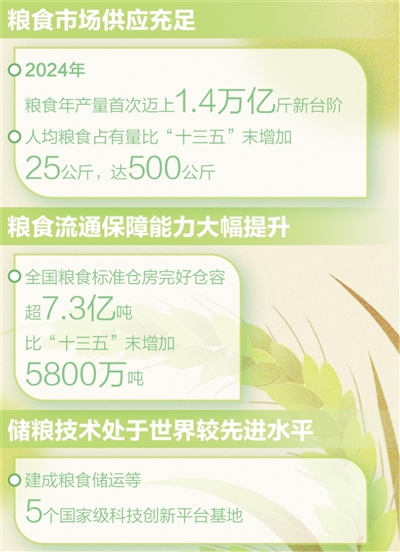
Core Insights - The article emphasizes the effective guarantee of national food security through stable grain production and improved storage capacity during the "14th Five-Year Plan" period [2][3]. Group 1: Grain Production and Supply - Grain production in China has remained stable at over 1.3 trillion jin annually, with projections to exceed 1.4 trillion jin in 2024, marking a 25 kg increase in per capita grain availability compared to the end of the "13th Five-Year Plan," reaching 500 kg, which is above the internationally recognized safety line of 400 kg [3]. - The average annual grain purchase volume has surpassed 400 million tons, indicating a robust supply and stable market operation [3]. Group 2: Storage and Management Improvements - The national grain storage capacity has significantly increased, with the total capacity of standard grain warehouses exceeding 730 million tons, an increase of 58 million tons since the end of the "13th Five-Year Plan" [3]. - The capacity for low-temperature and quasi-low-temperature storage has reached 220 million tons, up by 70 million tons from the previous period [3]. Group 3: Emergency Response and Quality Assurance - The grain emergency response system has been enhanced, with the number of emergency processing enterprises increasing from 5,448 to 6,872, a growth of 26%, and daily processing capacity rising from 1.2 million tons to 1.78 million tons, a 48% increase [6]. - Over 100 national standards and 50 industry standards have been revised or established since 2021, focusing on quality, nutrition, and health to ensure consumer safety [8]. Group 4: Financial Support and Investment - Since 2021, the Ministry of Finance and the National Food and Strategic Reserves Administration have allocated 46.2 billion yuan in fiscal funds, attracting over 84 billion yuan in social investment for more than 8,400 projects aimed at enhancing the quality of the grain industry [8].
国家粮食安全得到有效保障(权威发布·高质量完成“十四五”规划)
Ren Min Ri Bao· 2025-10-14 22:12
Core Insights - The article discusses the achievements and future plans regarding grain circulation reform and development during the "14th Five-Year Plan" period in China, emphasizing the importance of food security for high-quality economic and social development [2][3]. Group 1: Grain Production and Supply - During the "14th Five-Year Plan" period, China's annual grain production remained stable at over 1.3 trillion jin, with a projected increase to 1.4 trillion jin in 2024, resulting in a per capita grain availability of 500 kg, surpassing the international safety line of 400 kg [3]. - The average annual grain purchase volume exceeded 400 million tons, supported by improved services for farmers and enterprises [3]. Group 2: Grain Storage and Management - The grain storage capacity has significantly improved, with the total capacity of standard grain warehouses exceeding 730 million tons, an increase of 58 million tons compared to the end of the "13th Five-Year Plan" [3]. - The grain storage management is transitioning towards high-quality development, focusing on green storage and quality preservation, with advanced storage technologies being widely adopted [5]. Group 3: Emergency Response and Supply Chain - A comprehensive grain emergency response system has been established, with the number of emergency processing enterprises increasing from 5,448 to 6,872, a growth of 26% [6]. - The daily processing capacity for emergency grain oil has risen from 1.2 million tons to 1.78 million tons, an increase of 48%, ensuring sufficient supply for urban markets [6]. Group 4: Quality Standards and Consumer Health - Over 100 national standards and 50 industry standards related to grain quality have been revised since 2021, focusing on green, high-quality, and nutritious food [7]. - The government has invested 46.2 billion yuan in quality grain projects, leading to over 84 billion yuan in social investment and the implementation of more than 8,400 projects [7].