新能源+生态治理

Search documents
内蒙古磴口:沙漠“蓝海”增“绿”记
Xin Hua Wang· 2025-12-10 00:45
Core Viewpoint - The project in Inner Mongolia's Bayannur City combines photovoltaic energy generation with ecological restoration, aiming to produce green energy while combating desertification and promoting local biodiversity [1][2]. Group 1: Project Overview - The photovoltaic project covers an area of 44,600 acres and is expected to generate an average annual electricity output of 3.27 billion kWh, reducing carbon dioxide emissions by 2.07 million tons and saving 1.07 million tons of standard coal annually [1]. - The project employs a "photovoltaic sand control" technique, allowing for sufficient growth space for sand-fixing plants like Haloxylon ammodendron, while also providing shade to reduce evaporation and enhance vegetation growth [1]. Group 2: Ecological and Economic Benefits - The integration of photovoltaic panels with ecological restoration efforts leads to a win-win situation for both economic and ecological benefits, as vegetation growth helps suppress dust and enhances the efficiency of energy generation [1]. - The county has established a photovoltaic installed capacity of 5.36 million kW and has completed ecological restoration over 143,400 acres, including the planting of Haloxylon ammodendron and other species [2]. Group 3: Future Developments - Two energy storage stations have been constructed to support the grid and enhance the consumption of renewable energy, with one station expected to be operational by mid-month and an annual charging capacity of 1 billion kWh [2]. - The county aims to implement a circular industrial development model that integrates energy generation, ecological restoration, and rural revitalization, leveraging the opportunities presented by renewable energy [3].
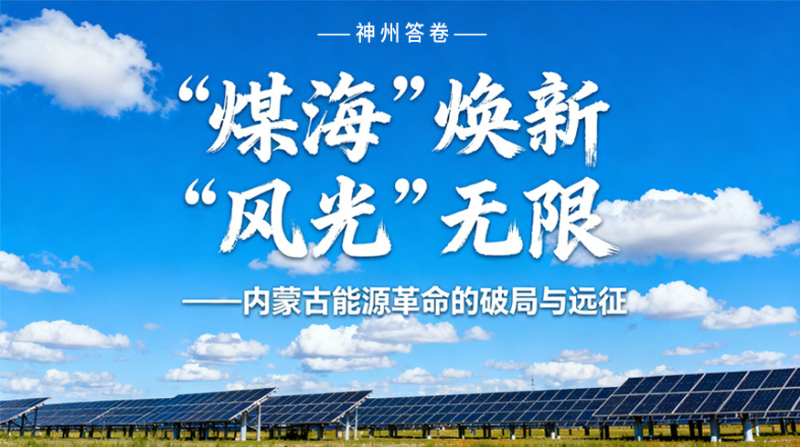
"煤海"焕新 "风光"无限--内蒙古能源革命的破局与远征
Xin Hua Wang· 2025-11-20 12:05
Core Insights - Inner Mongolia is undergoing a significant transformation in its energy sector, leveraging its abundant coal, wind, and solar resources to drive a comprehensive energy revolution [1][7][8] Traditional Energy Industry Transformation - Inner Mongolia is developing a modern coal chemical industry that converts coal into various chemical products, with a projected local conversion utilization scale exceeding 100 million tons by 2024 [1][3] - The Guoneng Baotou Coal Chemical Company operates the world's first coal-to-olefins demonstration facility, converting 3 million tons of coal into 1.8 million tons of methanol and 600,000 tons of polyethylene annually, generating approximately 6 billion yuan in revenue [3] New Energy Industry Development - Inner Mongolia has become the first province in China to exceed 100 million kilowatts of installed renewable energy capacity, with a total of 150 million kilowatts, surpassing thermal power installations [8] - The region is actively constructing large-scale wind and solar energy projects, transforming desert areas into significant renewable energy bases [13][15] Future Energy Industry Initiatives - The region has launched the largest green hydrogen project in China, producing 320,000 tons of green ammonia annually, marking a shift towards large-scale commercial operations in the green hydrogen sector [16][18] - Inner Mongolia is developing a comprehensive green hydrogen industry, including the establishment of hydrogen corridors and pipelines, aiming to become a national leader in green hydrogen production and applications [18] New Energy Storage Development - Inner Mongolia is initiating multiple new energy storage projects, with a total of 34 projects started in the first half of the year, aiming for a storage capacity of 10.32 million kilowatts by the end of 2024 [20][21] - The region is focusing on new energy storage as a stabilizing and regulating component of the power system, essential for integrating renewable energy into the grid [21] Electricity Market Reform - Inner Mongolia is leading in green electricity trading, with a total of 76.2 billion kilowatt-hours traded in 2024, and is establishing cooperative relationships for green electricity trading with several provinces [23] - The region is committed to enhancing its energy industry advantages to ensure national energy security and contribute to China's modernization efforts [23]


神州答卷|“煤海”焕新 “风光”无限——内蒙古能源革命的破局与远征
Xin Hua Wang· 2025-11-20 01:45
Core Insights - Inner Mongolia is undergoing a significant energy transformation, leveraging its abundant coal, wind, and solar resources to drive a comprehensive energy revolution [2][10]. Traditional Energy Industry - Inner Mongolia is developing a modern coal chemical industry, transforming coal into high-value products like polyethylene and polypropylene, with a projected conversion scale exceeding 100 million tons by 2024 [3][5]. - The coal-to-olefins demonstration facility in Baotou processes 3 million tons of coal annually to produce 600,000 tons of methanol and generates approximately 6 billion yuan in annual revenue [5]. New Energy Industry - Inner Mongolia has become the first region in China to exceed 100 million kilowatts of installed renewable energy capacity, with current installations reaching 150 million kilowatts, surpassing thermal power capacity [11]. - The region is developing a complete photovoltaic industry chain, producing high-purity polysilicon and solar panels, with innovative processes reducing energy consumption and costs [13][16]. Future Energy Industry - The launch of the largest green ammonia project in China marks a significant step in the green hydrogen and ammonia industry, with an annual production capacity of 320,000 tons [19][21]. - Inner Mongolia is planning to establish a green hydrogen corridor and hydrogen pipeline network, aiming to become a national leader in green hydrogen production and applications [21]. New Energy Storage - A series of new energy storage projects are underway, with a target of reaching 10.32 million kilowatts of installed capacity by the end of 2024, and projections of over 16 million kilowatts by 2025 [23]. - The region is actively reforming its electricity market, leading the nation in green electricity trading volumes, with 76.2 billion kilowatt-hours settled in 2024 [24].