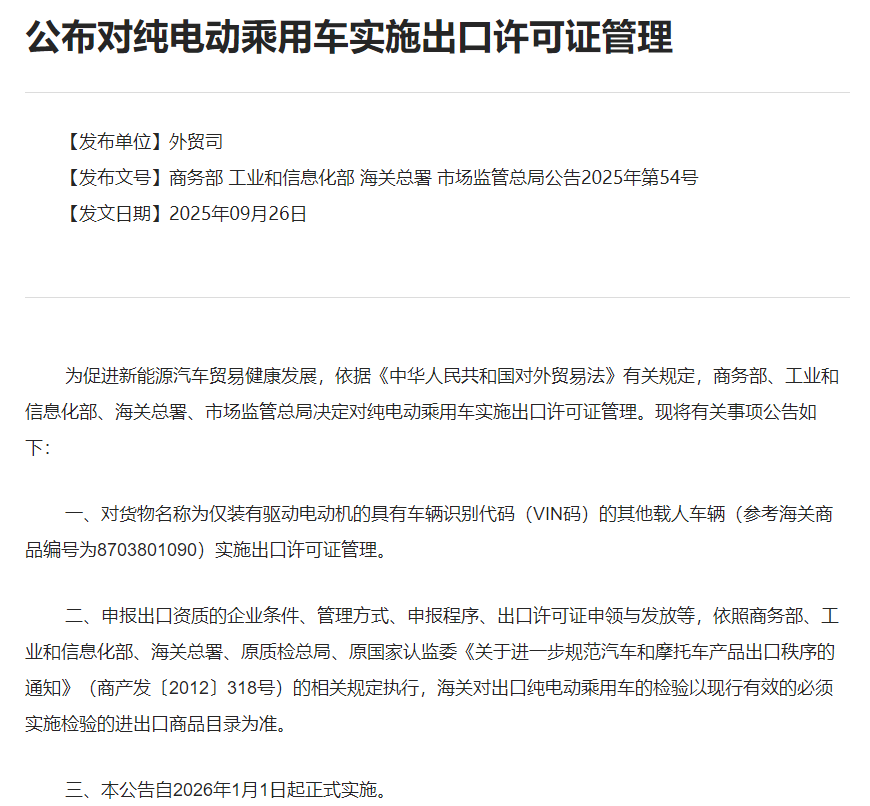
新能源汽车出口许可证管理

Search documents
国家突然出手!过去5年最暴利的行业,彻底凉凉
Qian Zhan Wang· 2025-10-16 01:30
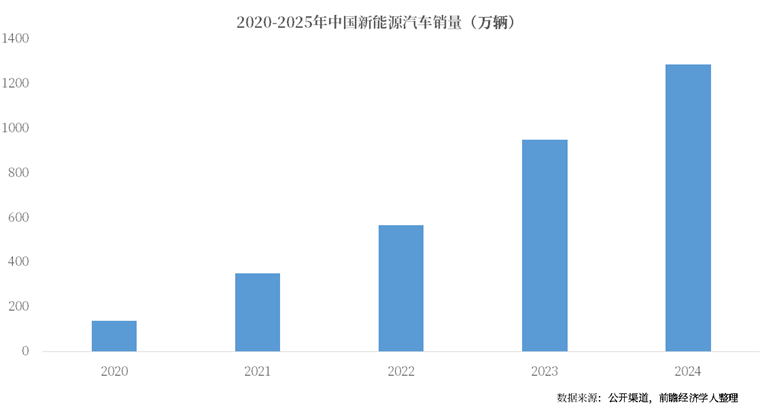
Core Viewpoint - The Chinese government has announced a new export license policy for pure electric passenger vehicles, effective January 1, 2026, to regulate the export of this growing sector and address issues related to gray market exports and intense domestic competition [1][8][17]. Group 1: Industry Growth and Achievements - The Chinese electric vehicle (EV) industry has seen remarkable growth, with production and sales expected to reach 12.8 million units in 2024, marking a significant increase from just over 1 million units in 2020 [2][4]. - The market penetration rate of EVs in China reached 44.3% in the first half of 2025, up from 5.4% in 2020, indicating a nearly eightfold increase [4]. - China has become a leading exporter of vehicles, with exports rising from 2.14 million in 2021 to 4.91 million in 2023, and projected to reach 5.86 million in 2024 [4][6]. Group 2: Export License Policy Rationale - The new export license policy aims to fill a legal gap in the regulation of pure electric vehicle exports, which previously did not require such licenses [6][7]. - The policy addresses the rise of gray market exports, where unauthorized dealers have been exporting vehicles without proper oversight, leading to market disorder and lack of after-sales support for consumers [8][9]. - The implementation of the export license is expected to reduce the prevalence of gray market activities and protect the interests of legitimate manufacturers [9][10]. Group 3: Industry Challenges and Internal Competition - The profitability of the Chinese automotive industry has declined significantly, with profits dropping from 215.1 billion in 2020 to an estimated 65.4 billion in 2024, indicating increasing internal competition [10][11]. - The average price of domestic EVs is projected to decrease by 10%-15% in 2024, with some models seeing price cuts exceeding 30% [11][12]. - The number of EV brands in China has surpassed 70, with over 3,000 models available, leading to intensified competition and market saturation [12][13]. Group 4: Future Directions and Strategic Recommendations - The export license policy is anticipated to accelerate industry consolidation, favoring leading companies with robust global service networks and technological capabilities [18]. - Key industrial regions are encouraged to shift from scale-driven growth to innovation-driven development, focusing on advanced technologies such as solid-state batteries and smart driving [19]. - Border regions are advised to transform from gray market hubs to legitimate trade and service centers, enhancing logistics and customs processes to support legitimate exports [20]. - Logistics hubs should evolve from simple transportation to providing comprehensive supply chain services, integrating advanced technologies for efficiency [21].



2026年1月1日正式实施!纯电动乘用车出口设“许可门槛” 专家:将重构出口秩序,助力出口提质升级
Mei Ri Jing Ji Xin Wen· 2025-09-26 13:13
Core Viewpoint - The announcement by the Ministry of Commerce and other regulatory bodies marks a shift in China's electric vehicle (EV) export strategy from a focus on scale to prioritizing quality, establishing a licensing system for exports starting January 1, 2026 [1][4]. Group 1: Export Licensing System - Starting January 1, 2026, all pure electric passenger vehicles must obtain an export license from the Ministry of Commerce or its authorized agencies, with non-compliance leading to export bans [4][5]. - Only automotive manufacturers and their authorized dealers are eligible to apply for export licenses, and they can only export vehicles under their own brand [4][6]. - The licensing system aims to regulate the export order of pure electric vehicles and prevent irregular practices such as parallel exports [4][5]. Group 2: Quality Control and Market Impact - The new regulations are designed to enhance the quality of Chinese EV exports, addressing issues such as the export of "0-kilometer used cars" as new vehicles, which has harmed China's automotive reputation internationally [5][6]. - The announcement reflects lessons learned from the motorcycle industry in the 1990s, where a lack of standards led to a decline in market share due to a "low-price, low-quality" perception [5][6]. - The export licensing management is expected to create a more favorable development environment for Chinese brands in overseas markets, preventing price wars and enhancing brand image [6][7]. Group 3: Industry Dynamics and Future Outlook - The implementation of the export licensing system is anticipated to lead to significant industry differentiation, benefiting established companies with strong overseas operations while potentially eliminating those lacking compliance and service capabilities [7]. - The announcement aims to systematically restructure export order by reinforcing brand responsibility, improving service levels, and curbing low-price competition, thereby fostering a sustainable export ecosystem for Chinese electric vehicles [7].