
新能源汽车产业内卷

Search documents
国家突然出手!过去5年最暴利的行业,彻底凉凉
Qian Zhan Wang· 2025-10-16 01:30
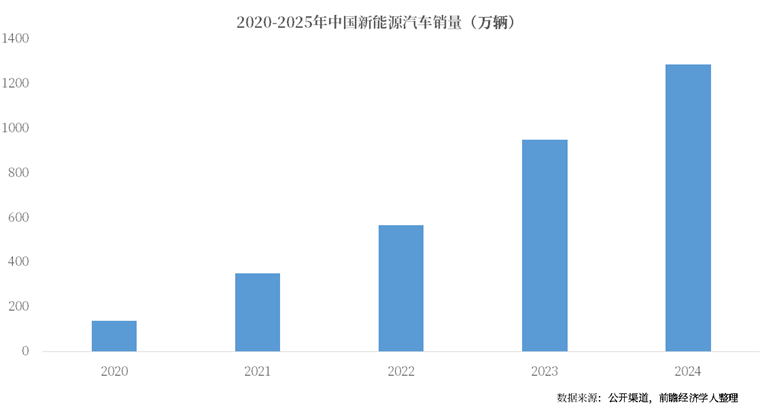
Core Viewpoint - The Chinese government has announced a new export license policy for pure electric passenger vehicles, effective January 1, 2026, to regulate the export of this growing sector and address issues related to gray market exports and intense domestic competition [1][8][17]. Group 1: Industry Growth and Achievements - The Chinese electric vehicle (EV) industry has seen remarkable growth, with production and sales expected to reach 12.8 million units in 2024, marking a significant increase from just over 1 million units in 2020 [2][4]. - The market penetration rate of EVs in China reached 44.3% in the first half of 2025, up from 5.4% in 2020, indicating a nearly eightfold increase [4]. - China has become a leading exporter of vehicles, with exports rising from 2.14 million in 2021 to 4.91 million in 2023, and projected to reach 5.86 million in 2024 [4][6]. Group 2: Export License Policy Rationale - The new export license policy aims to fill a legal gap in the regulation of pure electric vehicle exports, which previously did not require such licenses [6][7]. - The policy addresses the rise of gray market exports, where unauthorized dealers have been exporting vehicles without proper oversight, leading to market disorder and lack of after-sales support for consumers [8][9]. - The implementation of the export license is expected to reduce the prevalence of gray market activities and protect the interests of legitimate manufacturers [9][10]. Group 3: Industry Challenges and Internal Competition - The profitability of the Chinese automotive industry has declined significantly, with profits dropping from 215.1 billion in 2020 to an estimated 65.4 billion in 2024, indicating increasing internal competition [10][11]. - The average price of domestic EVs is projected to decrease by 10%-15% in 2024, with some models seeing price cuts exceeding 30% [11][12]. - The number of EV brands in China has surpassed 70, with over 3,000 models available, leading to intensified competition and market saturation [12][13]. Group 4: Future Directions and Strategic Recommendations - The export license policy is anticipated to accelerate industry consolidation, favoring leading companies with robust global service networks and technological capabilities [18]. - Key industrial regions are encouraged to shift from scale-driven growth to innovation-driven development, focusing on advanced technologies such as solid-state batteries and smart driving [19]. - Border regions are advised to transform from gray market hubs to legitimate trade and service centers, enhancing logistics and customs processes to support legitimate exports [20]. - Logistics hubs should evolve from simple transportation to providing comprehensive supply chain services, integrating advanced technologies for efficiency [21].



特朗普:无意修复与马斯克的关系;中美经贸磋商机制首次会议将举行;商务部回应!事关稀土出口、电动汽车等;吉利:不再建设新的汽车工厂丨每经早参
Mei Ri Jing Ji Xin Wen· 2025-06-07 22:53
Group 1 - He Lifeng, a member of the Political Bureau of the CPC Central Committee and Vice Premier, will visit the UK from June 8 to 13, during which he will hold the first meeting of the China-US economic and trade consultation mechanism [2] - Wang Wentao, the Minister of Commerce, clarified China's export control policies during his meeting with the EU's Trade and Economic Security Commissioner, emphasizing the establishment of a green channel for compliant applications [3] - The Ministry of Commerce stated that export controls on rare earths are in line with international practices, and China will continue to review export license applications [4] Group 2 - As of May 2025, China's foreign exchange reserves reached $32,853 billion, an increase of $36 billion from the end of April, marking a 0.11% rise [5] - The People's Bank of China reported a gold reserve of 7.383 million ounces (approximately 2,296.37 tons) as of the end of May, with an increase of 6,000 ounces (approximately 1.86 tons), marking the seventh consecutive month of gold accumulation [5] Group 3 - Geely Holding Group's Chairman Li Shufu announced that the company will not build new automobile production plants due to serious overcapacity in the global automotive industry [11] - Geely's Senior Vice President Yang Xueliang warned that "involution" and vicious competition in the Chinese new energy vehicle industry could lead to perilous situations, emphasizing the need for open and healthy competition [12] Group 4 - HNA Group announced a significant asset restructuring involving the acquisition of 100% equity in Hainan Tianyu Flight Training Co., Ltd. for 799 million yuan, which is expected to enhance its resource control [14] - 360 Group's founder Zhou Hongyi plans to challenge himself to conduct a complete product launch alone, aiming to save costs and test the capabilities of AI [15] Group 5 - Guolian Minsheng Securities expanded its executive team by appointing five new executives, primarily from Minsheng Securities, following the merger and restructuring of the two firms [17] - Basic Semiconductor, a company aiming for an IPO, integrates various semiconductor capabilities but faces challenges with declining product prices and negative profit margins [19]
