无人化运营

Search documents
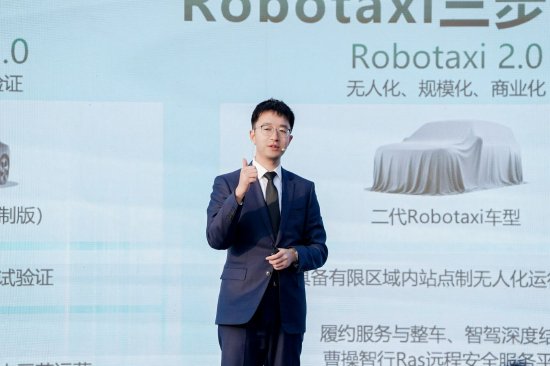
曹操出行发布Robotaxi“十年百城千亿”战略目标,启用全球首个“绿色智能通行岛”
Xin Lang Cai Jing· 2025-12-04 11:25
Core Viewpoint - Cao Cao Mobility announced an upgraded Robotaxi strategy with a goal of "Ten Years, One Hundred Cities, One Hundred Billion" during a press conference in Hangzhou [2][5] Group 1: Strategic Goals - The company aims to establish five global operation centers over the next decade, expand Robotaxi services to 100 cities, and achieve a total transaction value (GTV) of 100 billion RMB [2][5] - This initiative is a significant part of Geely Holding's global strategy focusing on smart mobility services [2][5] Group 2: Robotaxi Development Phases - The Robotaxi strategy consists of a "three-step" approach: initial technology validation and small-scale testing, transitioning from a safety driver to fully autonomous operation, and eventually launching fully customized Robotaxi models for global commercial operations [2][5][6] - In the Robotaxi 2.0 phase, the company will enhance the automation capabilities of its fleet and implement a remote safety service platform [6] Group 3: Infrastructure and Technology Integration - The launch of the "Green Intelligent Passage Island" marks a step towards future urban transportation infrastructure, featuring functions like automatic battery swapping, cleaning, vehicle maintenance, intelligent scheduling, and automatic settlement [6] - The Green Intelligent Passage Island is designed to facilitate seamless connections between Robotaxi services and eVTOL (electric vertical takeoff and landing) aircraft, supported by a low-orbit satellite network for comprehensive communication and high-precision positioning [6] Group 4: Strategic Partnerships - A strategic cooperation agreement was signed between Cao Cao Mobility and Qianli Zhijia to deepen collaboration in the Robotaxi sector, aiming to accelerate the large-scale application and commercialization of intelligent driving technologies [6]


汉嘉设计(300746) - 300746汉嘉设计投资者关系活动记录表(2025-001)
2025-03-24 09:32
Group 1: Company Overview - Hanjia Design Group Co., Ltd. focuses on urban governance and smart city solutions through its subsidiary, Futai Technology, established in 2005 [2][3]. - Futai Technology has provided IT and operational services to over 200 cities and more than 600 government departments [3]. Group 2: Business Segments and Achievements - Futai Technology has developed a comprehensive urban governance framework, including urban operation management and water resources management [3]. - The company holds over 300 software copyrights and patents and has contributed to approximately 50% of the systematic platform construction planning for urban sanitation on the government side [3]. Group 3: Robotics and AI Development - Since 2019, Futai Technology has expanded into AI and robotics, launching various products including the V-AIbox and multiple types of sanitation robots [4]. - The company plans to produce a 1-ton sanitation robot by the second half of 2025, with existing robots covering various urban governance scenarios [4]. Group 4: Market Potential and Financial Insights - The potential market size for unmanned cleaning robots is estimated at approximately 680 billion CNY annually for cleaning scenarios, 400 billion CNY for collection and transportation, and 480 billion CNY for underground pipeline inspection [9]. - The pricing for the robots ranges from 100,000 to 800,000 CNY depending on the model [9]. Group 5: Clientele and Revenue Model - Most clients are government or state-owned enterprises, with a strong willingness to adopt unmanned management solutions due to cost-effectiveness and efficiency [5][6]. - The company is actively managing cash flow risks by collaborating closely with local platform companies and ensuring strict contract terms [6]. Group 6: Employment and Industry Impact - The introduction of unmanned cleaning robots is expected to create new job opportunities, such as maintenance engineers, while addressing the aging workforce in sanitation [16]. - The transition to unmanned operations is seen as a way to improve productivity and attract more skilled workers to the industry [16].