日本国债市场冲击

Search documents
【债市观察】债市收回开年跌幅 10债关注临近1.80%阻力
Xin Hua Cai Jing· 2026-01-26 02:52
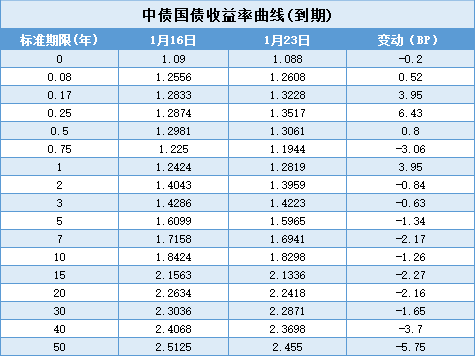
Core Viewpoint - The People's Bank of China (PBOC) has increased the volume of Medium-term Lending Facility (MLF) operations, leading to a more relaxed liquidity environment in the latter half of the week, which has positively impacted the bond market and caused a downward shift in the yield curve [1][9]. Market Overview - The yield on the 10-year government bond decreased by 1.3 basis points to 1.83%, reversing the gains made at the beginning of the year [1]. - The net financing of local bonds is expected to exceed 300 billion yuan this week, highlighting the need to focus on institutional absorption capacity and the impact of the end-of-month liquidity and equity market on the bond market [1]. Bond Market Performance - The yield curve for government bonds showed varied changes from January 16 to January 23, with the 1-year yield increasing by 3.95 basis points and the 30-year yield decreasing by 5.75 basis points [2][3]. - The bond futures market saw a general increase, with the 30-year main contract rising by 1.02% and the 10-year contract increasing by 0.12% [4]. Upcoming Issuance - For the week of January 26 to January 30, a total of 73 bonds are planned to be issued, amounting to 474.28 billion yuan, with no government bonds scheduled for issuance [5]. International Market Insights - The U.S. bond market experienced volatility, with the 10-year Treasury yield reaching a five-month high of 4.31% before stabilizing at 4.23% by the end of the week [6][7]. - Japanese government bonds saw significant fluctuations, with the 10-year yield rising to 3.38% before retreating, driven by concerns over fiscal deterioration and expectations of interest rate hikes [8]. Institutional Perspectives - West Securities noted that the pressure from local bond supply is increasing, with a total issuance of 4.393 billion yuan expected next week, which may elevate the pressure on banks to absorb these bonds [15]. - Huatai Securities indicated that the current yield on the 10-year government bond is approaching a lower boundary of the expected range, suggesting that without significant catalysts, yields may face resistance around the 1.8% level [16].