智慧健身

Search documents
广西出台新规明确新建居住区需按标准配建体育设施
Xin Lang Cai Jing· 2026-01-09 00:10
Core Viewpoint - The newly issued "Management Measures for the Construction and Management of Supporting Sports Facilities in New Residential Areas (Trial)" aims to address the public's concerns about fitness accessibility by mandating the construction of sports facilities in new residential areas in Guangxi [1][3]. Group 1: Regulations and Standards - The management measures require new residential areas to provide sports facilities according to specific standards, including a minimum of 0.1 square meters of indoor space or 0.3 square meters of outdoor space per person [1]. - The measures detail requirements for the construction of indoor fitness venues, emphasizing safety, accessibility, and the inclusion of smart fitness facilities and areas for various sports activities [2]. - Outdoor sports facilities should be integrated with public spaces and designed to accommodate the needs of different demographic groups, including children, the elderly, and people with disabilities [2]. Group 2: Implementation and Compliance - The "Five Synchronization" principle mandates that the planning, design, construction, acceptance, and delivery of sports facilities occur simultaneously with the residential project [2]. - Natural resource departments are responsible for enforcing compliance with these regulations, and projects that do not meet the standards will not receive planning verification or completion acceptance [2]. - The construction of these facilities is to be funded by the developers, with encouragement for participation from charitable organizations and individuals [2].
公园上新智能健身设备
Ren Min Ri Bao Hai Wai Ban· 2025-06-12 23:00
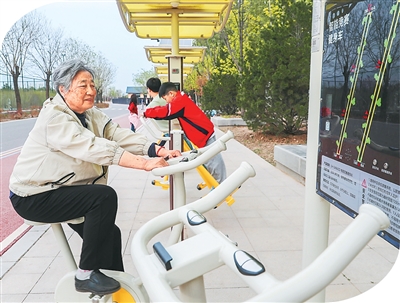
Core Insights - The integration of technology in fitness is becoming a trend, with smart fitness equipment being introduced in parks and communities to enhance public engagement in physical activities [9][11][14]. Group 1: Smart Fitness Equipment - Smart fitness facilities are being installed in various public spaces, such as parks and community centers, to provide residents with convenient access to exercise options [11][14]. - The smart fitness areas have seen a significant increase in foot traffic, especially during weekends, indicating a growing interest in these facilities [10]. - Examples of smart fitness installations include AI fitness testing stations and interactive screens that provide real-time data on exercise metrics [7][12][13]. Group 2: Urban Development and Health Initiatives - Urban areas, such as Beijing's Haidian District, are undergoing smart renovations of sports parks, focusing on ecological and technological integration to create harmonious urban spaces [9][14]. - The "National Fitness Facility Improvement Action Plan (2023-2025)" aims to promote the construction of smart outdoor fitness equipment across 2,000 county-level administrative regions by the end of 2025 [14]. - The initiative also emphasizes the importance of enhancing health consumption scenarios and strengthening the application of technology in fitness [14]. Group 3: User Experience and Challenges - While smart fitness devices offer advanced features, there are concerns regarding usability, particularly for older adults, due to complex interfaces and lack of voice guidance [15]. - The management and maintenance of smart fitness equipment are crucial for their long-term effectiveness, with local authorities implementing management protocols to ensure regular upkeep [15].