
智慧长江建设

Search documents
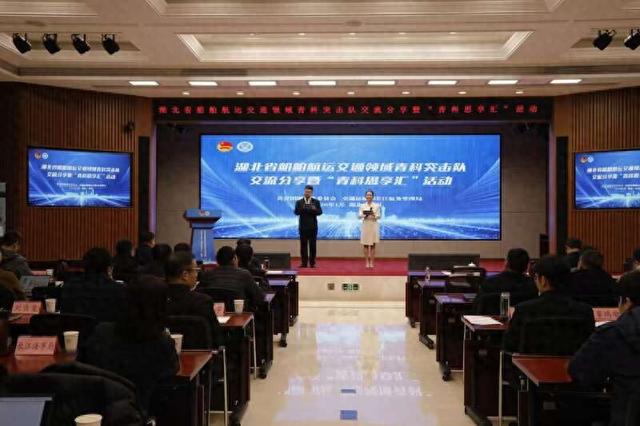
湖北船舶航运交通领域“青科思享汇”活动举行
Xin Lang Cai Jing· 2026-01-22 13:01
Core Insights - The event "Qingke Sihanghui" in Wuhan focused on technological innovation in the shipping and transportation sector, highlighting the importance of youth-led initiatives in addressing industry challenges [1][3] - The event was co-hosted by the Hubei Provincial Committee of the Communist Youth League and the Yangtze River Navigation Administration, emphasizing collaboration between government and educational institutions [1][3] Group 1: Event Overview - The event featured multiple youth innovation teams sharing their achievements in areas such as geological disaster monitoring in the Three Gorges area, green energy ship propulsion technology, lift ship technology innovation and operation, intelligent ship driving systems, and smart waterway construction [1] - Keynote speaker Ma Feng from Wuhan University of Technology presented on the "navigation brain" technology system for autonomous ship navigation [1] Group 2: Strategic Importance - Liu Zhitian, Secretary of the Hubei Provincial Committee, highlighted that innovation in the shipping industry is essential for the high-quality development of the Yangtze Economic Belt and the rise of the central region [3] - The Yangtze River Navigation Administration has emphasized the importance of youth innovation, with initiatives like the Smart Yangtze Construction and Application Innovation Competition to engage young professionals in the industry [3]

刘亮在宜昌调研并慰问一线职工和待闸船员
Xin Lang Cai Jing· 2026-01-21 14:27
Core Insights - The focus of the news is on the inspection and encouragement of frontline workers in the Yangtze River shipping sector by Liu Liang, the director of the Yangtze River Navigation Administration, emphasizing the importance of project progress, safety, and worker welfare. Group 1: Project Development and Management - Liu Liang visited the Three Gorges Navigation Engineering Testing and Maintenance Base and the Emergency Support Center, discussing project functions, planning, construction progress, and management, while suggesting optimizations to enhance project efficiency [1] - At the Gezhouba Navigation Capacity Expansion Project site, Liu emphasized the need for safety during winter construction and the importance of maintaining health and safety standards for frontline workers [1] Group 2: Worker Welfare and Support - Liu Liang provided support and New Year greetings to frontline workers and model employees at the Yichang Navigation Bureau, stressing the importance of ensuring safety and warmth for workers during the winter [2] - Liu visited the Yichang Port Group's green service area, acknowledging their efforts in providing comprehensive services for waiting ships and crew, and encouraged the use of information technology to enhance service levels [3] Group 3: Technological Advancements - Liu highlighted the significance of information technology in the Yangtze River shipping sector, particularly the integration of data collection and modeling technologies, and urged the Yichang Communication Bureau to accelerate the implementation of these projects [2] Group 4: Commitment to High-Quality Development - Liu expressed gratitude to frontline staff for their contributions to the stable safety situation in Yangtze River shipping and encouraged them to continue their dedication to ensuring smooth navigation [2] - He emphasized that 2026 is a critical year for promoting high-quality development in Yangtze River shipping, urging staff to adopt a proactive and resilient approach to their work [3]
超42亿吨!2025年长江干线港口货物吞吐量再创新高
Zhong Guo Jing Ji Wang· 2025-12-30 02:19
Core Insights - The cargo throughput of Yangtze River ports is expected to reach 4.2 billion tons by 2025, with a year-on-year growth of 4.8%, while the Three Gorges hub's throughput is projected at 170 million tons, growing by 8.7% [1] - During the 14th Five-Year Plan period, the total cargo throughput is anticipated to exceed 19.2 billion tons, marking a 30.1% increase compared to the 13th Five-Year Plan, contributing approximately 40 billion yuan annually to logistics cost reduction and efficiency improvement [1] - The Yangtze River shipping sector has made significant progress in infrastructure, service assurance, safety governance, green transformation, and smart development [1][2] Infrastructure and Capacity - The number of major ports on the Yangtze River has increased from 12 to 18, and the number of 10,000-ton production berths has risen from 360 to 487 over the past five years [1] - The completion of the second phase of the Jingjiang waterway improvement project and the operation of the 10.5-meter deep-water channel from Nanjing to Wuhu have significantly enhanced the navigation capacity for large vessels [1] Safety and Environmental Initiatives - The implementation of a "smart + credit" regulatory model has shifted safety governance towards proactive prevention, effectively mitigating major shipping safety risks [2] - The green waterway construction has established a complete technical system, with over 80% greening rate in improvement projects and full coverage of shore power at ports [2] Digital Transformation and Collaboration - A credit management system for Yangtze shipping has been effectively established, with the "Credit Yangtze" information system collecting data from 476,000 credit entities and 7.014 million records [2] - The "Yangtze e+" public service platform has surpassed 410,000 registered users, with nearly 450,000 daily clicks, supporting the digital transformation of the industry [2] Collaborative Governance - The Yangtze River Navigation Administration has expanded the "2+N" cooperation mechanism with provinces and cities along the river, promoting a new governance model for collaborative development [3] - The Yangtze shipping sector is positioned as a crucial support for the economic development of the Yangtze River Economic Belt, with a focus on high-quality development and modernization [3]
长江航运加速步入智慧化时代
Xin Hua Wang· 2025-09-26 09:30
Core Viewpoint - The Yangtze River shipping industry is undergoing a transformation towards a smart shipping era, driven by advancements in information technology and the establishment of a comprehensive management system [1][2]. Group 1: Smart Shipping Development - The Yangtze River shipping management authorities are promoting the construction of a smart Yangtze, achieving significant advancements in information technology and management [1]. - The smart Yangtze construction is encapsulated in a "131" framework: building one credit management system, creating three major platforms for intelligent management, comprehensive support, and public services, and establishing one unified open shipping market [1]. - The construction of 5,146 5G base stations along the Yangtze River has resulted in over 95% coverage, enabling the integration of multi-source data such as vessel and radar information [1]. Group 2: Application and Services - The "Yangtze e+" public service platform offers 86 public service items across seven categories, with over 380,000 users and an average of 300,000 daily clicks [2]. - The platform allows for real-time monitoring of vessel information and facilitates services such as remote medical consultations and delivery of supplies directly to vessels [2]. - The Yangtze shipping management bureau has collected 6.3 million data entries and generated over 700,000 evaluations, achieving real-time monitoring of 5,714 enterprises and 56,000 vessels [2]. Group 3: Financial Innovations - The Yangtze shipping management bureau has introduced a "credit + financial insurance" service model to address financing challenges for small and medium-sized enterprises, providing low-interest loans and facilitating mortgage registrations [3]. - In 2023, from January to August, the total cargo throughput at Yangtze River ports reached 2.69 billion tons, reflecting a year-on-year growth of 4.7% [3]. - The bureau aims to build a smart Yangtze shipping ecosystem, enhancing safety and efficiency while supporting the high-quality development of the Yangtze Economic Belt [3].
今年前7个月长江干线港口货物吞吐量超23亿吨
Yang Shi Xin Wen· 2025-08-08 03:38
Core Insights - The Yangtze River's cargo throughput is expected to reach 2.34 billion tons from January to July this year, marking a year-on-year increase of 4.8% [1] - The Three Gorges Hub has seen a cargo throughput of 98.584 million tons, reflecting a significant year-on-year growth of 15.3% [1] - The number of vessels guided by the Yangtze Pilot Center has increased to 35,000, up by 2.4% year-on-year [1] - The cruise passenger volume reached 5.144 million, showing a year-on-year increase of 5.3% [1] Industry Developments - The construction of a smart Yangtze initiative is accelerating, with collaborative mechanisms established among Jiangsu, Anhui, and Chongqing to enhance cross-regional credit governance [1] - The promotion of the new generation Beidou shipborne intelligent terminals is underway, with electronic navigation charts covering 5,606 kilometers of the Yangtze River [1] - A unified open market is being developed, with the "Yangtze Ship Capacity Renewal Service System" operational, providing comprehensive services for ship scrapping and renewal [1] Environmental Initiatives - The green shipping system along the Yangtze River is improving, with the "Yangtze New Energy Clean Energy Ship Monitoring and Service" system operating efficiently [1] - From January to July, the use of shore power by vessels at ports in the Yangtze Economic Belt reached 12.8628 million kilowatt-hours, representing a year-on-year increase of 22% [1]