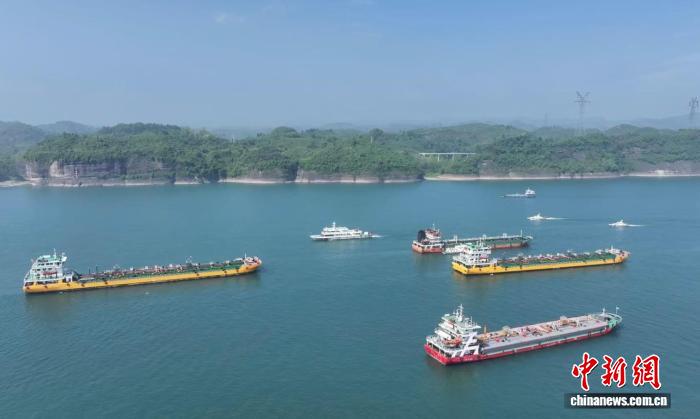
绿色航道建设

Search documents
超42亿吨!2025年长江干线港口货物吞吐量再创新高
Zhong Guo Jing Ji Wang· 2025-12-30 02:19
Core Insights - The cargo throughput of Yangtze River ports is expected to reach 4.2 billion tons by 2025, with a year-on-year growth of 4.8%, while the Three Gorges hub's throughput is projected at 170 million tons, growing by 8.7% [1] - During the 14th Five-Year Plan period, the total cargo throughput is anticipated to exceed 19.2 billion tons, marking a 30.1% increase compared to the 13th Five-Year Plan, contributing approximately 40 billion yuan annually to logistics cost reduction and efficiency improvement [1] - The Yangtze River shipping sector has made significant progress in infrastructure, service assurance, safety governance, green transformation, and smart development [1][2] Infrastructure and Capacity - The number of major ports on the Yangtze River has increased from 12 to 18, and the number of 10,000-ton production berths has risen from 360 to 487 over the past five years [1] - The completion of the second phase of the Jingjiang waterway improvement project and the operation of the 10.5-meter deep-water channel from Nanjing to Wuhu have significantly enhanced the navigation capacity for large vessels [1] Safety and Environmental Initiatives - The implementation of a "smart + credit" regulatory model has shifted safety governance towards proactive prevention, effectively mitigating major shipping safety risks [2] - The green waterway construction has established a complete technical system, with over 80% greening rate in improvement projects and full coverage of shore power at ports [2] Digital Transformation and Collaboration - A credit management system for Yangtze shipping has been effectively established, with the "Credit Yangtze" information system collecting data from 476,000 credit entities and 7.014 million records [2] - The "Yangtze e+" public service platform has surpassed 410,000 registered users, with nearly 450,000 daily clicks, supporting the digital transformation of the industry [2] Collaborative Governance - The Yangtze River Navigation Administration has expanded the "2+N" cooperation mechanism with provinces and cities along the river, promoting a new governance model for collaborative development [3] - The Yangtze shipping sector is positioned as a crucial support for the economic development of the Yangtze River Economic Belt, with a focus on high-quality development and modernization [3]
近五年长江干线港口货物吞吐量超192亿吨
Zhong Guo Xin Wen Wang· 2025-12-29 07:39
Core Insights - During the "14th Five-Year Plan" period, the cargo throughput of the Yangtze River mainline ports exceeded 19.2 billion tons, representing a 30.1% increase compared to the "13th Five-Year Plan" period, contributing approximately 40 billion RMB annually to logistics cost reduction and efficiency improvement [1][2] Group 1: Cargo Throughput and Growth - The cargo throughput of the Yangtze River mainline ports is projected to reach 4.2 billion tons by 2025, with the Three Gorges hub throughput expected to be 170 million tons, reflecting year-on-year growth of 4.8% and 8.7% respectively [1][2] - The number of major ports with a throughput of over 100 million tons increased from 12 to 18, and the number of 10,000-ton production berths rose from 360 to 487 during the "14th Five-Year Plan" [2] Group 2: Infrastructure and Safety Improvements - The improvement of waterway conditions has significantly enhanced the navigation capacity for large vessels, with 82% of the high-grade waterway electronic navigation charts now interconnected [2] - The Yangtze River shipping department has adopted a "smart + credit" regulatory model, transitioning safety governance towards proactive prevention, resulting in a sustained low level of water traffic accidents [2] Group 3: Green Initiatives - A complete technical system for green waterway construction has been established, with over 80% greening rate for rectification projects, and full coverage of shore power at ports [2] - The introduction of 402 new clean energy vessels has been achieved, with a comprehensive approach to managing shipborne pollutants through "onboard storage and shore disposal" [2]