
船舶航运

Search documents
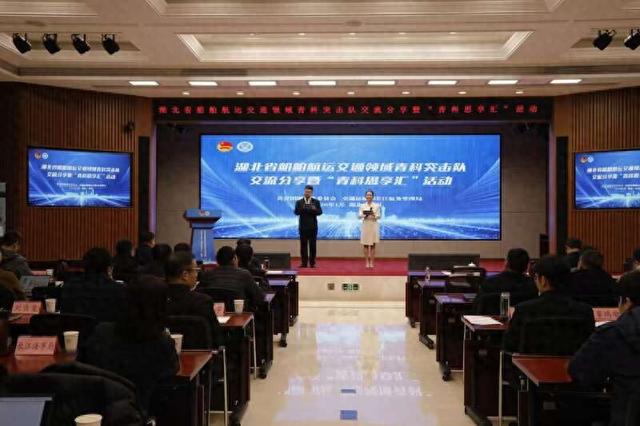
湖北船舶航运交通领域“青科思享汇”活动举行
Xin Lang Cai Jing· 2026-01-22 13:01
Core Insights - The event "Qingke Sihanghui" in Wuhan focused on technological innovation in the shipping and transportation sector, highlighting the importance of youth-led initiatives in addressing industry challenges [1][3] - The event was co-hosted by the Hubei Provincial Committee of the Communist Youth League and the Yangtze River Navigation Administration, emphasizing collaboration between government and educational institutions [1][3] Group 1: Event Overview - The event featured multiple youth innovation teams sharing their achievements in areas such as geological disaster monitoring in the Three Gorges area, green energy ship propulsion technology, lift ship technology innovation and operation, intelligent ship driving systems, and smart waterway construction [1] - Keynote speaker Ma Feng from Wuhan University of Technology presented on the "navigation brain" technology system for autonomous ship navigation [1] Group 2: Strategic Importance - Liu Zhitian, Secretary of the Hubei Provincial Committee, highlighted that innovation in the shipping industry is essential for the high-quality development of the Yangtze Economic Belt and the rise of the central region [3] - The Yangtze River Navigation Administration has emphasized the importance of youth innovation, with initiatives like the Smart Yangtze Construction and Application Innovation Competition to engage young professionals in the industry [3]

申万宏源:十五五规划十大投资机会,建议关注人工智能、机器人、航空航天、低空经济、战略资源金属等(图)
Xin Lang Cai Jing· 2025-12-08 04:16
Core Viewpoint - The report by Shenwan Hongyuan outlines ten key investment opportunities during the "14th Five-Year Plan" period, focusing on future manufacturing, information, materials, energy, space, and health sectors [1][14]. Group 1: Future Manufacturing and Information - The robotics industry in China is transitioning from product definition to commercialization, with "Artificial Intelligence +" expected to empower various industries by 2026 [3][16]. - Quantum technology is highlighted as a critical future industry for forward-looking development [3][16]. Group 2: Aerospace and Low-altitude Economy - The aerospace industry is a key focus for the "14th Five-Year Plan," with the establishment of the Space Administration and a three-year action plan to promote high-quality and safe development in commercial aerospace [3][16]. - The drone and low-altitude economy sectors are rapidly forming a clustered development pattern [3][16]. Group 3: Strategic Resources and Metals - Strategic minor metals are receiving policy support, with a joint work plan from eight departments elevating resource security to a strategic level [7][20]. - A table outlines various metals and their applications across different industries, emphasizing their importance in sectors like defense, aerospace, and renewable energy [8][21]. Group 4: Future Energy - The development of controllable nuclear fusion is emphasized as a priority, with significant energy demand driving investments in nuclear power from major companies [9][22]. - The report notes the strategic cultivation of hydrogen energy within the future industrial framework [9][22]. Group 5: Future Health - China's innovative drug development has established global competitiveness in areas like ADC and cell therapy, achieving breakthroughs in both the quantity and quality of research pipelines [11][24]. - Brain-computer interface technology is advancing in clinical applications, with significant progress in medical rehabilitation as a primary commercialization scenario [13][26].


2275万元,北京71个标准化创新项目获补助
Xin Jing Bao· 2025-10-15 04:50
Core Insights - The Beijing Municipal Market Supervision Administration announced the launch of the 2025 Capital Standardization Strategy Subsidy Fund, with a total of 22.75 million yuan allocated to 71 benchmark projects across 60 units in the city [1] Group 1: International Standardization - Four projects participating in international standard organizations received 2.1 million yuan, enhancing China's competitiveness in the intelligent shipping industry and promoting the internationalization of cultural heritage protection standards [2] - Four overseas demonstration application projects focused on hydrogen energy and digital television, aiding the implementation of Chinese standards in Europe, the United States, and Belt and Road Initiative countries like Pakistan and Russia [2] Group 2: Results Transformation - The local standard "Community Resilience Evaluation Guidelines" has been successfully transformed into a national standard project, providing a unified evaluation basis for community safety resilience construction across the country [2] Group 3: Pilot Projects - Twelve pilot projects covering service industries, cultural tourism, social management, and public services will establish replicable and promotable industry development benchmarks through standardized production and operation models [2] Group 4: Industry Empowerment - Fifty subsidized standard projects are concentrated in high-tech industries, resource-saving sectors, and service industries, laying a solid standard foundation for the construction of an international science and technology innovation center and the optimization of industrial upgrades [2]