智能型组织

Search documents
智能型组织:“一将顶千军”的AI革命 | 人力资本论
Jing Ji Guan Cha Bao· 2025-11-10 07:36
Core Insights - The report by McKinsey outlines the evolution of organizational forms into three stages: Industrial Era (hierarchical and assembly line), Digital Era (cross-functional teams and agile iterations), and AI Era (collaboration between humans and AI agents) [2][3] - The concept of "Agentic Organization" is introduced, emphasizing that organizations will evolve into self-driving entities where human intelligence and AI capabilities co-create value [3][4] Organizational Paradigm Shift - AI is driving the most significant organizational paradigm shift since the Industrial and Digital Revolutions, leading to the emergence of "intelligent organizations" [3][4] - The productivity of a few high-performing individuals, enhanced by AI, will surpass that of traditional large teams, creating a new dynamic where individual strategic thinking is amplified by AI [3][4] Key Conclusions from the Report - Output concentration will increase, with a few efficient individuals achieving productivity levels previously thought impossible [4] - Organizational structures will transition from hierarchical to flat, networked, and highly autonomous team ecosystems [4] - The relationship between humans and machines will evolve from "humans using tools" to "humans and agents co-creating," necessitating a shift in leadership roles [4] - Competitive advantages will shift from scale and process efficiency to cognitive capabilities, data advantages, and collaborative speed [4] Practical Framework for Intelligent Organizations - Five pillars are proposed for building intelligent organizations: 1. **Business Model**: Companies must reconstruct competitive advantages through AI-native channels, AI-first workflows, and protected data ecosystems [7] 2. **Operational Model**: Traditional departmental silos will be replaced by outcome-focused intelligent teams [8] 3. **Governance Mechanism**: Real-time governance will be embedded in workflows, ensuring accountability and compliance [9] 4. **Talent and Culture**: New roles will emerge, and corporate culture will evolve to support human-AI collaboration [10] 5. **Technology and Data**: A dynamic ecosystem will be created where technology capabilities are not limited to IT departments [11] Controversies and Choices - The future of middle management is debated, with some arguing for its disappearance while others see a transformation into more valuable roles [14] - The evolution path of organizations may either be a complete overhaul into AI-native structures or a gradual integration of AI into existing operations [15] - The dual goal of leveraging AI for cost reduction while enhancing value creation is emphasized, advocating for a balanced approach [17] Implementation Steps - Companies should initiate a "flagship project" led by the CEO to drive strategic transformation [18] - Identifying "lighthouse domains" for pilot projects will help demonstrate AI's potential and facilitate broader organizational change [18] - Focus on three core transformations: shifting management focus from oversight to designing workflows, embedding corporate values into operational rules, and adopting an open-ecosystem approach to technology capabilities [19]


硅谷大裁员,组织变天了
Tai Mei Ti A P P· 2025-11-04 05:55
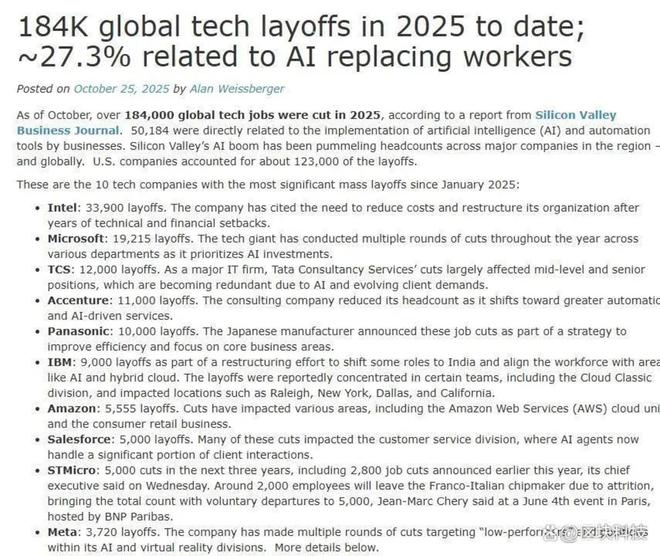
Group 1 - Major layoffs in Silicon Valley tech companies have exceeded 184,000 employees as of October 2025, with significant cuts from companies like Intel (33,900), Microsoft (19,215), and Accenture (11,000) [2][4] - Companies are undergoing organizational adjustments to adapt to the AI era, with YouTube introducing a Voluntary Exit Program to encourage employees to leave for new challenges [4][10] - Despite the layoffs, many of these companies are experiencing rising stock prices, indicating that their value is driven by factors other than headcount [4][13] Group 2 - The layoffs are primarily targeting non-essential roles and middle management, as AI technology reduces the need for positions that merely relay information [10][12] - The motivation behind these layoffs differs from those in China, where layoffs are often due to survival pressures, while in Silicon Valley, they are driven by market capitalization pressures [13][14] - Companies previously created redundant positions to showcase potential to capital markets, but now face pressure to demonstrate efficiency and high productivity with fewer employees [13][15] Group 3 - The future organizational structure may rely on a small number of elite employees utilizing AI tools to achieve significant growth, leading to a reduction in job opportunities for others [16][18] - Core talent will be essential for building and evolving intelligent systems within organizations, while other roles may become obsolete if they do not contribute to decision-making processes [16][17] - The demand for core talent will continue to evolve, requiring individuals to keep pace with advancements in AI and organizational needs [17][18]