智能家居安防

Search documents
鹿客科技递表港交所;港股1月IPO集资金额较去年同期上升555%丨港交所早参
Mei Ri Jing Ji Xin Wen· 2026-02-08 17:08
Group 1: Company Developments - LuKe Technology has submitted its listing application to the Hong Kong Stock Exchange, with China Galaxy International as the exclusive sponsor. The company is a pioneer in AI home security solutions, focusing on smart locks and comprehensive safety solutions for homes and communities. In 2024, LuKe's shipment of vein recognition smart locks is expected to rank first globally, with a market share of 10.5%, while its overall smart lock shipments are projected to be fourth globally, with a market share of 2.6% [1] - Jiaxin International Resources has issued a positive profit forecast, expecting to turn a loss of 173 million HKD for the year ending December 31, 2024, into a profit of approximately 300 to 340 million HKD for the year ending December 31, 2025. This turnaround is attributed to the commencement of commercial production in April 2025, which will generate revenue [3] - Poly Property Group reported a 22.92% year-on-year decrease in contract sales amounting to approximately 3.7 billion HKD in January 2026, with a sales area of about 151,000 square meters and an average contract sales price of 24,774 HKD per square meter. The company faces pressure on sales during the market adjustment period [4] Group 2: Market Trends - The Hong Kong stock market saw a significant increase in IPO fundraising, with January 2026's total IPO amount reaching 39.3 billion HKD, a 555% increase from 6 billion HKD in the same month last year. The total fundraising amount for January 2026 was 53.1 billion HKD, up 318% from 12.7 billion HKD year-on-year. This surge is attributed to capital inflow, favorable policies, and a wave of hard technology listings [2]

研判2025!中国可视门铃行业政策汇总、产业链、市场规模、竞争格局及趋势分析:消费者对家居安全的重视,推动可视门铃行业规模上涨[图]
Chan Ye Xin Xi Wang· 2025-08-26 01:23
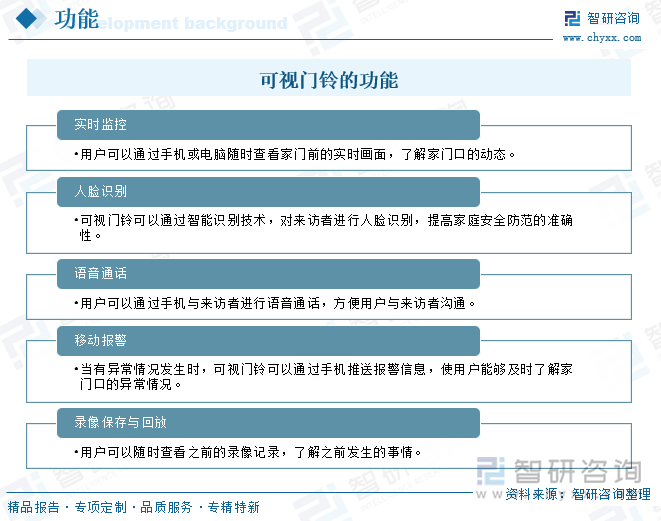
Core Insights - The visual doorbell industry is rapidly growing, driven by increasing consumer demand for home security and convenience, with the market size in China projected to grow from 1.5 billion yuan in 2018 to 4.38 billion yuan by 2024, representing a compound annual growth rate (CAGR) of 19.6% [1][10] Industry Overview - Visual doorbells, also known as electronic cat eyes, integrate advanced technologies such as high-definition cameras, smart recognition, and wireless communication, enhancing home security and user convenience [2] - The product is widely used in various settings, including homes, offices, and hotels, and serves as an upgrade to traditional optical cat eyes by providing monitoring capabilities [2] Policy Influence - Recent government policies in China are promoting the development of smart security, with visual doorbells being a key component. Policies include promoting smart security and enhancing community service levels [4][5] - Regulations are in place to ensure that the installation of image capture devices does not infringe on public safety or personal privacy [4] Industry Chain - The visual doorbell industry consists of an upstream supply chain involving materials like metals, plastics, chips, sensors, and displays, a midstream manufacturing segment, and a downstream sales channel including e-commerce platforms and retail stores [6] Market Trends - The global shipment of visual doorbells is expected to reach 25.9 million units by 2024, reflecting a year-on-year increase of 29.5% [8] - The market is primarily concentrated in regions such as Europe, North America, China, Japan, and South Korea, with Europe being the largest consumer market [8] Competitive Landscape - Major global players like Ring, Nest, and Arlo dominate the market, with Ring holding over 60% market share. In China, brands like Hikvision, Xiaomi, and Anjubao are competing effectively, although no single brand has achieved absolute dominance [12] Future Development Trends - The demand for visual doorbells is expected to continue growing due to urbanization, the proliferation of smart home products, and increasing consumer safety concerns [19] - The integration of artificial intelligence will enhance the smart recognition capabilities of visual doorbells, allowing for more accurate identification of visitors and potential intruders [20] - Visual doorbells will increasingly integrate with other smart home devices, creating a more seamless and automated home environment [22]