
智能电动变革

Search documents
【报告】汽车海外零部件巨头系列十:电装,日系Tier1标杆借势、精进、全球化(附下载)
Xin Lang Cai Jing· 2025-12-25 12:44
Core Viewpoint - The report emphasizes the historic opportunity for the Chinese automotive industry to grow stronger through the transformation to smart electric vehicles, suggesting that Chinese automakers can surpass their foreign counterparts in the electric vehicle era, leveraging speed and cost advantages to create leading domestic companies and parts suppliers [3][4]. Group 1: Overview of Global Tier 1 Suppliers - The report outlines the growth paths of global Tier 1 automotive suppliers, highlighting that German suppliers focus on technology, Japanese and Korean suppliers are often supported by their parent manufacturers, and American suppliers face more competition [4][28]. - It notes that tire manufacturers have a significant branding advantage, with a monopolistic competition structure formed by "three giants + eight groups," providing growth opportunities for latecomers [4][28]. Group 2: Evolution of Japanese DENSO - DENSO, initially a part of Toyota, became independent in 1949 and relied on Toyota orders initially, later diversifying its client base to include General Motors and Ford [11][30]. - The company successfully adopted lean management and expanded globally, reducing dependency on Toyota while maintaining strong customer relationships [30]. - DENSO's success is attributed to its ability to innovate and adapt, leveraging partnerships and technology to become the second-largest automotive parts supplier globally [11][30]. Group 3: Changes in Chinese Automotive Parts Suppliers - Chinese automotive parts suppliers are undergoing significant changes, with a shift towards smart electric vehicles since 2020, driven by new entrants like Tesla and NIO, which have redefined the supplier-manufacturer relationship [29]. - The report identifies several emerging Chinese suppliers that have capitalized on this shift, including Top Group, Desay SV, and others, which have gained market share through high cost-performance and rapid response capabilities [29]. - The globalization of Chinese suppliers has accelerated, with companies like Top Group and New Spring actively expanding overseas to compete with global giants [29]. Group 4: Future Outlook and Opportunities - The report anticipates that the transition to electric and smart vehicles will create new opportunities for parts suppliers, particularly in high-value components such as batteries, electric drives, and smart driving systems [9][30]. - It highlights the potential for AI and robotics to further transform the industry, with companies like DENSO and others entering the humanoid robot market to seek new growth avenues [29][30].

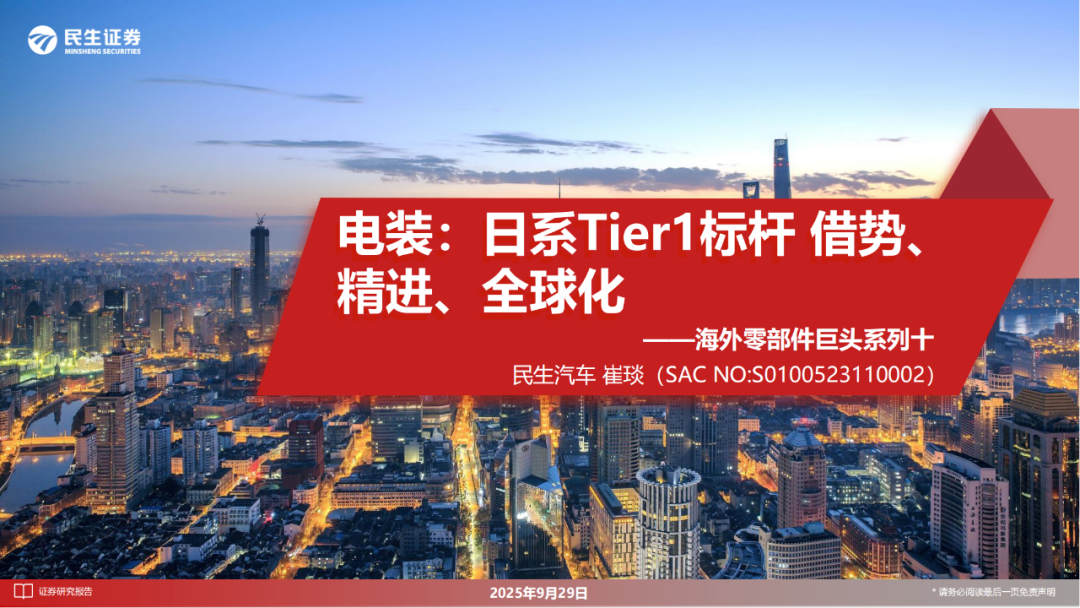
海外零部件巨头系列十:电装:日系Tier1标杆借势、精进、全球化
Minsheng Securities· 2025-09-29 08:50
Investment Rating - The report maintains a positive outlook on the automotive parts industry, particularly in the context of the transition to smart electric vehicles, indicating a historical opportunity for growth in the Chinese automotive sector [3]. Core Insights - The report emphasizes that the shift from traditional fuel vehicles to smart electric vehicles presents a significant opportunity for Chinese automotive companies to leapfrog their competitors, potentially leading to the emergence of leading domestic automotive and parts manufacturers [3][4]. - It highlights the historical development and transformation paths of global Tier 1 automotive parts suppliers, particularly focusing on DENSO as a benchmark for Japanese suppliers [3][4][8]. Summary by Sections 1. Historical Development of DENSO - DENSO was initially part of Toyota's electrical components division and became independent in 1949, relying heavily on Toyota's orders in its early years [10]. - The company gradually diversified its customer base, reducing dependency on Toyota and expanding to clients like General Motors and Ford [8][10]. - DENSO's success is attributed to its lean management practices, strong customer relationships, and significant investments in technology and R&D [8][10]. 2. Growth Pathways of Global Tier 1 Suppliers - The report categorizes the growth of global automotive parts suppliers into three main pathways: technology-driven, dependent rise, and acquisition-driven growth [7][34]. - It notes that German suppliers are primarily technology-focused, while Japanese and Korean suppliers often receive support from their respective automakers [4][7]. - The report identifies that the automotive parts industry is undergoing a transformation, with a shift towards electric and smart technologies, creating new opportunities for both established and emerging players [9][18]. 3. Current Landscape and Future Outlook - The report outlines the competitive landscape, indicating that the transition to electric vehicles is reshaping the supply chain dynamics, with new entrants and traditional manufacturers adapting to the changing market [18][19]. - It highlights the importance of high-value components such as powertrains, automotive electronics, and chassis systems as key growth areas for suppliers [24][28]. - The report also discusses the increasing globalization of Chinese suppliers, with companies like Top Group and New Spring Group expanding their overseas presence [7][9]. 4. Financial Performance and Market Position - DENSO is positioned as the second-largest automotive parts supplier globally, with a diverse product portfolio and a strong focus on innovation and quality [10][32]. - The report provides insights into the revenue distribution among the top global suppliers, indicating that German and Japanese companies dominate the market, while Chinese suppliers have significant growth potential [29][30].

海外零部件巨头系列八:安道拓:汽车座椅之王并购、专注、全球发展
Minsheng Securities· 2025-09-24 11:49
Investment Rating - The report maintains a positive outlook on the automotive parts industry, particularly focusing on the opportunities presented by the transition to smart electric vehicles in China [2]. Core Insights - The report emphasizes the historical opportunity for Chinese automotive companies to leverage the shift from traditional fuel vehicles to electric vehicles, potentially allowing them to surpass established global players [2]. - It highlights the successful growth strategies of global automotive parts giants, particularly in the context of mergers and acquisitions, technological innovation, and market expansion [3][7]. - The report details the evolution of Adient, a leading automotive seating company, from its separation from Johnson Controls to its current status as a global leader in the seating market, driven by strategic acquisitions and a focus on core competencies [7][10]. Summary by Sections Historical Overview - The report outlines the historical development of Adient, detailing its key acquisitions and strategic decisions that have shaped its growth in the automotive seating sector [41][50]. - It notes the transition from being part of Johnson Controls to becoming an independent entity focused on seating solutions, highlighting significant milestones in its journey [10][41]. Success Factors - Adient's success is attributed to its ability to capitalize on market opportunities, strategic mergers and acquisitions, and a strong focus on product innovation and technology [7][10]. - The report identifies three primary growth strategies employed by global automotive parts suppliers: technology-driven growth, reliance on major automotive manufacturers, and expansion through acquisitions [6][33]. Market Outlook - The report anticipates a significant shift in the automotive parts landscape due to the rise of electric and smart vehicles, with a focus on the development of new technologies and products that cater to these trends [8][10]. - It discusses the competitive dynamics of the automotive parts industry, noting the increasing importance of innovation and customer responsiveness in maintaining market leadership [19][28].