
智能眼镜市场发展

Search documents
2025年第三季度全球智能眼镜出货量同比大涨74.1%,中国厂商表现亮眼
Huan Qiu Wang· 2025-12-17 02:09
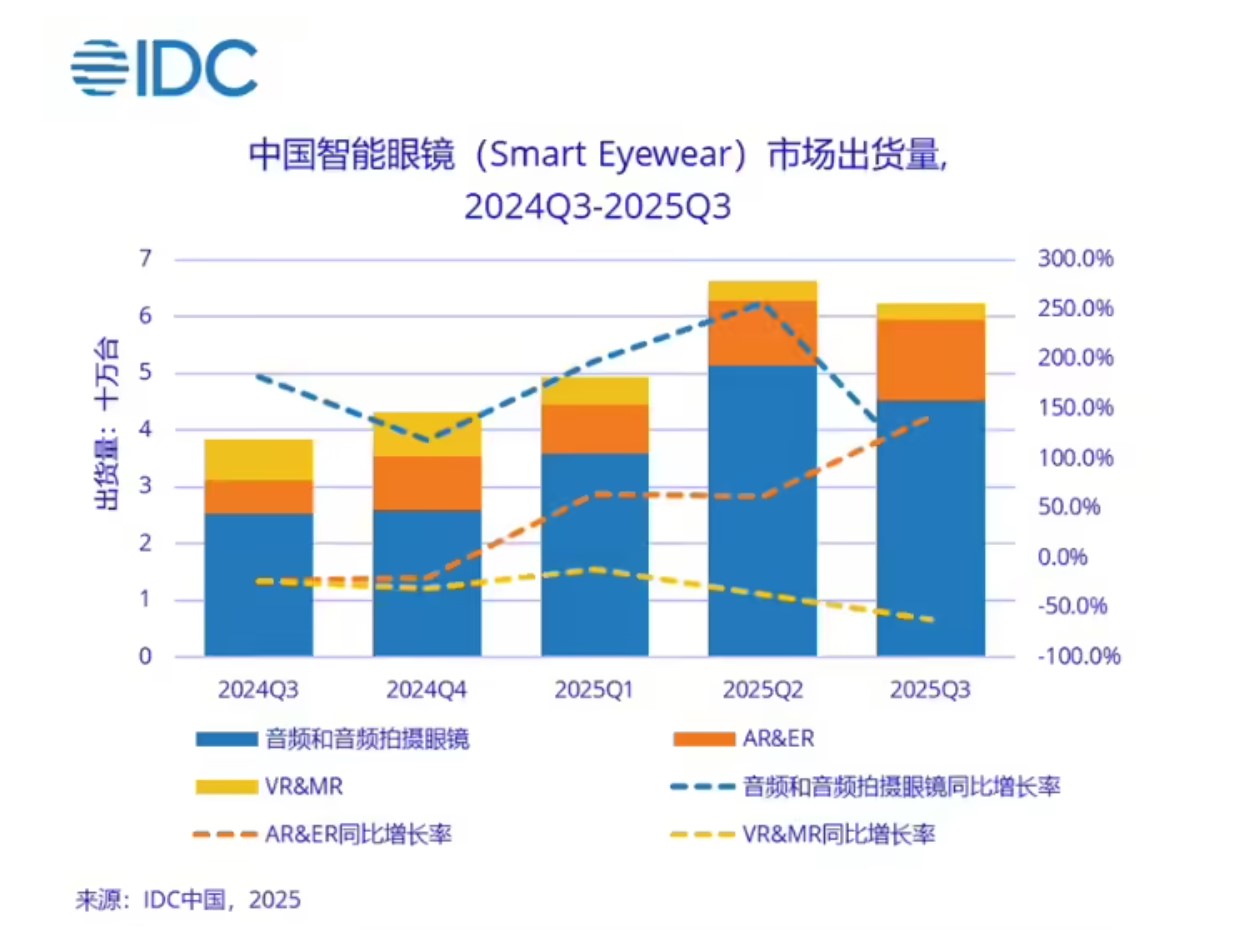
Core Insights - The global smart glasses market is projected to reach 4.296 million units in Q3 2025, reflecting a significant year-on-year growth of 74.1% [1] - Meta maintains a dominant market position with a 75.7% market share, driven by the launch of innovative products such as Ray-Ban Meta 2nd generation and Oakley sports line [1] - Chinese companies Xiaomi, Thunder, Xreal, and Viture have successfully entered the top five global market players, showcasing their increasing innovation capabilities and international competitiveness [1] Market Performance - The global audio and audio-capturing glasses market has seen a remarkable surge, with shipments reaching 2.994 million units, a year-on-year increase of 287.5% [1] - The AR/VR market, however, experienced a decline in shipments, totaling 1.302 million units, down 23.2% year-on-year, indicating structural differentiation within the market [1] - Key regional markets such as North America, Western Europe, China, and Asia-Pacific (excluding China and Japan) achieved over 50% year-on-year growth, with Western Europe leading at 106.5% [2] China Market Insights - In Q3 2025, China's smart glasses market is expected to ship 623,000 units, marking a year-on-year growth of 62.3% [5] - The audio and audio-capturing glasses segment in China is projected to ship 454,000 units, reflecting a 79.2% increase year-on-year, while the AR/VR segment is expected to reach 169,000 units, growing by 29.4% [5] - IDC forecasts that by 2026, China's smart glasses market will continue to grow rapidly, with shipments anticipated to reach 4.508 million units, a year-on-year increase of 77.7% [5]


从夸克眼镜看眼镜行业新变化
2025-12-04 02:22
Summary of the Eyewear Industry Conference Call Industry Overview - The global eyewear market is experiencing stable growth, with an expected CAGR of 6.2%. Key drivers include the demand for functional lenses among adults, myopia management lenses for children and adolescents, and presbyopia needs among the elderly [1][3] - The Chinese eyewear market is growing faster than the global average, with a retail CAGR of 8.8% from 2020 to 2024, projected to reach RMB 48.9 billion by 2028, with a future CAGR of 7.1% [1][4] Financial Metrics - Midstream manufacturers in the eyewear industry have a gross margin of 50%-55% and a net margin of 10%-20%. In contrast, the downstream retail sector has a gross margin of 60%-70% but a lower net margin of about 10%-12% [1][5] Market Structure - The upstream sector consists of raw material suppliers and equipment manufacturers, while the midstream includes lens production companies. The downstream comprises agents, distributors, and retailers, including optical chain stores and hospitals [5] - The domestic manufacturing sector is highly concentrated, with the top 10 companies holding a market share of 50%-60%, while the retail sector is more fragmented, with the top 10 holding only 10%-15% [5] Smart Glasses Development - The smart glasses market is accelerating, with brands rapidly releasing new products. Core technologies include micro-display technology, sensor fusion technology, and XR technology, although weight and fitting remain significant challenges [1][6][7] - Traditional eyewear companies play a crucial role in promoting smart glasses by providing accurate fitting services and offline channel support, addressing fitting challenges and enhancing comfort [8] Sales Channels - Offline channels account for approximately 40% of smart glasses sales, providing on-site experiences and value-added services that help reduce return rates. Major manufacturers need to prioritize partnerships with offline retailers [2][10] - The importance of offline channels is underscored by the fact that over 90% of consumers lack actual usage experience, leading to high return rates if purchases are made solely online [10] Pricing and Profitability - For example, the Quark glasses SE standard set is priced at RMB 4,699 without prescription lenses, with additional costs for different refractive indices ranging from RMB 719 to RMB 1,529. This indicates a good profitability for fitting companies [11] Opportunities for Traditional Companies - Traditional eyewear companies can benefit from establishing deep partnerships with smart eyewear brands to secure fitting orders, while retail companies can become important partners through channel cooperation [12] - Companies that master integrated fitting technology and leading firms in both manufacturing and retail sectors are expected to create new growth trajectories [12]