月球定居

Search documents
马斯克:暂时搁置火星计划,重点转向建造月球城市
Sou Hu Cai Jing· 2026-02-09 13:52
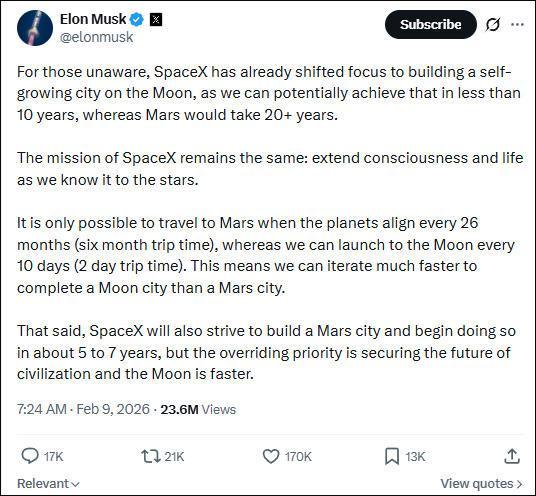
Core Viewpoint - SpaceX has shifted its focus from Mars exploration to prioritizing the construction of a self-sustaining city on the Moon, acknowledging that lunar settlement is more feasible in the short term compared to Mars missions [1][2]. Group 1: Strategic Shift - Elon Musk announced on social media that SpaceX will pause its long-standing plans to send humans to Mars and instead prioritize lunar settlement, aligning with U.S. space policy under President Trump [1][2]. - The company aims to build a lunar city within 10 years, while Mars colonization is projected to take over 20 years [2]. - Musk emphasized that SpaceX's mission remains to extend consciousness and life beyond Earth, but the Moon project can progress at a much faster pace than Mars [2]. Group 2: Timeline and Competition - SpaceX plans to initiate work on Mars city in approximately 5 to 7 years, but the immediate focus is on ensuring the future of human civilization through lunar projects [2]. - The U.S. is in a competitive race with China for manned lunar landings by 2030, with the last human visit to the Moon occurring in 1972 [2][3]. - SpaceX has informed investors of its priority shift towards lunar landings, targeting an unmanned Moon landing by March 2027 [3]. Group 3: Historical Context and Policy Alignment - Musk's previous timelines for Mars missions have been optimistic, with estimates ranging from 10 to 20 years for human landings, but recent statements reflect a more cautious approach [4][6]. - The strategic adjustment aligns with U.S. government space policy, particularly the Artemis program, which aims for manned lunar landings by 2028, with SpaceX as a key contractor [6][7]. - The Artemis 3 mission is planned for mid-2027 to achieve crewed lunar return, although this timeline has faced multiple delays [7].

马斯克宣布重大调整
Guan Cha Zhe Wang· 2026-02-09 13:51
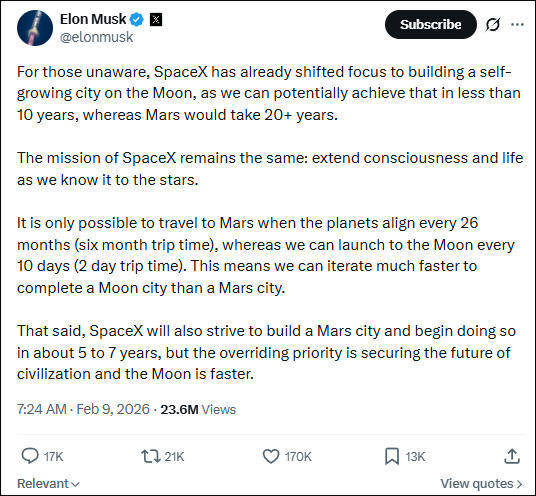
Core Viewpoint - SpaceX has shifted its focus from Mars exploration to prioritizing the construction of a self-sustaining city on the Moon, aligning with U.S. space policy under President Trump, which emphasizes lunar missions over Mars [1][4]. Group 1: Strategic Shift - Elon Musk announced on February 8 that SpaceX will pause its long-standing Mars mission plans to prioritize lunar settlement, aiming to achieve this within 10 years, while Mars colonization is projected to take over 20 years [2][3]. - Musk stated that SpaceX's mission remains to extend consciousness and life to the stars, but the Moon offers a faster path for human settlement compared to Mars [2][4]. Group 2: Timeline and Competition - SpaceX plans to initiate work on Mars city in approximately 5 to 7 years, but the immediate focus is on lunar projects due to their quicker implementation [2][3]. - The U.S. is in a competitive race with China for manned lunar landings by 2030, with the last human visit to the Moon occurring in 1972 [2][3]. Group 3: Alignment with U.S. Policy - Musk's comments reflect a broader alignment with U.S. government space policy, particularly the Artemis program, which aims for a manned lunar landing by 2028, with SpaceX as a key contractor [4][6]. - The Artemis 3 mission is scheduled for mid-2027 to achieve a manned return to the Moon, although this timeline has faced multiple delays [6][7].