
月球科学研究

Search documents
【人民网】嫦娥六号月球样品中首次发现晶质赤铁矿
Ren Min Wang· 2025-11-18 02:05
Core Insights - China's research team has made a significant breakthrough in lunar science by discovering micron-sized hematite (α-Fe2O3) and magnetite (γ-Fe2O3) crystals from samples returned by the Chang'e 6 mission, revealing a new lunar oxidation reaction mechanism [1][2] - The study suggests that the formation of hematite is closely related to large impact events in the Moon's history, which created a transient high oxygen fugacity gas environment that oxidized iron elements [2] Group 1 - The research was conducted by a collaboration between Shandong University, the Chinese Academy of Sciences, and Yunnan University, supported by the National Space Administration's lunar sample [1] - The findings have been published in the journal Science Advances, providing important scientific evidence for future lunar research and enhancing the understanding of the Moon's evolutionary history [1] Group 2 - The study indicates that the intermediate products of the oxidation reaction include magnetic magnetite and magnetite, which may serve as mineral carriers for the magnetic anomalies at the edges of the South Pole-Aitken Basin [2] - This research confirms the presence of strong oxidizing substances like hematite on the lunar surface under a highly reduced background, shedding light on the Moon's redox state and the causes of magnetic anomalies [2]

【新华社】“月球科学多模态专业大模型V2.0”发布
Xin Hua She· 2025-08-31 15:20
Core Viewpoint - Chinese scientists are integrating artificial intelligence into lunar scientific research, significantly enhancing research efficiency through the development of a specialized model for lunar impact crater analysis [1][2]. Group 1: AI Integration in Lunar Research - The "Lunar Science Multi-Modal Professional Model V2.0" was released by the Institute of Geochemistry, Chinese Academy of Sciences, during the 2025 China International Big Data Industry Expo [1]. - The model serves as the "intelligent brain" for the "Digital Moon" cloud platform, facilitating the analysis of lunar geological evolution by identifying and classifying impact craters [1]. Group 2: Research Achievements - Over 1 million impact craters with a diameter greater than 1 kilometer have been identified on the moon, while the number of smaller craters remains unquantified [1]. - The model has achieved an accuracy rate of 88% in classifying the ages of impact craters and 93% in automatically identifying lunar structures [2]. Group 3: Future Developments - The "Digital Moon" cloud platform is scheduled for completion in 2027 and will be open for global sharing [2].

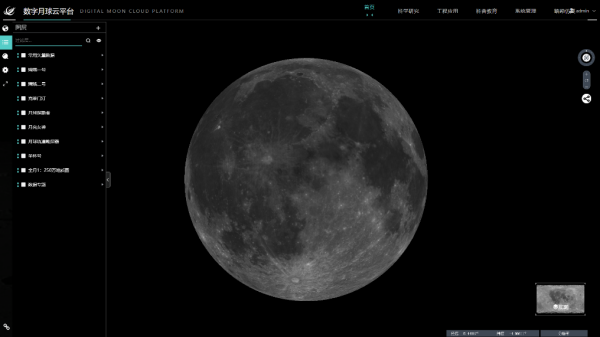
“月球科学多模态专业大模型V2.0”发布
Xin Hua She· 2025-08-30 08:04
Group 1 - Chinese scientists are integrating artificial intelligence into lunar scientific research, exemplified by the release of the "Lunar Science Multimodal Professional Model V2.0" during the 2025 China International Big Data Industry Expo [1] - The model enhances the efficiency of lunar research by allowing researchers to input images of lunar impact craters and receive detailed analyses regarding their shape, size, and formation age [1] - Over 1 million impact craters with a diameter greater than 1 kilometer have been identified on the moon, while the number of smaller craters remains unquantified, highlighting the challenges of manual identification [1] Group 2 - A comprehensive multimodal data labeling standard has been established, creating a dataset with over 8,700 labeled lunar impact craters and 7,272 other lunar structures [2] - The model has achieved significant accuracy rates, with 88% in classifying the ages of impact craters and 93% in automatic recognition of lunar structures [2] - The "Digital Moon" cloud platform is projected to be completed by 2027 and will be open for global sharing [2]