服务器CPU

Search documents
设备占比较高的半导体设备ETF易方达(159558)连续16日净流入,盘中再获资金净申购近5000万份
Xin Lang Cai Jing· 2026-01-21 06:12
Group 1 - The semiconductor equipment ETF E Fund (159558) has seen significant inflows, with nearly 50 million shares net subscribed and a turnover rate of 5.51%, resulting in a transaction volume of 241 million yuan [1] - As of January 20, the latest scale of the semiconductor equipment ETF reached 4.351 billion yuan, with a total of 1.916 billion shares, both hitting record highs since its inception [1] - Over the past 16 days, the semiconductor equipment ETF has experienced continuous net inflows, with a peak single-day net inflow of 621 million yuan, totaling 2.366 billion yuan [1] Group 2 - The Greater Bay Area Compound Semiconductor Ecological Application Conference and Semiconductor Industry CEO Conference was held in Zhuhai High-tech Zone, where leaders expressed hopes for more companies to establish R&D centers, manufacturing bases, and regional headquarters in Zhuhai to create a globally influential compound semiconductor industry hub [1] - Western Securities anticipates sustained growth in demand for server CPUs due to upgrades in data center architecture and increasing AI inference computing power needs, with domestic server CPUs improving in performance and software compatibility, potentially increasing market share driven by demand and policy [1]
低谷翻倍,AMD又行了?
Ge Long Hui· 2025-08-10 12:37
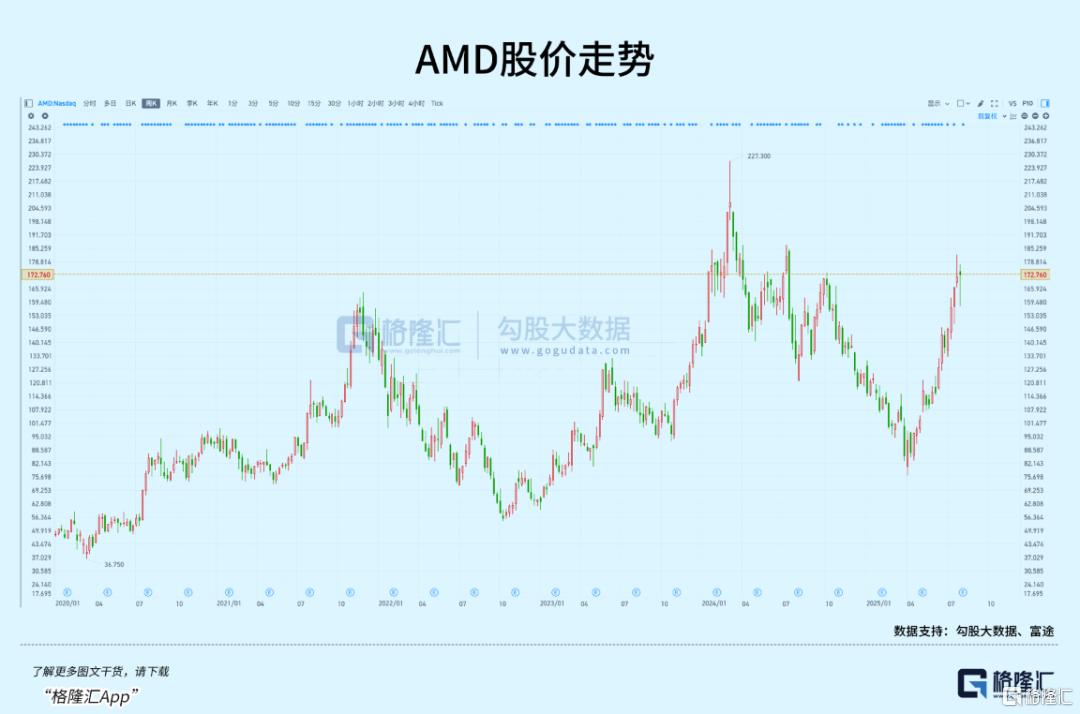
Core Viewpoint - AMD is facing significant challenges in the AI chip market, primarily due to supply chain constraints and competition from NVIDIA, despite recent stock price recovery and product launches [1][3][12]. Group 1: AMD's Product Developments - AMD's MI300 series was launched in December 2023, featuring memory 2.4 times that of NVIDIA's H100 and memory bandwidth 1.6 times higher, positioning it as a strong competitor in the AI chip market [3]. - The MI325X chip, intended to compete with NVIDIA's H200, is expected to start production in Q4 2024, but faces competition from NVIDIA's B200 [7][8]. - The MI350 series, released in June, utilizes TSMC's 3nm process and integrates 1,850 billion transistors, with a performance capability of 20 PFLOPS, significantly enhancing AMD's competitive stance [17][24]. Group 2: Market Performance and Stock Movements - AMD's stock price rebounded from a low of $76.48 in April to over $170, a rise of more than 100%, driven by the MI350 series launch and expectations of increased market share in server CPUs [12][15]. - Despite the stock price increase, AMD's sales expectations for the MI300 series remain below market expectations, primarily due to supply chain limitations rather than demand [6][21]. Group 3: Competitive Landscape - NVIDIA's dominance in the AI chip market is underscored by its significant market share and superior product performance, with NVIDIA's data center revenue growing by 154% compared to AMD's 14% [24]. - AMD's market share in the server market has increased from 2% to 36.5% over eight years, but it still lags behind NVIDIA in overall revenue and profitability [12][24]. - The software ecosystem remains a critical disadvantage for AMD, with NVIDIA's CUDA framework covering over 90% of AI developers, while AMD's ROCm7 lacks the same level of community support and optimization [27]. Group 4: Future Outlook - The upcoming MI400 series aims to compete directly with NVIDIA's DGX SuperPod ecosystem, with significant investments in AI infrastructure expected from major tech companies [19][20]. - AMD's strategy focuses on being a viable alternative in the AI chip market, with the belief that the market can support multiple players, rather than solely aiming to defeat NVIDIA [30].