未成年人网游充值退款

Search documents
男孩半年充值游戏超2万余元 未成年人网游过度充值何解
Ren Min Ri Bao· 2026-01-16 02:57
Core Viewpoint - A recent case in Henan highlights the issue of minors making unauthorized in-game purchases, leading to a civil lawsuit where the court ruled that the minor's actions were invalid due to lack of parental consent, but also noted the mother's failure in supervision, resulting in a partial refund of the funds [1][2]. Group 1: Legal Framework and Consumer Rights - According to the Civil Code, minors over eight years old have limited civil capacity, requiring parental consent for significant legal actions, which was not present in this case [2]. - The court determined that the minor's actions were not suitable for his age and intellect, thus invalidating the transactions and mandating the return of funds obtained through these invalid actions [2]. Group 2: Platform Responsibilities - Gaming platforms are urged to take social responsibility by improving complaint handling processes and refund services for parents seeking to recover funds spent by minors without consent [3]. - Platforms should enhance identity verification measures to prevent minors from using adult accounts for gaming and purchases, in compliance with national anti-addiction policies [3]. - There is a need for stricter management of payment processes, including clearer warnings and limits on transaction amounts for accounts suspected to be operated by minors [3]. Group 3: Parental Guidance and Education - Parents are encouraged to monitor and guide minors' internet usage, fostering healthy interests and responsible spending habits [4]. - It is advised that parents securely manage their devices and payment information, and regularly check transaction records to identify any unusual activities [4]. - In cases of unauthorized purchases, parents should collect evidence and communicate with gaming companies to assert their claims, utilizing consumer protection platforms if necessary [5].
合力破解未成年人网游过度充值问题
Ren Min Ri Bao· 2026-01-14 04:18
Core Viewpoint - The case of an 11-year-old boy in Henan who charged over 20,000 yuan to his mother's game account without consent highlights the issue of minors making unauthorized in-game purchases, leading to a civil lawsuit and a court ruling that partially returned the funds due to the mother's lack of supervision [1][2]. Group 1: Legal Framework and Court Ruling - According to the Civil Code, minors over eight years old have limited civil capacity and require parental consent for legal actions, which was not provided in this case [2]. - The court ruled that the boy's actions were invalid due to lack of consent, but also noted the mother's failure in supervision, resulting in a decision to return half of the charged amount [1][2]. Group 2: Industry Response and Recommendations - The China Consumer Association emphasizes the need for gaming platforms to take social responsibility by improving complaint handling, refund processes, and customer service to address unauthorized charges by minors [3]. - Platforms should enhance identity verification and implement stricter measures to prevent minors from using adult accounts for gaming and purchases [3]. - It is recommended that gaming companies manage payment processes more effectively, including setting clear alerts and limits on transactions that appear to be made by minors [3]. Group 3: Parental Guidance and Consumer Education - Parents are advised to monitor and guide their children's online activities and spending habits, fostering a healthy understanding of consumption [4]. - It is crucial for parents to secure their devices and payment information, and to regularly check transaction records for any unusual activity [4]. - In cases of unauthorized charges, parents should collect evidence and communicate with gaming companies to resolve disputes, utilizing consumer protection platforms if necessary [5].
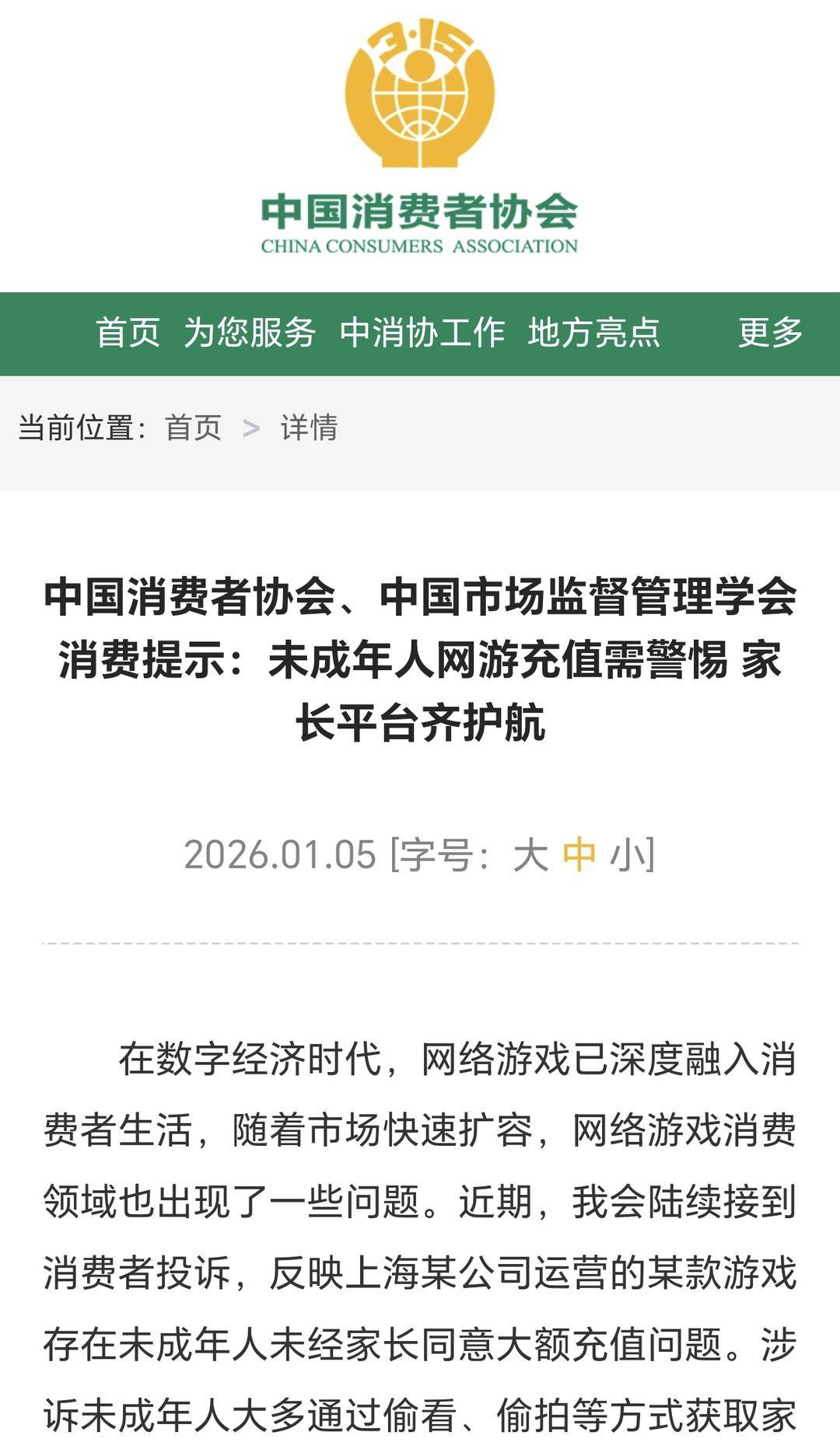
未成年人网游充值平均涉诉2551.57元,中消协等提醒家长平台齐护航
Yang Zi Wan Bao Wang· 2026-01-05 14:08
Core Viewpoint - Recent complaints received by the China Consumers Association (CCA) highlight issues regarding minors making large in-game purchases without parental consent, raising concerns about consumer protection and the responsibilities of gaming platforms [5][7]. Group 1: Consumer Complaints and Legal Cases - The CCA has reported that a significant number of minors have accessed their parents' payment information to make unauthorized in-game purchases, with an average complaint amount of 2,551.57 yuan from August 1, 2025, to December 10, 2025 [5]. - An 11-year-old boy in Henan used his mother's WeChat account to recharge over 20,000 yuan for gaming without her consent, leading to a civil lawsuit where the court ruled the transactions invalid but held the mother partially responsible for inadequate supervision [7]. Group 2: Recommendations for Gaming Platforms - The CCA emphasizes that gaming platforms should actively address consumer complaints and enhance their social responsibility [8]. - Platforms are urged to implement stricter identity verification measures to prevent minors from misusing adult accounts and to improve payment management by setting clear reminders and limits on recharge amounts [8]. Group 3: Parental Responsibilities - Parents are reminded to manage their children's gaming time and to secure their payment information to prevent unauthorized access [8]. - In cases of unauthorized large purchases by minors, parents should collect evidence such as transaction records and communication logs to support their claims for refunds [8].

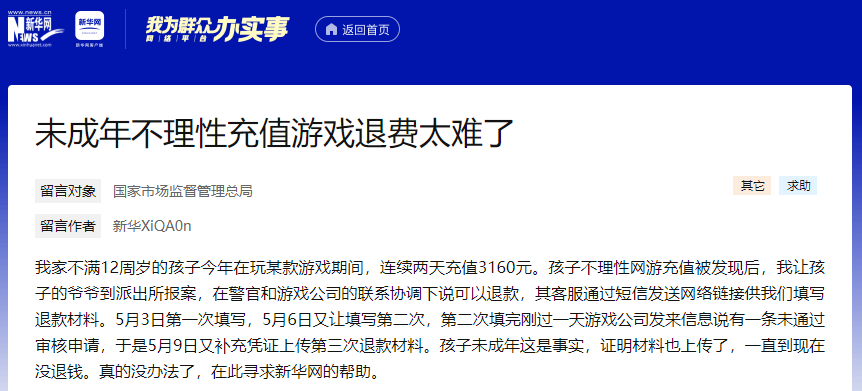
我为群众办实事|未成年人网游“氪金”退款难困局如何破解
Xin Hua Wang· 2025-06-17 00:31
Core Viewpoint - The issue of minors excessively spending on online games and the difficulties in obtaining refunds has become a focal point of social concern, with numerous complaints from parents regarding their children's unauthorized in-game purchases [1][3][5]. Group 1: Refund Challenges - Many parents report difficulties in obtaining refunds for unauthorized charges made by their children, with some cases involving significant amounts, such as over 40,000 yuan [3]. - The refund process is complicated by the need to prove that the charges were made by minors, as accounts are often registered under adults' names, making it challenging to establish responsibility [5][6]. - Legal experts suggest that the responsibility for refunds may be shared between game companies and parents, with a proposed liability ratio of 30%-70% based on the effectiveness of anti-addiction measures [4][6]. Group 2: Regulatory Framework - The National Press and Publication Administration has implemented regulations limiting the amount minors can spend on games, with specific caps based on age [4]. - New regulations set to take effect in 2024 will further clarify the responsibilities of game service providers and guardians regarding minors' online spending [4][8]. - The Chinese Internet Association has proposed standards for managing minors' online game consumption, emphasizing the need for clear accountability among all parties involved [4][7]. Group 3: Technological Solutions - Some leading gaming companies are developing technologies such as facial recognition and AI to better identify and manage minor users, creating a comprehensive protective system [8]. - However, the implementation of such technologies is often limited to larger companies due to the high costs associated with data protection and technology development [8][9]. - Experts emphasize the importance of collaboration among families, schools, and regulatory bodies to create a supportive environment for minors and mitigate excessive spending on games [9].