极端通勤

Search documents
20万打工人一年花52天在路上,全国超400万人跨城通勤
Xin Lang Cai Jing· 2025-12-30 00:30
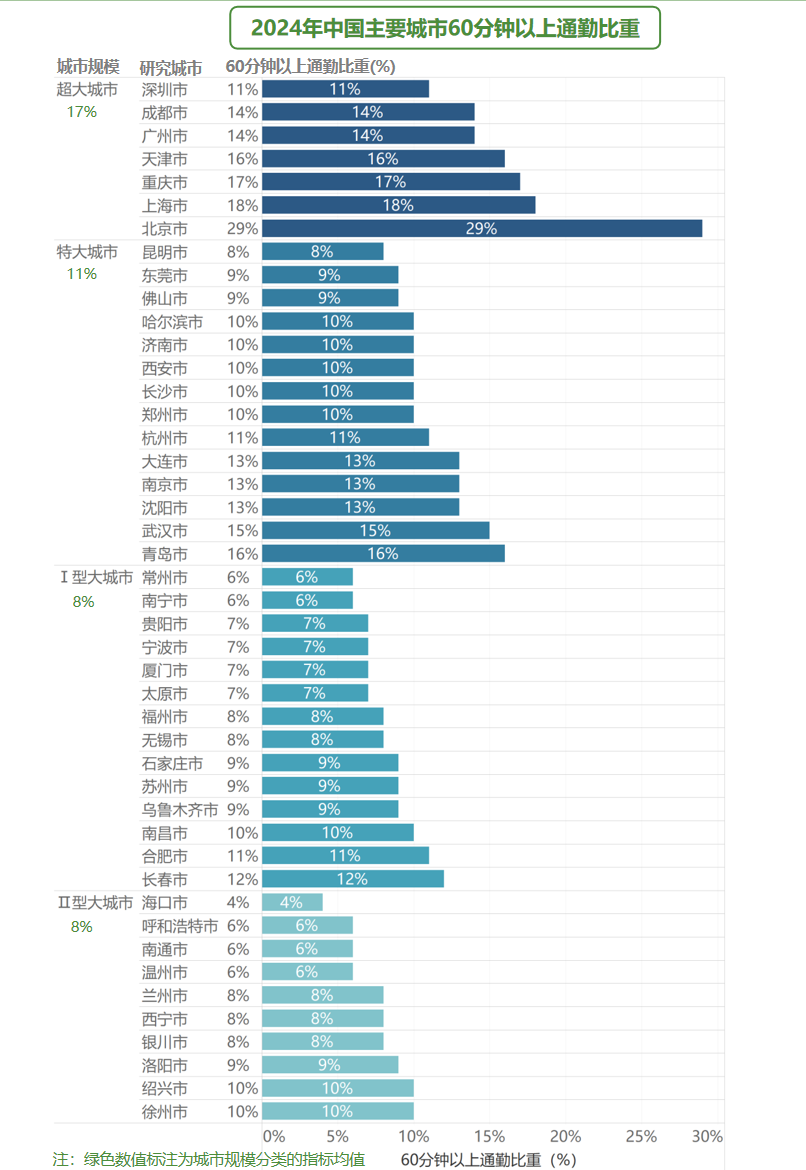
Core Insights - The report indicates that the commuting radius in major Chinese cities has increased by 1-3 kilometers over the past five years, with Beijing, Shanghai, and Chongqing having the largest commuting radius at 42 kilometers each [1] - The phenomenon of "extreme commuting" is particularly pronounced in Beijing, where approximately 30% of commuters spend over 60 minutes commuting, the highest in the country [1] - The report highlights the trend of population and economic concentration around urban clusters and metropolitan areas, leading to a significant number of commuters living far from their workplaces, with about 4% of commuters in 22 major cities commuting across city borders [1] Commuting Patterns - The number of commuters who need to travel across cities exceeds 4 million, with 10% of these commuters averaging a one-way distance of over 50 kilometers and taking about 153 minutes [1] - Among these long-distance commuters, approximately 200,000 are from major cities like Beijing, Shanghai, Guangzhou, and Shenzhen, spending an estimated 52 days and traveling 30,000 kilometers annually on their commutes [1] Future Projections - In 2024, the proportion of extreme commuters in Beijing is expected to increase by 1 percentage point to 29%, while the average one-way commuting time is projected to rise by 1 minute to 47 minutes after three years of improvement or stability [1]
全国超400万“打工人”跨城通勤,北上广深约20万人一年52天在路上
Di Yi Cai Jing· 2025-12-29 02:59
Core Insights - The report highlights that in 2024, the average proportion of commuters in major Chinese cities who can commute within 45 minutes is 77%, with significant improvements in commuting convenience over the past few years [1][4]. Group 1: Commuting Trends - Major cities in China have seen a 50% increase in new rail transit mileage from 2020 to 2024, totaling 3,700 kilometers, with 48% of commuters in these cities able to reach their destinations within 45 minutes using metro or bus [3][4]. - The commuting radius in major cities has increased by 1-3 kilometers over the past five years, with Beijing, Shanghai, and Chongqing having the largest commuting radius at 42 kilometers [1][9]. - The phenomenon of "extreme commuting," defined as commutes over 60 minutes, has been increasing, with Beijing having the highest proportion of such commuters at 29% in 2024 [7][9]. Group 2: Infrastructure and Coverage - The report indicates that the proportion of commuters benefiting from rail coverage has increased from 15% in 2020 to 21% in 2024, with super-large cities reaching 30% [4][5]. - Despite the increase in rail mileage, the marginal effect on commuter coverage has diminished, with only a 6 percentage point increase in rail coverage commuting over five years [5][15]. - Cities like Guiyang have shown significant improvements in rail coverage commuting, with a 21 percentage point increase over five years, while cities like Shenzhen and Xi'an have also seen substantial growth [5][10]. Group 3: Intercity Commuting - Approximately 4% of commuters in 22 super-large cities engage in intercity commuting, totaling over 4 million individuals, with the Guangdong-Hong Kong-Macau Greater Bay Area having the most significant intercity commuting connections [11][12]. - The average commuting distance for intercity commuters is 25 kilometers, with a notable 10% commuting between city centers averaging 52.6 kilometers and taking 153 minutes [12][14]. - The report emphasizes the need for improved infrastructure investment to support the expected growth of urban agglomerations, with projections indicating the formation of around 30 super-large urban circles by 2035 [2][15].

为什么你越上班越穷?答案就在通勤时间上
洞见· 2025-10-22 12:35
Core Insights - The article discusses the challenges and consequences of extreme commuting, highlighting how long commutes can lead to a cycle of fatigue, decreased motivation, and ultimately hinder financial and personal growth [12][19][26] Group 1: Commuting Experiences - A man from Zhangjiakou commutes over 400 kilometers daily to work in Beijing, spending more than six hours on the road each day for over two years [4] - Many workers face similar situations, with long commutes draining their energy and affecting their quality of life [8][10] - A report indicates that over 10 million workers in 36 major Chinese cities have a one-way commute exceeding one hour [9] Group 2: Psychological and Economic Impacts - Research shows that individuals commuting over 1.5 hours daily experience a 30% slower income growth compared to those with shorter commutes [12] - Long commutes can lead to increased anxiety and a sense of helplessness, making individuals less likely to pursue new opportunities or improve their skills [16][17] - The cycle of long commutes can result in a negative feedback loop where workers become increasingly disengaged and less productive [17] Group 3: Strategies for Improvement - The article suggests that individuals should consider the total cost of commuting, including time and opportunity costs, rather than just focusing on rent savings [20][21] - Investing time in personal development during commutes can transform this time into a growth opportunity, as demonstrated by a colleague who learned English during his commute [23][24] - The key to breaking the cycle of extreme commuting is to prioritize personal growth and skill development, which can lead to better job opportunities and financial stability [26][27]