极致能效

Search documents
经济日报:钢铁业主攻极致能效
Jing Ji Ri Bao· 2026-02-06 00:17
Core Viewpoint - The steel industry is a crucial sector for the national economy, facing significant pressure from market, environmental, and cost factors, and is actively pursuing energy efficiency and carbon reduction initiatives to align with national carbon neutrality goals [1][3][7]. Group 1: Energy Efficiency and Carbon Reduction Initiatives - The "Extreme Energy Efficiency Project" was launched in December 2022, aiming to achieve energy savings of over 24 million tons of standard coal and reduce carbon dioxide emissions by 60 million tons, exceeding initial targets [1]. - The steel industry heavily relies on coal and coke, which account for over 90% of energy inputs, contributing to high carbon emissions. The core technical pathway for carbon reduction before 2030 focuses on systematic energy efficiency improvements, which hold a potential 15% reduction in carbon emissions [2]. - By 2025, over 50 demonstration enterprises are expected to invest a total of 40.9 billion yuan, with an average investment of 700 million yuan per enterprise, leading to a reduction in energy costs by 29 yuan per ton of steel [3]. Group 2: Technological Innovation and Application - Technological innovation is essential for addressing the "high carbon lock-in" challenge in the steel industry, with a focus on promoting advanced energy-saving and carbon-reducing technologies [5]. - The "Extreme Energy Efficiency Capability List (2025 Edition)" has been released, expanding to cover 134 technologies across seven categories, emphasizing full-process energy efficiency and results transformation [5]. - The implementation of intelligent management systems has led to significant reductions in energy loss, with one case reporting a 30-degree Celsius decrease in temperature drop at the iron-steel interface, resulting in annual savings of 9,580 tons of standard coal and a reduction of 25,500 tons of carbon dioxide [6]. Group 3: Collaborative Efforts and Future Directions - The steel industry will be included in the national carbon emissions trading market by 2025, introducing dual constraints on total carbon emissions and carbon intensity, which will guide the industry's energy consumption control strategies [7]. - Future evaluations of extreme energy efficiency will shift from focusing solely on individual process energy consumption to a comprehensive evaluation system integrating carbon control [7]. - The China Iron and Steel Association (CISA) plans to enhance collaboration among enterprises, universities, and research institutions to address technological challenges and promote joint research efforts [8].
钢铁业主攻极致能效
Jing Ji Ri Bao· 2026-02-03 22:19
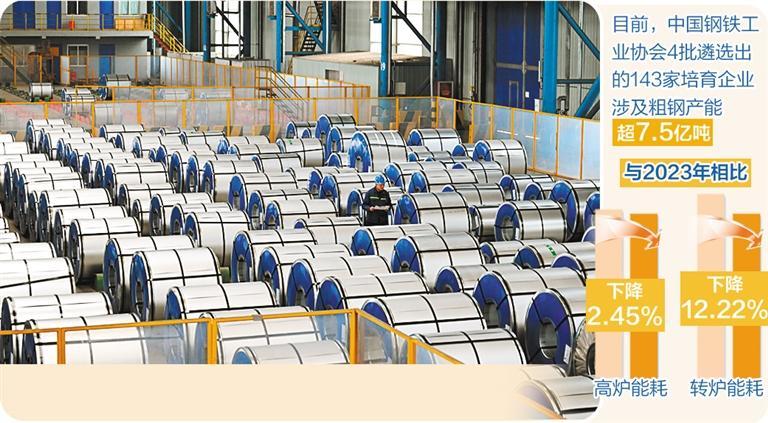
Core Viewpoint - The steel industry is undergoing a significant transformation towards energy efficiency and carbon reduction, with the implementation of the "Extreme Energy Efficiency Project" aimed at achieving substantial energy savings and CO2 emissions reductions by 2025 [2][3][4]. Group 1: Energy Efficiency and Carbon Reduction Achievements - The steel industry has achieved energy savings exceeding 24 million tons of standard coal and reduced CO2 emissions by 60 million tons, surpassing the targets set in the energy-saving and carbon reduction action plan [2]. - As of now, 143 selected enterprises have a crude steel capacity of over 750 million tons, with energy consumption in blast furnaces and converters decreasing by 2.45% and 12.22% respectively compared to 2023, resulting in cumulative energy savings of 13.2 million tons of standard coal and a reduction of 34 million tons of CO2 [3]. Group 2: Cost Reduction and Efficiency Improvement - The steel industry is facing multiple pressures, leading companies to focus on extreme energy efficiency, resulting in significant cost reductions. For instance, Jiangyin Xingcheng Special Steel achieved annual cost savings of 136 million yuan by reducing energy consumption [4]. - Over 50 demonstration enterprises have invested a total of 40.9 billion yuan over three years, with an average investment of 700 million yuan per enterprise, leading to a reduction in energy costs of 29 yuan per ton of steel and an average payback period of 3.27 years [4]. Group 3: Technological Innovation and Application - Technological innovation is crucial for addressing the high carbon emissions in the steel industry, with the "Extreme Energy Efficiency Project" providing a technology list that includes 134 advanced technologies across various processes [6]. - The implementation of intelligent management systems has led to a reduction in temperature drop at the iron-steel interface, resulting in significant energy savings. For example, Baowu Steel's system reduced temperature drop by 30 degrees Celsius, saving 9,580 tons of standard coal annually [7]. Group 4: Future Directions and Collaborative Efforts - The steel industry will be included in the national carbon emissions trading market by 2025, indicating a shift towards dual control of carbon emissions in terms of total volume and intensity [8]. - The focus will shift from single-process energy efficiency to a comprehensive evaluation system integrating carbon control, emphasizing system integration and digital twin technologies [8][9]. - The China Iron and Steel Association (CISA) plans to promote collaborative innovation among enterprises, universities, and research institutions to address technological challenges and enhance the industry's carbon neutrality efforts [9][10].

我国钢铁产业驶入“新质赛道” 95.1%钢企持续实施数智化改造升级
Yang Shi Xin Wen· 2025-08-08 06:14
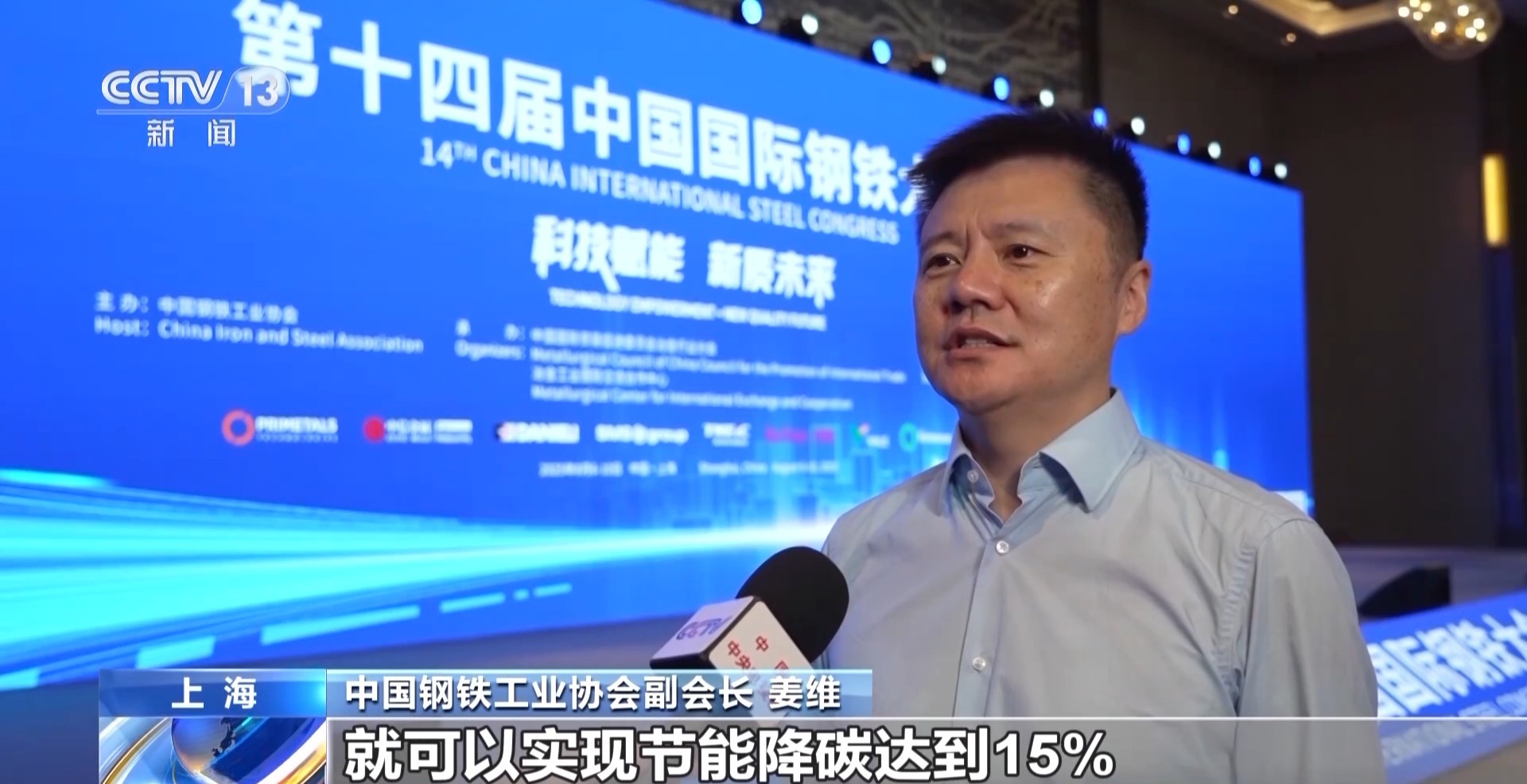
Core Insights - The 14th China International Steel Conference highlighted the acceleration of intelligent manufacturing and green low-carbon initiatives in the steel industry, with "new quality productivity" as a central theme [1] Digital Transformation - 95.1% of steel enterprises in China have integrated digital transformation strategies into their overall development processes, focusing on smart upgrades [1] - The application of digital technologies in energy-saving within the steel sector can achieve a carbon reduction of 15% [3] Energy Efficiency and Emission Standards - 117 steel enterprises, representing approximately 660 million tons of capacity, are participating in the "dual carbon" best practice energy efficiency benchmark demonstration [3] - China has established the world's strictest ultra-low emission standards, with some indicators being ten times stricter than the average in developed economies [3][6] Implementation of Smart Technologies - The density of robotic and unmanned equipment application has reached 65 units per 10,000 people [4] - 82.9% of enterprises have established intelligent centralized control centers, and 63.4% are using 3D visualization simulation systems to build digital factories [4] Low-Carbon Revolution - By 2024, the steel industry is expected to achieve total energy savings of 10.5 million tons of standard coal, equivalent to a reduction of approximately 27.5 million tons of CO2 emissions, or the carbon absorption capacity of 570 million trees annually [6] - The first ultra-low emission blue paper for the steel industry was released, indicating a significant transformation towards low-carbon practices [6] Future Goals and Investments - By 2025, 80% of total capacity is targeted for ultra-low emission upgrades, adhering to the strictest pollution discharge standards [8] - The steel industry has already invested over 300 billion RMB specifically for ultra-low emission upgrades [8] Environmental Performance - The emission intensity of the steel industry has decreased by over 50% compared to 2018, achieving international leading environmental performance [9]