
标准宇宙学模型

Search documents
“暗能量巡天”项目发布观测数据集
Ke Ji Ri Bao· 2026-01-29 01:27
Core Insights - The Dark Energy Survey (DES) team has released its first complete dataset after six years of observations, covering 758 nights from 2013 to 2019, which provides a significant foundation for global physicists studying dark energy and cosmic evolution [1][2] - The dataset includes information on 669 million galaxies located billions of light-years away, making it one of the most comprehensive dark energy observation programs to date [1] - The analysis integrates four independent dark energy research methods, enhancing the constraints on dark energy effects by a factor of two, which is a crucial step in understanding this dominant force in the universe [1] Summary by Sections Dataset Release - The DES has made its complete observational dataset publicly available, marking a significant milestone in dark energy research [1] - The dataset encompasses observations from 758 nights, covering 1/8 of the sky [1] Research Methods - The project employs a 570-million-pixel dark energy camera (DECam) for extensive deep-sky surveys [1] - Four independent methods are combined: baryon acoustic oscillations, Type Ia supernovae, galaxy cluster measurements, and weak gravitational lensing [1] Theoretical Implications - The latest analysis narrows the range of viable theoretical models, aligning more closely with the widely accepted standard model in cosmology [2] - There remains a discrepancy between DES measurements of galaxy clusters and predictions from the standard model, although the statistical significance of this discrepancy has not reached a level to overturn the current cosmological model [2] - Future efforts will focus on integrating DES results with other dark energy experiments to test alternative gravity theories and dark energy models [2]
“暗能量巡天”项目发布观测数据集 6年信息涵盖1/8的天空
Ke Ji Ri Bao· 2026-01-29 00:59
Core Insights - The Dark Energy Survey (DES) team has released its first complete dataset after six years of observations, covering 758 nights from 2013 to 2019, which provides a significant foundation for global physicists studying dark energy and cosmic evolution [1][2] - The dataset includes information on 669 million galaxies located billions of light-years away, making it one of the most comprehensive dark energy observation programs to date [1] - The analysis integrates four independent dark energy research methods, enhancing the constraints on dark energy effects by a factor of two, which is a crucial step in understanding this mysterious force that dominates the universe [1][2] Summary by Sections - **Dataset Release**: The DES has made its complete observational dataset available, which includes extensive data from a wide-field survey using a 570-megapixel camera [1] - **Research Objectives**: The project aims to provide precise theoretical constraints on the physical nature of dark energy through deep space observations [2] - **Theoretical Implications**: The latest analysis narrows the range of viable theoretical models, aligning more closely with the widely adopted standard model in cosmology, although discrepancies remain regarding the measurement of galaxy clusters [2] - **Future Directions**: The team plans to combine DES results with other dark energy experiments to test alternative gravity theories and dark energy models [2]
宇宙可能不是想象的那么“匀称”
Huan Qiu Wang Zi Xun· 2025-12-29 01:27
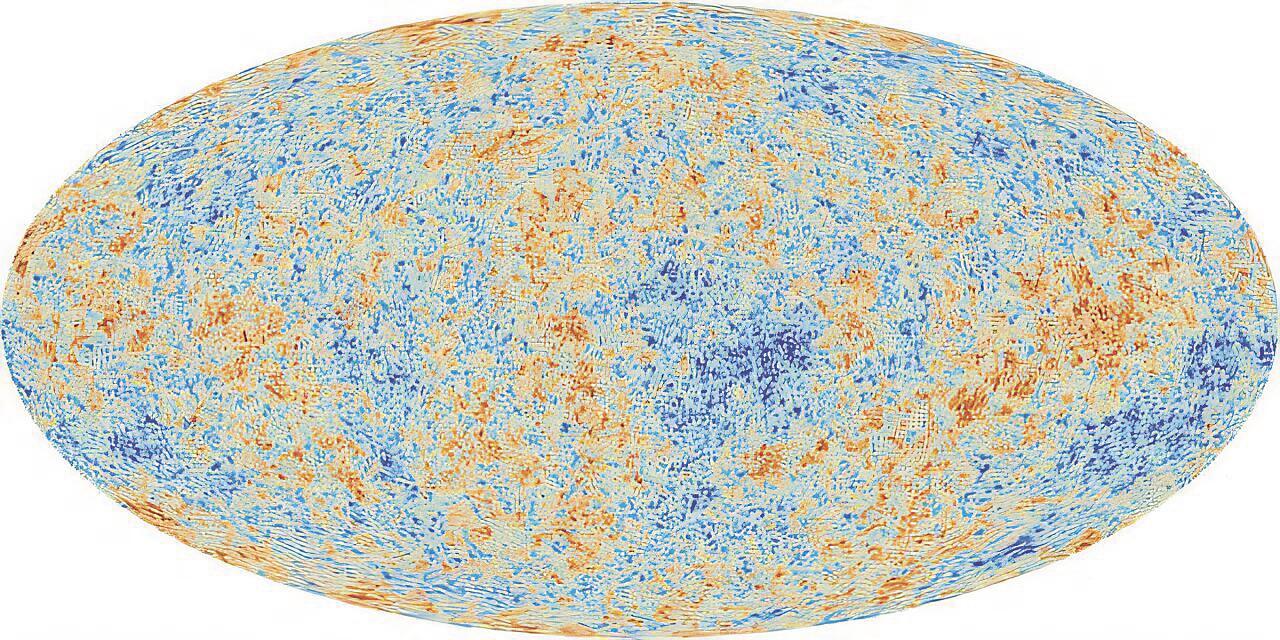
Core Findings - An international research team has published a review article in "Modern Physics Reviews," revealing that the universe may not be as uniform as previously thought, suggesting it could be "skewed" like a balloon that has been pressed on one side [1][3]. Group 1: Theoretical Implications - The discovery challenges the widely accepted "standard cosmological model," which is based on the belief that the universe should appear similar in all directions and locations, akin to a perfectly uniform cake batter [3]. - Scientists have identified a contradiction known as the "cosmic dipole anomaly," which relates to the slight temperature variations in the cosmic microwave background radiation, a remnant from the Big Bang [3][4]. Group 2: Observational Evidence - Observations of distant galaxies have shown a "skewed" distribution that does not align with the expected patterns based on the temperature variations of the cosmic microwave background, indicating a significant discrepancy [4]. - The consistency of results from various instruments, including ground-based radio telescopes and space satellites, strengthens the validity of these findings and reduces the likelihood of instrument error [4]. Group 3: Future Research Directions - Upcoming projects, such as the Euclid satellite and the Vera C. Rubin Observatory, are expected to provide clearer "cosmic panoramas," which may help resolve whether the universe is a regular sphere or has a more complex shape that is not yet understood [4].

“宇宙大片”看到了什么(科技大观)
Ren Min Wang· 2025-09-25 22:53
Core Insights - The COSMOS-Web project has created the largest deep-space cosmic map to date, marking the positions, speeds, and evolutionary histories of nearly 800,000 galaxies over a time span of 13.5 billion years, covering 98% of the universe's evolution history [1][4] Group 1: Project Overview - COSMOS-Web is based on data from the James Webb Space Telescope (JWST) and represents a significant advancement in cosmic mapping, providing unprecedented insights into galaxy formation and evolution [1][3] - The project involved a total observation time of 255 hours, making it the longest single project in JWST's first year, with data exceeding 1.5TB [2] Group 2: Technological Advancements - JWST's revolutionary infrared observation capabilities distinguish it from its predecessor, the Hubble Space Telescope, allowing it to observe wavelengths from 0.6 to 28 micrometers, thus enabling the study of earlier cosmic evolution stages [3] - The larger primary mirror of JWST, approximately six times that of Hubble, enhances its light-gathering ability and sensitivity, allowing it to detect fainter and more distant celestial bodies [3] Group 3: Key Discoveries - The project revealed an unexpectedly high number of galaxies in the early universe, with actual counts being about ten times higher than predictions based on Hubble data, challenging existing cosmological models [4] - The existence of supermassive black holes in the early universe, which were thought to take billions of years to form, was also confirmed, suggesting a need to rethink the relationship between galaxies and black holes [4] - These findings pose significant challenges to current cosmological theories, indicating potential unknown physical processes or the need for fundamental revisions in understanding dark matter and early universe physics [4]