
桥梁材料创新

Search documents
穿山越江又跨海!中国桥“上新”了哪些黑科技→
Xin Lang Cai Jing· 2025-12-20 00:32
Core Viewpoint - China's bridge construction technology has achieved world-leading standards, with recent projects continuously setting new records in terms of scale and innovation [3][5]. Group 1: Structural Innovation - The Hubei Yanjing Yangtze River Bridge employs a unique "four main cable system" to address challenges related to large spans and aviation height restrictions, showcasing advancements in bridge design [5]. - New breakthroughs in bridge structures focus on enhancing span, adapting to complex environments, and optimizing performance, with innovations in beam and arch bridge designs [5][6]. - The Jiangsu Changtai Yangtze River Bridge, set to open in September 2025, features a hybrid "steel-concrete" structure that sets a new world record for cable-stayed bridge spans [6]. Group 2: Material Innovation - Innovations in materials include lightweight saddle designs that improve performance by over 30%, high-strength cables that are corrosion-resistant, and green concrete that reduces costs by approximately 30 yuan per cubic meter [7]. - The use of high-performance composite materials and environmentally friendly materials is becoming essential to meet the demands of large-span and long-lifespan bridges [7][8]. - The Guizhou Huajiang Gorge Bridge incorporates advanced materials to enhance safety and durability, including basalt fiber for fire resistance [8]. Group 3: Equipment Innovation - The construction of modern bridges is increasingly reliant on advanced equipment, which drives industrialization, intelligence, and green transformation in bridge building [9][10]. - Innovations in construction equipment, such as integrated intelligent tower machines and modular bridge assembly systems, have significantly improved construction efficiency [10][11]. - Future trends in bridge equipment include the development of next-generation super equipment for extreme environments, deeper integration of AI and IoT technologies, and modular design for rapid assembly [11].

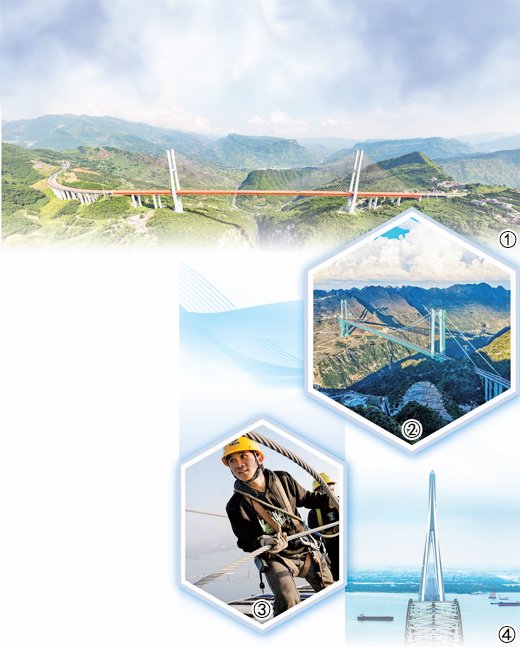
穿山越江又跨海,大桥“上新”黑科技(瞰前沿)
Ren Min Ri Bao· 2025-12-19 22:10
Core Viewpoint - China's bridge construction capabilities are rapidly advancing, with recent projects setting world records and showcasing innovative technologies that enhance structural performance and efficiency [2]. Group 1: Structural Innovation - The Hubei Yanjing Yangtze River Bridge employs a unique "different sag four main cable system" to address challenges related to large spans and aviation height restrictions, demonstrating significant structural innovation [4]. - New breakthroughs in bridge structures focus on enhancing span, adapting to complex environments, and optimizing load performance, with advancements in beam and arch bridge designs [4]. - The Jiangsu Changtai Yangtze River Bridge, set to open in September 2025, features a hybrid "steel-concrete" structure that sets a new world record for cable-stayed bridge spans [5]. Group 2: Material Innovation - Innovations in materials include lightweight saddle designs that improve performance by over 30%, high-strength cables that are corrosion-resistant, and green concrete that reduces costs by approximately 30 yuan per cubic meter [6]. - The use of high-performance composite materials and environmentally friendly materials is becoming essential for meeting the mechanical and durability requirements of large-span bridges [6]. - The Guizhou Huajiang Gorge Bridge incorporates advanced materials to achieve both lightweight and high strength, significantly enhancing its structural capabilities [6][7]. Group 3: Equipment Innovation - Modern bridge construction is increasingly reliant on advanced equipment, with innovations leading to industrialization, automation, and environmentally friendly practices [9]. - The use of integrated intelligent construction machines has doubled construction efficiency, while modular designs allow for rapid assembly and adaptability to various construction scenarios [10]. - Future trends in bridge equipment include the development of next-generation super equipment capable of withstanding extreme environmental conditions and the integration of AI and IoT technologies for automated control and real-time monitoring [10].
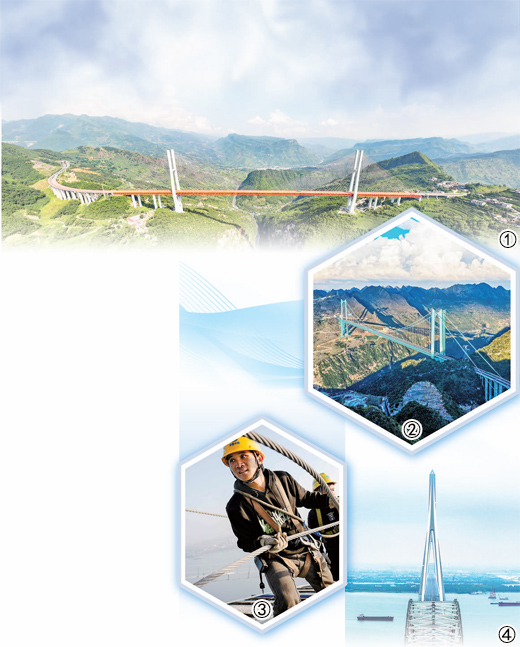
中国桥梁工程规模和技术水平持续提升 穿山越江又跨海,大桥“上新”黑科技(瞰前沿)
Ren Min Ri Bao· 2025-12-19 22:02
Core Viewpoint - China's bridge construction capabilities are advancing rapidly, utilizing innovative technologies and materials to achieve world-leading standards in engineering and design [1][3]. Structural Innovation - The Hubei Yanjing Yangtze River Bridge features a unique "four-cable system" that overcomes challenges related to large spans and aviation height restrictions, showcasing advancements in bridge structure design [3]. - New breakthroughs in bridge structures focus on enhancing span, adapting to complex environments, and optimizing load performance, with innovations in beam and arch bridge designs [3][4]. - The Jiangsu Changtai Yangtze River Bridge employs a hybrid "steel-concrete" structure to set a new world record for cable-stayed bridge spans [4]. Material Innovation - Innovations in materials include lightweight saddle designs that improve performance by over 30%, high-strength cables that are corrosion-resistant, and green concrete that reduces costs by approximately 30 yuan per cubic meter [5][6]. - The use of high-performance rock powder as a concrete additive can replace 20% of cement, significantly reducing carbon emissions during construction [6]. Equipment Innovation - The construction of major bridges is supported by advanced equipment, such as customized shield machines and heavy-lift cranes, which enhance construction efficiency and precision [7][8]. - The shift towards industrialized, intelligent, and green construction methods is transforming traditional construction sites into efficient production lines, improving construction speed and reducing land use [8][9]. - Future trends in bridge equipment innovation include developing next-generation super equipment for extreme environments, integrating AI and IoT for automated control, and creating modular solutions for rapid assembly [9].