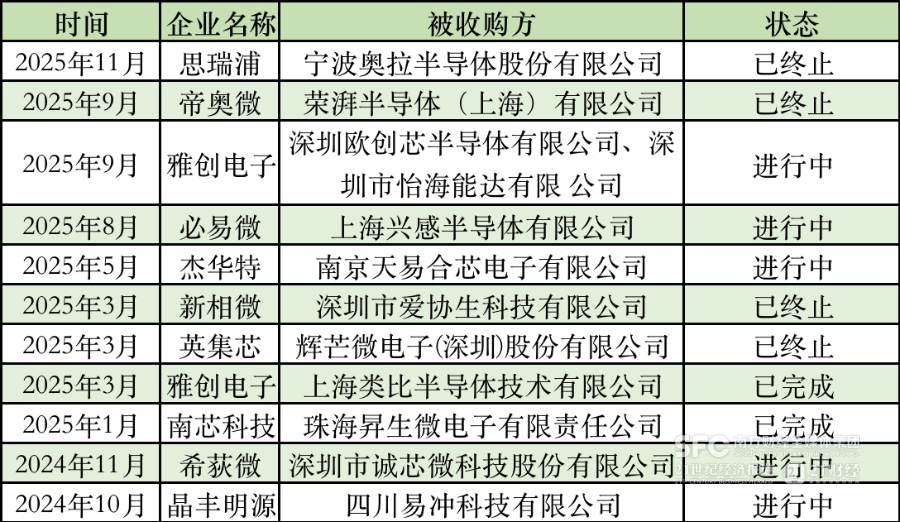
模拟芯片横向并购

Search documents
芯片业两大横向并购案火速终止
2 1 Shi Ji Jing Ji Bao Dao· 2025-12-11 00:41
Core Viewpoint - The recent trend in the semiconductor industry, particularly in the analog chip sector, has seen a surge in mergers and acquisitions (M&A), but several notable deals have been terminated due to disagreements on key terms and conditions [2][9][10]. Group 1: Company Actions - SiRuPu (688536.SH) announced the termination of its major asset restructuring plan, with its stock resuming trading the following day [1]. - DiAoWei (688381.SH) held an investor briefing to announce the termination of its share issuance for asset acquisition, citing a lack of consensus on the transaction terms among parties involved [1][2]. - The timeline for both SiRuPu and DiAoWei's M&A activities was notably short, with SiRuPu's acquisition attempt of Ningbo Aola Semiconductor taking only half a month from initiation to termination, and DiAoWei's acquisition of Rongpai Semiconductor taking just over two months [2]. Group 2: Industry Trends - The analog chip sector has experienced a wave of horizontal consolidation, with companies like Yachuang Electronics (301099.SZ) actively pursuing M&A opportunities [4][6]. - A total of 9 horizontal M&A attempts have been initiated by 8 domestic analog chip manufacturers this year, indicating a robust interest in consolidation within the industry [6]. - The trend of M&A in the analog chip industry is driven by the need to acquire core technologies, R&D teams, and customer resources, which can shorten development cycles and mitigate market risks [7][10]. Group 3: Challenges and Terminations - Several M&A attempts in the analog chip sector have been terminated this year, primarily due to parties failing to reach agreement on key transaction terms [9]. - The reasons for termination include the immaturity of conditions for major asset restructuring and disagreements on transaction pricing and core terms [9][10]. - The current economic cycle and capital market conditions have created challenges for M&A transactions, leading to difficulties in closing deals [9]. Group 4: Future Outlook - Despite the recent terminations, external M&A is still viewed as a critical growth path for analog chip companies, with firms like Xinxiangwei expressing intentions to continue pursuing both organic and external growth strategies [10]. - The global analog chip market is dominated by leaders like Texas Instruments (TI) and Analog Devices (ADI), which have successfully utilized M&A to build comprehensive product lines [12]. - The potential for creating a "Chinese version of TI" exists, as domestic companies seek to enhance their competitiveness through strategic acquisitions [12][13].



芯片业两大横向并购案火速终止
21世纪经济报道· 2025-12-11 00:34
Core Viewpoint - The article discusses the recent trend of horizontal mergers and acquisitions (M&A) in the analog chip industry, highlighting both successful and terminated deals, and the implications for the industry's growth and consolidation [1][3][8]. Group 1: Recent M&A Activity - Sirepu (688536.SH) announced the termination of its major asset restructuring plan on December 9, leading to the resumption of its stock trading [1]. - DiAoWei (688381.SH) also held an investor meeting on the same day to announce the termination of its share purchase agreement for acquiring Rongpai Semiconductor (Shanghai) Co., Ltd. due to disagreements on key terms [1]. - The rapid termination of these M&A deals, particularly in the analog chip sector, reflects challenges in reaching consensus on transaction terms [1][4]. Group 2: Industry Trends - The analog chip sector has seen a surge in M&A activity this year, with companies like Yachuang Electronics (301099.SZ) leading the charge in horizontal acquisitions [3][4]. - A total of nine horizontal M&A attempts have been initiated by eight domestic analog chip manufacturers, including Sirepu, DiAoWei, and Yachuang Electronics [4][6]. - The trend of horizontal consolidation is driven by the industry's characteristics, such as a wide range of products and a dispersed customer base, which necessitate rapid acquisition of technology and resources [6][7]. Group 3: Reasons for Termination of M&A - Several M&A attempts have been terminated this year due to failure to reach agreement on key terms, such as transaction pricing and restructuring plans [7]. - The inability to finalize agreements is a significant reason for the high rate of M&A terminations in the analog chip sector [7]. - Economic adjustments and a cooling capital market have created discrepancies between market valuations and the pricing of M&A deals, complicating the completion of transactions [7]. Group 4: Future Outlook - Despite the challenges, external M&A is still viewed as a critical growth strategy for analog chip companies, with firms like Xinxiangwei indicating a commitment to combining internal growth with external acquisitions [8]. - The article suggests that the analog chip industry could benefit from a consolidation similar to that seen in global leaders like Texas Instruments (TI) and Analog Devices (ADI), which have successfully expanded through strategic acquisitions [10][11]. - There is a recognition that domestic analog chip companies need to enhance their product lines and core capabilities to compete globally, particularly in terms of manufacturing processes and product diversity [12].

两起模拟芯片横向并购案“火速”终止,行业并购潮迎分化拐点
2 1 Shi Ji Jing Ji Bao Dao· 2025-12-10 13:09
Core Viewpoint - The recent trend in the semiconductor industry, particularly in the analog chip sector, shows a surge in horizontal mergers and acquisitions (M&A), but several notable deals have been terminated due to disagreements on key terms and conditions [1][5][6]. Group 1: M&A Activity - SiRuPu (688536.SH) announced the termination of its major asset restructuring plan, leading to the resumption of its stock trading [1] - DiAoWei (688381.SH) held an investor briefing to announce the termination of its share purchase agreement for acquiring RongPai Semiconductor (Shanghai) Co., Ltd., due to a lack of consensus on the transaction terms [1] - A total of 9 horizontal M&A attempts have been initiated by 8 domestic analog chip manufacturers this year, including notable companies like SiRuPu, DiAoWei, and YaChuang Electronics [2][3]. Group 2: Reasons for M&A Termination - The primary reason for the termination of several M&A deals is the inability of the parties involved to reach an agreement on the transaction's core terms, such as pricing and performance commitments [5][6] - SiRuPu cited that the conditions for implementing a major asset restructuring were not fully mature as a reason for its deal's termination [5] - The semiconductor industry has experienced a significant influx of capital over the past decade, leading to inflated valuations, which, combined with economic adjustments, has made M&A transactions more challenging [5][6]. Group 3: Industry Characteristics and Trends - The analog chip industry is characterized by a long product lifecycle, a wide variety of chip types, and a low individual chip value, making it difficult for single companies to cover all product categories through self-research [4][7] - Horizontal M&A is seen as a key growth strategy for analog chip companies, allowing them to quickly acquire core technologies, R&D teams, and customer resources, thereby shortening development cycles and reducing market risks [3][4]. - The global analog chip market is dominated by companies like Texas Instruments (TI) and Analog Devices (ADI), which have successfully built comprehensive product lines through strategic acquisitions [6][7]. Group 4: Future Outlook - Despite the recent terminations, external M&A is still viewed as a crucial growth path for analog chip companies, with firms like Xinxiangwei indicating a commitment to combining organic growth with external development strategies [5][6]. - The Chinese analog chip sector has over 400 design companies, but there is a notable absence of domestically competitive large firms capable of global competition [6][7].