
欧元区经济韧性

Search documents
多空博弈!欧央行维稳非农来袭 突破窗口开启?
Jin Tou Wang· 2026-02-10 03:03
Core Viewpoint - The euro to dollar exchange rate is stabilizing around 1.1899, influenced by the divergence in monetary policies between the ECB and the Fed, the resilience of the Eurozone economy, and key US economic data [1] Group 1: ECB Policy and Economic Resilience - The ECB decided to maintain its key interest rates unchanged, with the deposit facility rate at 2.00%, the main refinancing rate at 2.15%, and the marginal lending rate at 2.40%, marking the fifth consecutive meeting of rate stability since July 2025 [1] - The ECB anticipates inflation to stabilize around the 2% target in the medium term, with expectations of no rate cuts in 2026, providing support for the euro [2] - Eurozone economic indicators show resilience, with a GDP growth of 0.3% quarter-on-quarter in Q3 and an unemployment rate of 6.4%, close to historical lows [2] Group 2: US Economic Data and Market Reactions - Upcoming US economic data, including the delayed January non-farm payrolls (expected to add 70,000 to 85,000 jobs with an unemployment rate of 4.4%) and CPI data, are critical for short-term volatility in the dollar [2] - The Michigan Consumer Sentiment Index rose to 57.3, a six-month high, briefly suppressing the euro but not altering the overall oscillating trend [2] - Concerns over a rebound in US inflation and mixed signals from Fed officials are contributing to increased volatility in the exchange rate [2] Group 3: Technical Analysis - The exchange rate is oscillating around 1.1900, with a current trading range of 1.1897 to 1.1914, and technical indicators show a balanced momentum between bulls and bears [3] - Key support levels are identified at 1.1897, 1.1880, and 1.1850, while resistance levels are at 1.1914, 1.1930, and 1.2000 [3] - The direction of the exchange rate is likely to be influenced by the upcoming non-farm payrolls, CPI data, and subsequent ECB statements [3]
欧元区经济第四季度意外增长0.3%
Xin Lang Cai Jing· 2026-01-30 14:36
Group 1 - The Eurozone economy unexpectedly grew by 0.3% in Q4 2025, surpassing economists' expectations of 0.2% and maintaining the same growth rate as the previous quarter, marking nine consecutive quarters of expansion [1][5] - Spain was highlighted as the standout economy with a growth rate of 0.8% in Q4 2025, according to S&P Global Market Intelligence economist Diego Iscaro [1][5] - Germany and France also exceeded expectations with growth rates of 0.3% and 0.2% respectively in the same quarter [2][6] Group 2 - The European Central Bank (ECB) raised its GDP growth forecast for the year to 1.2%, with expectations to maintain the interest rate at 2% in the upcoming 2026 meeting [2][6] - Germany has emerged from recession, achieving its first growth since 2022, driven by significant government borrowing for infrastructure and defense investments [2][6] - Spain's Prime Minister announced that Spain ended 2025 with a growth rate of 2.8%, double the Eurozone's expected growth rate, and is expected to continue robust growth in 2026 [7] Group 3 - Following the data release, the Euro exchange rate saw minimal changes, declining by 0.5% against the strengthening US dollar, trading at 1.191 USD [3][7] - Market expectations for interest rate changes remained stable, with a 25% probability of a further 25 basis point cut this year [4][7]
经济韧性抵御逆风 欧洲央行第三次“按兵不动”
智通财经网· 2025-10-30 13:43
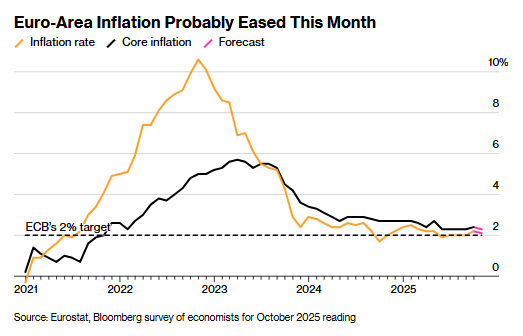
Core Points - The European Central Bank (ECB) decided to keep the key deposit rate unchanged at 2%, marking the third consecutive meeting without a rate change since the last cut in June, when the inflation rate in the Eurozone reached the target of 2% [1] - The ECB stated that inflation remains close to the medium-term target of 2%, and the assessment of the inflation outlook has largely remained unchanged [1] - Despite a challenging global environment, the economy continues to grow, supported by a strong labor market and robust private sector balance sheets [1] - The ECB warned of uncertainties in the outlook, particularly due to ongoing global trade disputes and geopolitical tensions [1] - Eurozone inflation rose slightly to 2.2% in September, primarily driven by an increase in service prices, leading economists to suggest that the ECB is likely to adopt a cautious approach regarding interest rate adjustments [1] Economic Data - Preliminary data showed that the Eurozone's economy grew by 0.2% quarter-on-quarter in the third quarter, which was above expectations and reinforced the ECB's decision to maintain interest rates [3] - The ECB reiterated its approach of making interest rate decisions based on data and meeting-by-meeting assessments [3] - ECB officials indicated that the rate-cutting cycle is nearing its end, with comments suggesting that there is no immediate need to adjust policies unless significant changes occur [3] - A survey conducted in mid-October revealed that the majority of economists expect the ECB to keep the deposit rate unchanged for the remainder of the year, with 57% of surveyed economists predicting that rates will remain stable until the end of 2026 [3]

欧洲央行料继续按兵不动 市场聚焦拉加德释放政策转向信号
Xin Hua Cai Jing· 2025-09-11 08:58
Core Viewpoint - The European Central Bank (ECB) is expected to maintain its key interest rates during the upcoming monetary policy meeting, continuing its pause on rate hikes due to improved economic data from the Eurozone [1][2]. Economic Data - Eurozone GDP grew by 0.1% quarter-on-quarter in Q2, exceeding market expectations and indicating a recovery in economic resilience [1]. - The Harmonized Index of Consumer Prices (HICP) rose by 2.1% year-on-year in August, slightly above the previous value of 2.0% and meeting the ECB's inflation target of 2% [1]. Trade Agreements - Recent trade agreements between the US and Europe provide additional support for the regional economic outlook, helping to alleviate previous downward pressures from external trade uncertainties [1]. Market Expectations - While the current interest rate decision is widely anticipated, market focus has shifted to future policy guidance, with many economists believing the ECB's easing cycle has ended [2]. - The swap market still implies a 25 basis point rate cut within the next 12 months, indicating a divergence between financial market expectations and mainstream economic forecasts [2]. ECB Communication Strategy - ECB President Christine Lagarde is expected to emphasize "enhanced economic resilience" and "reduced external trade uncertainty" in her upcoming press conference [2]. - The ECB management has indicated that further rate cuts would require a significant deterioration in economic prospects or persistent deflation risks, suggesting a cautious approach to future policy adjustments [2].