欧洲对俄能源购买

Search documents
小金毛约翰逊看不下去欧洲伪善,先停止买俄罗斯的能源吧
Sou Hu Cai Jing· 2025-12-13 07:21
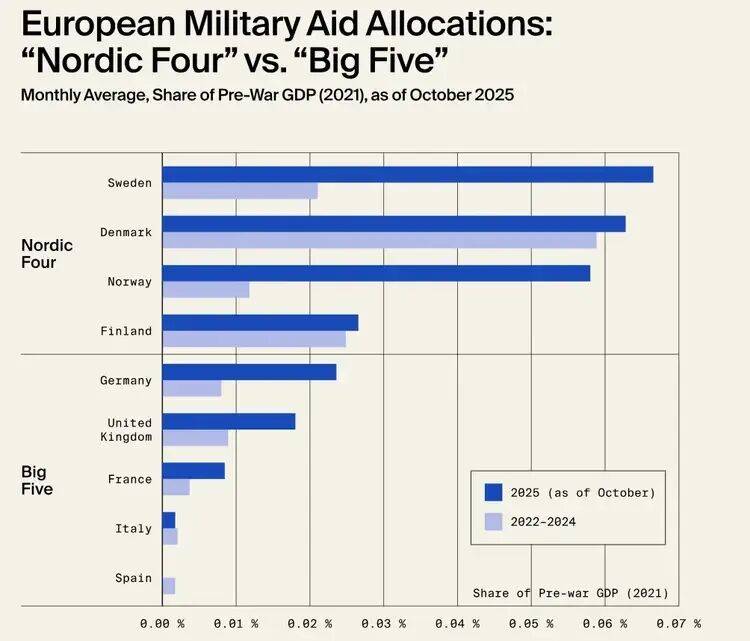
Core Viewpoint - The Kiel Institute for the World Economy reports that European military aid commitments in 2025 will be insufficient to compensate for reductions by the United States, potentially making it the lowest year for Western military aid since the onset of the Russia-Ukraine war [1]. Group 1: Military Aid Commitments - From 2022 to 2024, the average annual military aid commitment to Ukraine was approximately €41.6 billion, while only €32.5 billion has been pledged for 2025 so far, falling short by €9.1 billion to match the previous three years' levels [4]. - The growth in military aid from France, Germany, and the UK is noted, but it remains relatively low compared to Nordic countries, while Southern Europe, particularly Italy and Spain, has seen a reduction in commitments [4]. Group 2: Criticism of European Response - Former UK Prime Minister Boris Johnson criticized the European response to the war, highlighting a "double standard" where Europe complains about U.S. reductions in aid while continuing to purchase Russian energy, which funds the war [4]. - Johnson estimates that Europe is sending approximately $1 billion per month to Putin's war machine through energy purchases, a figure he suggests is conservative as it does not account for oil and gas bought through intermediaries [6]. Group 3: European Security Dynamics - The report emphasizes that Europe has historically relied on strong rhetoric against Russia but lacks the military capability to deter it, despite having an economy ten times larger than Russia's [6]. - The expectation that moral arguments alone can compel Russia to cease its aggression is critiqued, suggesting that Europe must enhance its military strength to regain a strategic advantage [6].