正食症

Search documents
14岁女儿沉迷“干净饮食”,身体却吃不消了:脱发、经期紊乱、晕倒……
Xin Lang Cai Jing· 2025-12-31 06:32
Core Viewpoint - The article highlights the rising concern of "orthorexia," a condition characterized by an unhealthy obsession with healthy eating, particularly among adolescents, leading to severe health issues such as heart damage and eating disorders [3][5]. Group 1: Case Study - A 14-year-old girl, referred to as Xiaoxi, developed orthorexia after being teased about her weight, leading her to adopt extreme dietary restrictions that resulted in significant health problems, including hair loss and fainting due to low blood sugar [1][2]. - After receiving treatment that included cognitive behavioral therapy and nutritional support, Xiaoxi began to relax her strict dietary rules and returned to a more balanced diet [2]. Group 2: Definition and Characteristics - Orthorexia, first introduced by Dr. Steve Bratman in 1997, is defined as a pathological obsession with "pure" and "healthy" foods, differing fundamentally from other eating disorders like anorexia and bulimia, which focus on food quantity or weight [3][5]. - Individuals with orthorexia often create strict dietary rules, avoid certain food groups, and experience anxiety when these rules are broken, leading to a narrow food selection and excessive time spent on meal planning [4][5]. Group 3: Contributing Factors - The article identifies three key factors contributing to the rise of orthorexia among adolescents: 1. **Appearance Anxiety and Social Media Influence**: Adolescents are highly sensitive to body image, and social media promotes extreme dieting as a desirable behavior [7]. 2. **Family Environment**: Parents' overemphasis on health and body image can lead children to associate food control with safety and security [8]. 3. **Psychological Needs**: Adolescents may use food control as a coping mechanism for anxiety related to academic and social pressures, leading to obsessive behaviors [9]. Group 4: Warning Signs and Interventions - Warning signs of orthorexia include increasingly strict dietary rules, avoidance of social gatherings due to dietary restrictions, and physical symptoms such as significant weight loss and fatigue [10][11][12]. - Recommended interventions include empathetic communication, restructuring dietary perceptions to promote variety, reducing exposure to extreme dieting content, and seeking professional help if symptoms persist [13].
警惕青少年陷入“正食症”心理困局
Xin Lang Cai Jing· 2025-12-26 23:07
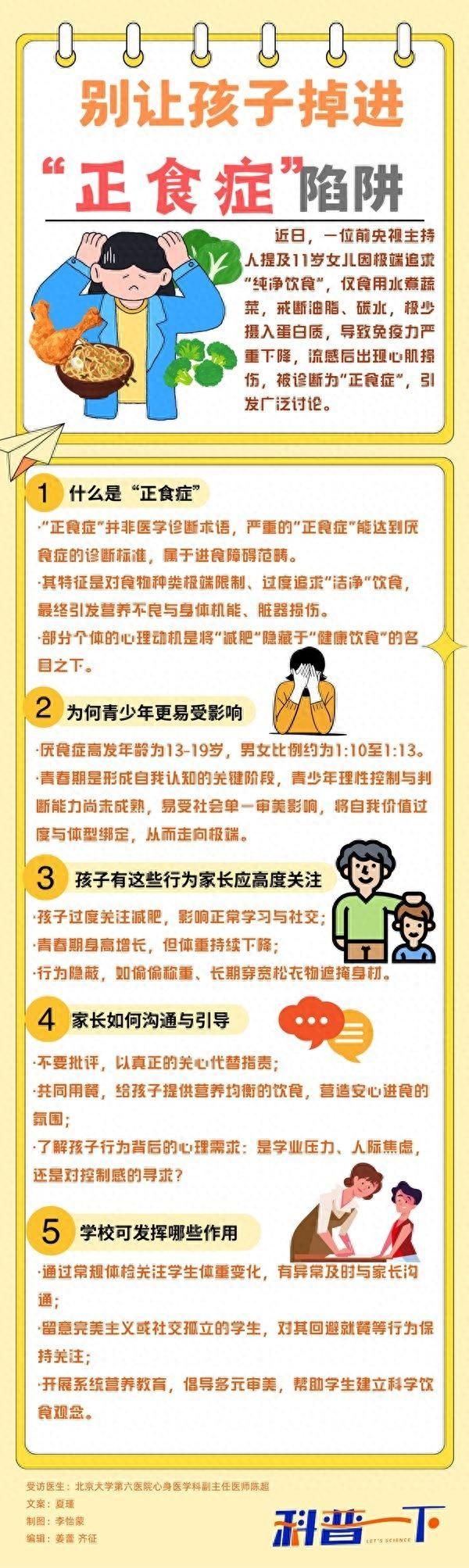
Core Viewpoint - The recent case of a former CCTV host's daughter suffering from "orthorexia" has brought significant public attention to this eating disorder, which stems from an extreme obsession with "pure" eating habits that can lead to severe health consequences [3][4]. Group 1: Definition and Characteristics of Orthorexia - "Orthorexia" is defined as an eating disorder characterized by an excessive focus on healthy eating, leading to severe nutritional deficiencies and organ damage [4]. - It is not recognized as an independent medical diagnosis and is considered a manifestation of anorexia nervosa, similar to binge eating disorders [4][5]. - Patients often disguise their desire to lose weight under the guise of pursuing a healthy diet, indicating a deeper psychological issue [4][5]. Group 2: Demographics and Psychological Factors - Adolescents, particularly those aged 13-19, are at a higher risk for developing eating disorders, with a significant gender disparity favoring females [6]. - The pursuit of an ideal body image during adolescence can lead to extreme dieting behaviors, as seen in cases where academic and social pressures contribute to unhealthy weight control methods [6][9]. - Many adolescents with orthorexia exhibit perfectionist traits and are influenced by societal beauty standards, which can distort their self-worth and lead to unhealthy eating patterns [9][10]. Group 3: Treatment and Recovery - Treatment for orthorexia involves a combination of nutritional support and psychological intervention, focusing on restoring healthy eating habits and addressing underlying psychological issues [8][10]. - Successful recovery often requires medical supervision and family support, with patients gradually regaining a balanced approach to food and life [7][8]. - Schools play a crucial role in early detection and prevention of eating disorders by monitoring students' health and providing education on nutrition and body image [11][12].

密密麻麻,浙江姑娘体内取出2斤!这习惯已持续近20年……医生:被塞满了
Xin Lang Cai Jing· 2025-12-26 11:52
Core Insights - The article discusses a case of "trichophagia," a type of eating disorder where an individual consumes hair, leading to the formation of a large hairball in the stomach, known as "trichobezoar" or "hair stone" [1][5][6] Medical Condition - The patient, referred to as Jiajia, experienced severe abdominal bloating for three to four months, which was initially misdiagnosed as a common gastrointestinal issue [1] - Upon examination, it was discovered that her stomach was filled with a mass of hair, which had formed a hard "stone" due to the inability to digest hair and its accumulation with food remnants [1][2] Treatment Approach - Due to the size of the hairball, surgical intervention was deemed more effective than multiple endoscopic procedures, which could risk damage to the esophagus [2][3] - The surgical team, led by Professor Yu Jiren, spent over an hour breaking down the hairball into smaller pieces for removal, ultimately extracting nearly 2 pounds of hair from Jiajia's stomach [4][5] Psychological Factors - Jiajia's condition is classified as "pica," characterized by the consumption of non-nutritive substances, often linked to psychological stress and anxiety [5][6] - The article highlights that such behaviors can stem from emotional distress, where individuals may resort to eating non-food items as a coping mechanism [6][7] Health Implications - The article emphasizes that relying on eating as a means to manage emotional issues can lead to serious health consequences, including gastrointestinal disorders and increased risk of conditions like stomach cancer [7]

“正食症”是什么病?痴迷健康饮食的5大误区→
Xin Lang Cai Jing· 2025-12-24 13:41
Group 1 - The core issue of "orthorexia" is gaining attention, particularly among adolescents who excessively control their weight by avoiding fats and only consuming boiled vegetables, leading to physical harm [1] - "Orthorexia" is not merely an extreme form of healthy eating but a serious mental health issue that can result in malnutrition, osteoporosis, hormonal imbalances, social isolation, anxiety, and depression [2] - Overly strict dietary habits can lead to significant health risks, including muscle loss due to inadequate carbohydrate intake, as the body resorts to using fats and proteins for energy [4] Group 2 - Some elderly individuals avoid fats to control blood lipids, resulting in low dietary fat and salt, which can lead to electrolyte imbalances and malnutrition over time [6] - Strict vegetarianism can lead to insufficient intake of animal proteins, and while plant proteins can be supplemented, their absorption and utilization are not as effective as animal proteins [8] - An excessive focus on whole grains can result in digestive issues and nutrient absorption problems, indicating that a balanced intake of refined and whole grains is necessary [11]

前央视主持人王小骞哭诉11岁女儿患正食症!“正食症”是一种什么病?
Xin Lang Cai Jing· 2025-12-23 13:55
Core Viewpoint - The recent case of Wang Xiaoqian's daughter suffering from Orthorexia Nervosa has brought attention to this eating disorder, which is characterized by an excessive focus on healthy eating, leading to severe dietary restrictions and potential nutritional deficiencies [4][5]. Group 1: Definition and Characteristics - Orthorexia Nervosa, translated from English, refers to a strict limitation on diet in pursuit of an overly "healthy" and "pure" eating pattern, which can lead to malnutrition [4]. - Unlike anorexia, which primarily aims at weight control, Orthorexia is driven by the belief in achieving a perfect diet, resulting in a narrow range of food choices [5]. Group 2: Health Implications - Patients with Orthorexia may experience significant weight loss and nutritional deficiencies, potentially evolving into anorexia if the condition worsens [5]. - The condition can lead to severe health issues, such as heart damage, as seen in Wang Xiaoqian's daughter, who exhibited a heart rate of 120 due to extreme dietary restrictions [4]. Group 3: Psychological Aspects - Both Orthorexia and anorexia may be associated with compulsive behavior patterns, reflecting cognitive biases and a high need for control [5]. - The underlying psychological motivations for these eating disorders often stem from environmental factors, such as a tense family atmosphere, leading individuals to exert control over their food intake [5].