
气候变化监测

Search documents
【宝鸡】秦岭国家大气本底站一期项目建成
Shan Xi Ri Bao· 2025-12-08 22:43
Core Viewpoint - The Qinling National Atmospheric Background Station has entered the testing phase, which is crucial for monitoring greenhouse gases and understanding climate change [1] Group 1: Project Overview - The Qinling National Atmospheric Background Station is the only planned regional atmospheric background station in the Qinling area, located at an altitude of 2,655 meters in Taibai County [1] - The station's establishment is significant for improving the national meteorological observation network and enhancing regional climate research accuracy [1] Group 2: Operational Challenges - Recently, the station faced operational risks due to a snowstorm, which threatened the stability of its instruments [1] - A temporary team was formed by meteorological workers from Baoji City and Taibai County to ensure the equipment's normal operation, involving a five-hour trek in knee-deep snow to perform repairs [1] Group 3: Project Phases - The construction of the Qinling National Atmospheric Background Station is planned in two phases, with the first phase already completed and operational, while the second phase is under construction and expected to be fully operational by the end of 2027 [1]
我国成功发射风云三号08星,用于气候变化监测等领域
Yang Shi Xin Wen Ke Hu Duan· 2025-09-28 10:50
Core Points - The successful launch of Fengyun-3 08 satellite marks the 596th flight of the Long March series of rockets [1] - Fengyun-3 08, designated as H star, is the 22nd Fengyun meteorological satellite and the 8th of the second generation low-orbit meteorological satellites [3] - The satellite is equipped with nine remote sensing instruments, including a medium-resolution spectral imager and an infrared hyperspectral atmospheric detector, aimed at high-precision global greenhouse gas detection [3] Group 1 - The launch took place at 3:28 AM from the Jiuquan Satellite Launch Center using a Long March 4B rocket [1] - Fengyun-3 08 will replace Fengyun-3 D star in its operational duties [3] - The satellite operates in a sun-synchronous orbit and is primarily used for weather forecasting, atmospheric chemistry, and climate change monitoring [3]

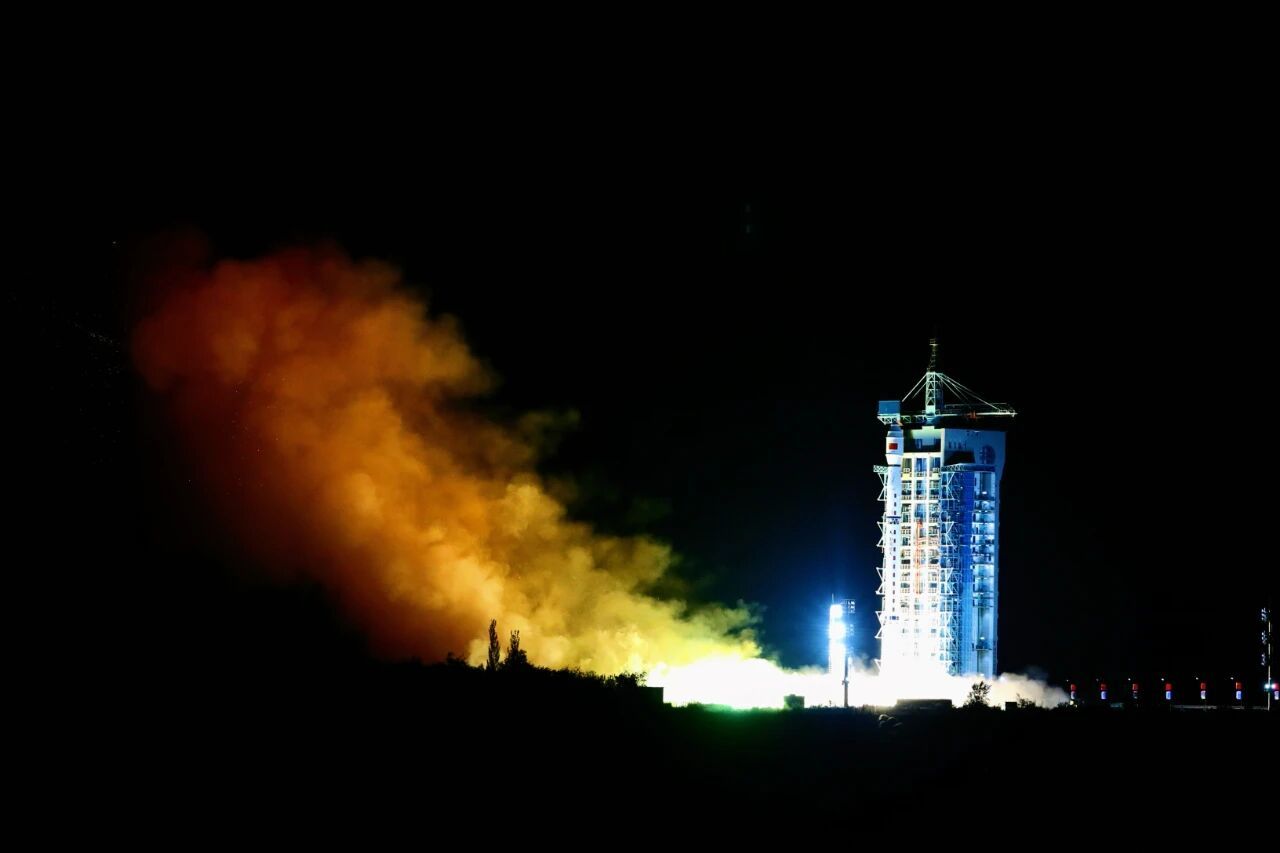
“风云”可测,这颗卫星能观“气象万千”
Xin Hua She· 2025-09-27 12:56
Core Viewpoint - The successful launch of the Fengyun-3H satellite enhances China's capabilities in weather forecasting, atmospheric chemistry, and climate change monitoring, contributing significantly to global climate change efforts [1][2][3] Group 1: Satellite Features - Fengyun-3H satellite weighs approximately 2780 kilograms and operates at an altitude of 830 kilometers in a sun-synchronous orbit with an inclination of 98.7 degrees [1] - It is equipped with nine advanced remote sensing instruments, including a high-spectral greenhouse gas monitoring instrument, which will enable high-precision global greenhouse gas detection with a 100-kilometer width [1][2] Group 2: Monitoring Capabilities - The satellite will monitor ice and snow cover, sea surface temperature, and provide remote sensing information necessary for short-term climate forecasting and climate change assessment [2] - It will enhance the ability to respond to natural disasters and environmental issues, improving comprehensive capabilities for weather disaster prevention and mitigation [2] Group 3: Global Contribution - China operates a unique multi-satellite network for near-Earth meteorological observation, providing a complete global observation network with operational satellites in various orbits [3] - The Fengyun-3H satellite will replace the Fengyun-3D satellite in the afternoon monitoring role and work in conjunction with other operational satellites to ensure high-quality data support for meteorological services [3]