水质监测

Search documents
水质监测仪器迎来新机遇:《生态环境法典》即将施行
仪器信息网· 2026-03-18 09:02
Core Viewpoint - The newly published "Ecological Environment Code" systematically integrates various regulations in the field of ecological environment protection, marking a new phase of legal and systematic governance in China's ecological environment management [2][10]. Group 1: Regulatory Responsibilities - The Code provides a comprehensive definition of "ecological environment," covering various natural elements and their interactions, including air, water, marine, land, forests, wetlands, wildlife, and urban-rural areas [3]. - It establishes a principle of "unified supervision management" combined with "division of responsibilities," where local governments are responsible for unified supervision of ecological environment protection within their jurisdictions [3]. Group 2: Water Resource Management - Water resource protection and management are core components of the Code, which implements a rigid water resource management system, emphasizing the need to align urban and industrial development with water resource capacity [4]. - The Code promotes water conservation and the establishment of a groundwater reserve system, with strict controls on water usage and the encouragement of recycled water in sectors like landscaping and sanitation [4]. Group 3: Water Pollution Prevention - A dedicated chapter on "water pollution prevention" prioritizes the protection of drinking water sources and imposes strict controls on industrial and urban pollution, as well as agricultural non-point source pollution [5]. Group 4: Drinking Water Source Protection - The Code mandates the delineation of drinking water source protection areas, requiring risk assessments and pollution prevention measures around these zones [7]. - Local governments are required to monitor and publicly disclose drinking water safety information at least quarterly, ensuring public awareness [7]. Group 5: Targeted River Basin Management - The Code emphasizes comprehensive, systematic, and source-oriented governance for key river basins, allowing local governments to set stricter emission standards for specific pollutants and industries [8]. - It prohibits the transfer of heavily polluting enterprises upstream in key river basins [8]. Group 6: Monitoring Network Development - The Code outlines the establishment of a comprehensive water quality monitoring network, including specific regulations for industrial parks and river discharge outlets, aiming for full coverage of monitoring by 2028 [9]. - A digital management system for river discharge outlets will be implemented, with water quality data becoming a key assessment criterion for river basin management [9]. Group 7: Legal Foundation for Environmental Improvement - The introduction of the "Ecological Environment Code" provides a solid legal foundation for improving ecological environment quality and ensuring national water security, emphasizing source prevention, full-process supervision, and social governance [10].


水质监测“国家队”:115套仪器系统入选总站适用名录
仪器信息网· 2026-02-09 09:01
Core Viewpoint - The article highlights the importance of multi-parameter water quality monitoring systems, emphasizing their role in detecting water pollution and supporting environmental management through real-time data collection and analysis [1][5]. Summary by Sections Water Quality Monitoring Parameters - The five core parameters for assessing water quality include pH, dissolved oxygen (DO), turbidity, electrical conductivity, and temperature, which are essential for monitoring various water bodies such as surface water, groundwater, industrial wastewater, and drinking water sources [2][3]. - pH is a critical indicator of water acidity or alkalinity, with normal surface water pH ranging from 6.5 to 8.5. Deviations can affect aquatic life and pollutant behavior [2]. - Dissolved oxygen (DO) levels indicate the self-purification capacity of water; levels below 5 mg/L can lead to aquatic life suffocation and pollution issues [2]. - Turbidity measures the clarity of water, with high turbidity affecting photosynthesis in aquatic plants and increasing treatment costs for drinking water [3]. - Electrical conductivity reflects the concentration of dissolved ions in water, with higher values indicating potential pollution from soluble salts and heavy metals [3]. - Temperature influences the solubility of oxygen and the metabolic rates of aquatic organisms, serving as a calibration reference for monitoring data [3]. Additional Monitoring Parameters - Multi-parameter analyzers also include supplementary indicators such as Chemical Oxygen Demand (COD), ammonia nitrogen (NH₃-N), total phosphorus (TP), and total nitrogen (TN), which are crucial for assessing organic pollution and nutrient enrichment risks [4][5]. - COD is used to evaluate the total amount of organic and reducible inorganic substances in water, while ammonia nitrogen and total phosphorus are key factors in assessing eutrophication risks [4]. - Total nitrogen, which includes various nitrogen forms, is essential for understanding potential eutrophication in water bodies [4]. Instrumentation and Compliance - A total of 95 manufacturers have produced 115 models of water quality multi-parameter automatic monitoring systems that have passed the suitability testing as per the list published by the China National Environmental Monitoring Center [1][5]. - The instruments comply with national monitoring standards, ensuring their reliability and effectiveness in various environmental monitoring scenarios [6][7].

水质应用进阶季,哈希新春礼盒等你领
仪器信息网· 2025-12-07 09:06
Group 1 - The article highlights HACH as a company with over 70 years of experience in water quality analysis, emphasizing its mission to protect water quality globally [1] - HACH is offering a special gift box to water quality guardians, encouraging participation through a registration process [1][3] - The company aims to expand the depth and breadth of water quality monitoring, addressing the increasing complexity of industrial processes and operational efficiency [5][6] Group 2 - HACH's solutions are designed to help businesses achieve more precise monitoring, faster processing, stable operations, and easier management in complex working conditions [5] - The article mentions specific applications of HACH products in various industries, including semiconductor and energy sectors, showcasing their versatility [8][9][10][11]

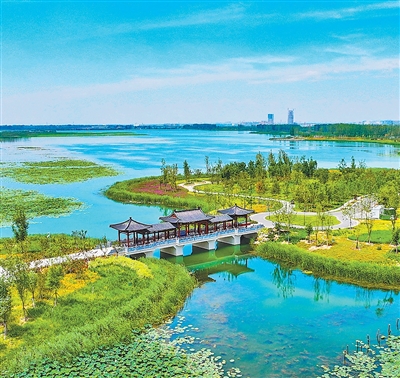
白洋淀 更透亮(我家门前有条河)
Ren Min Ri Bao· 2025-07-20 22:12
Core Viewpoint - The water quality of Baiyangdian has significantly improved from a grade of inferior V to a stable grade III, indicating successful ecological restoration efforts in the region [2][4]. Group 1: Water Quality Improvement - Baiyangdian's water quality was previously classified as inferior V, characterized by deep green, turbid water with an unpleasant odor [2]. - Following the establishment of the Xiong'an New Area in 2017, systematic ecological protection measures were implemented, leading to a rise in water quality to grade III, which has been stable since 2021 [3][4]. - The number of national monitoring points increased from 5 to 8, with sampling frequency raised to twice a week, enhancing the ability to detect and address water quality issues promptly [2][3]. Group 2: Biodiversity Recovery - The ecological recovery has led to an increase in wild bird species in Baiyangdian to 296, up by 90 species since the establishment of the Xiong'an New Area [4]. - The number of wild fish species has also risen to 48, an increase of 21 species compared to before the establishment of the new area [4]. - The discovery of the May Fourth midge, a typical indicator species for clean water, signifies ongoing improvements in the water ecosystem [4]. Group 3: Monitoring and Efforts - The monitoring team has faced challenges such as personnel shortages and outdated equipment, but recent upgrades have significantly improved efficiency, allowing for quicker analysis of water samples [3][5]. - Continuous efforts by dedicated environmental workers, like Liu Dongmei, have been crucial in documenting and supporting the water quality improvement process [5].