法务区建设

Search documents
海南自由贸易港法是可持续发展重要“压舱石”
Hai Nan Ri Bao· 2026-01-19 01:57
Core Viewpoint - The Hainan Free Trade Port Law serves as a crucial "ballast stone" for sustainable development, providing a stable legal environment that encourages long-term investment from both domestic and international investors [1][2]. Group 1: Progress and Achievements - The first step of the Hainan Free Trade Port has been executed effectively, achieving the goal of closing the island to external trade by December 18, 2025, and implementing the policy of "opening up the first line, controlling the second line, and allowing freedom within the island" [2][3]. - Hainan's practices are seen as a model for high-level national openness, balancing security and openness while laying a legal foundation for international economic and trade rules [2][3]. Group 2: Legal Framework and Implementation - The Hainan Free Trade Port Law establishes a core institutional framework for the construction of the free trade port, providing a long-term stable institutional environment for investors [3]. - It creates a mechanism for implementation that involves central coordination, departmental support, and provincial execution, ensuring that open policies progress in a legal manner while reducing arbitrary enforcement [3]. Group 3: Focus Areas for Improvement - The law addresses key investor concerns such as fair competition, intellectual property protection, and dispute resolution, aligning with international high-standard economic and trade rules [3]. - Emphasis is placed on transforming common international rule requirements into localized legal systems to create a trustworthy legal ecosystem that aligns with international standards [4][5]. Group 4: Legal Services and Talent Development - The establishment of a high-quality legal service area is crucial for attracting investors, ensuring that their rights are protected and that they receive timely legal remedies [5][6]. - The development of a talent pool tailored to the needs of the Hainan Free Trade Port is essential, focusing on training professionals who understand both Chinese law and international regulations [6][7]. Group 5: Attracting International Talent - To attract and retain top international legal, arbitration, and financial regulatory talent, a systematic talent ecosystem must be created, providing platforms for high-end business practices and ensuring a stable and transparent legal environment [7].
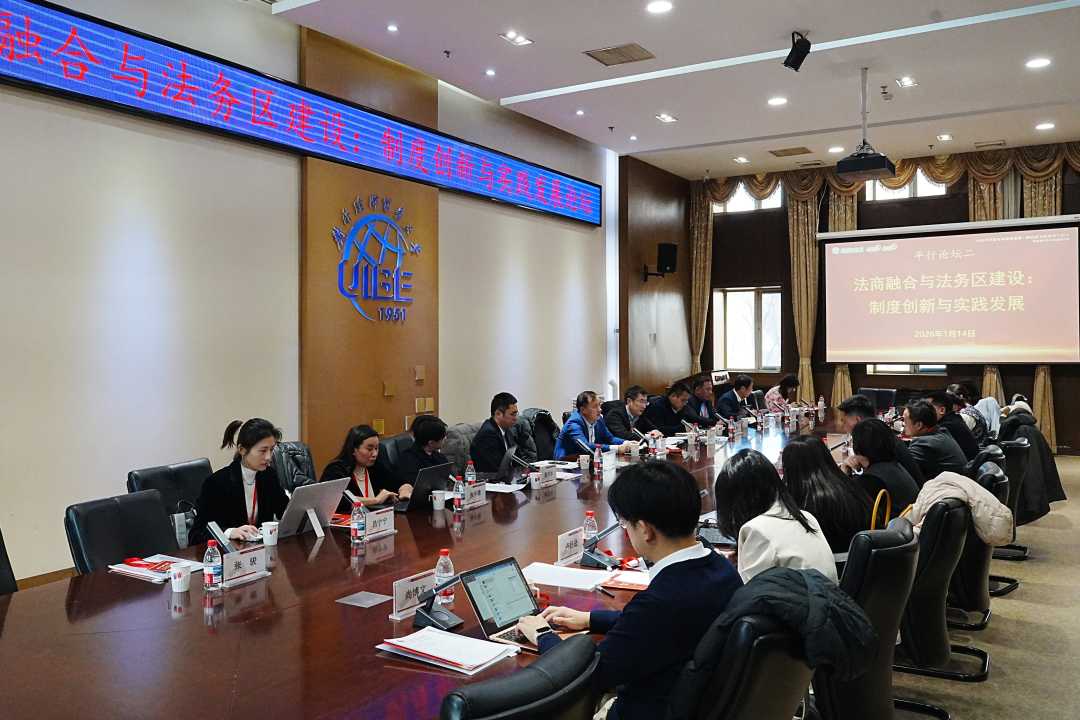
法商融合怎么融?法务区如何建?专家探讨制度创新与实践发展
Xin Lang Cai Jing· 2026-01-18 06:08
Core Insights - The forum focused on the integration of law and business, as well as the development of legal service zones in China, emphasizing institutional innovation and practical development [1][3] Group 1: Legal and Business Integration - Various regions in China are promoting the integration of law and business, with Beijing aiming to establish an international demonstration zone by 2027 and a global highland by 2030 [1] - The Tianfu Central Legal Service Zone, launched in February 2021, aims to become a legal service hub for the western region of China [1] - The Qingdao Central Legal Service Zone is set to be inaugurated in February 2024, focusing on maritime law and innovative law enforcement mechanisms [1][3] Group 2: Characteristics and Challenges - The three main characteristics of the integration of law and business and the construction of legal service zones are market-oriented, professional, and international [3] - Legal service zones are seen as key platforms for local institutional innovation and enhancing regional competitiveness [3] - There is a noted shortage of legal talent in foreign-related law, with suggestions for legal service zones to provide internship opportunities for students to gain practical experience [3] Group 3: Cultural Heritage and Legal Support - The integration of law and business has significant potential in the field of cultural heritage, providing legal support for both preservation and commercial development [3] Group 4: Institutional Collaboration - The forum was co-hosted by several institutions, including the University of International Business and Economics, which has established a national-level key discipline in international law and a foreign-related legal research institute [4] - The university aims to strengthen collaboration with practical sectors and contribute to national strategies and local development [4]