
法理台独

Search documents
赤裸“法理台独”恐加剧台海危机
Xin Lang Cai Jing· 2026-01-07 22:24
Core Viewpoint - The recent proposal to amend the "Cross-Strait Relations Act" in Taiwan has sparked significant controversy, being perceived as a provocative move towards formal independence, which has drawn strong criticism from various sectors in Taiwan and mainland China [1][3]. Group 1: Legislative Proposal and Reactions - A proposal was made by Democratic Progressive Party (DPP) legislator Lin Yi-chin to change the name of the "Cross-Strait Relations Act" to "Taiwan and the People's Republic of China Relations Act" and remove key phrases regarding "before national unification," which was seen as a blatant provocation for legal independence [1][3]. - The proposal was quickly retracted within two days, with accusations of the DPP lacking the courage to stand by its actions, drawing parallels to a similar proposal made in 2020 that was also withdrawn under pressure [2][3]. Group 2: Political Implications and Criticism - Critics from the Kuomintang (KMT) party have labeled the proposal as a political maneuver to distract from the DPP's failures, suggesting that it serves as a "cover" for the party's shortcomings during times of political crisis [3][4]. - The proposal has been condemned for potentially escalating tensions across the Taiwan Strait, with warnings that it could lead to disastrous consequences for Taiwan if relations are framed as "two countries" [3][4]. Group 3: Public Sentiment and Concerns - Public opinion in Taiwan reflects a strong disapproval of the DPP's actions, with many citizens expressing frustration over perceived political gamesmanship and the risks posed to Taiwan's safety and stability [4][5]. - The ongoing push for legal independence is viewed as a dangerous path that could undermine the overall welfare of Taiwanese society, with historical lessons suggesting that any attempts at separation will face significant backlash [5].
倒计时两年,2028年两岸关系的3个时间节点
经济观察报· 2026-01-07 11:10
Core Viewpoint - The upcoming Taiwan election will be a critical turning point for cross-strait relations, with potential outcomes leading to either peaceful unification or various forms of unification depending on the election results [1][4]. Group 1: Key Time Nodes - Experts highlight 2027 as a significant year for Taiwan, but the author identifies 2028 as the more crucial year due to three key dates: January 8 or January 15, May 20, and the U.S. election day [2][10]. - The first key date is the potential date for the next Taiwan election, which could be January 8 or January 15, 2028, based on the previous election schedule [4]. Group 2: Election Outcomes and Implications - If the Democratic Progressive Party (DPP) wins the next election, it would mark 16 years of DPP governance, raising questions about the implications for peaceful unification as outlined in the Anti-Secession Law [3][6]. - The DPP's push for "de jure independence" is unlikely, as recent proposals to change legal terminology were quickly retracted after warnings from the mainland [6][7]. - Despite the low likelihood of formal independence, the DPP may still employ strategies to promote independence sentiments and deepen cross-strait tensions [7]. Group 3: Mainland China's Response - Mainland China's actions in the lead-up to the election are expected to serve as warnings, but if the DPP continues to govern, these actions may escalate [8][9]. - The inauguration of the new Taiwanese leader on May 20 will be another critical moment, influencing mainland China's policy decisions based on the leader's inaugural speech [9]. Group 4: Alternative Scenarios - Besides the DPP winning, two other scenarios for the 2028 Taiwan situation include the Kuomintang (KMT) winning the election or the absence of an election altogether [11][12].


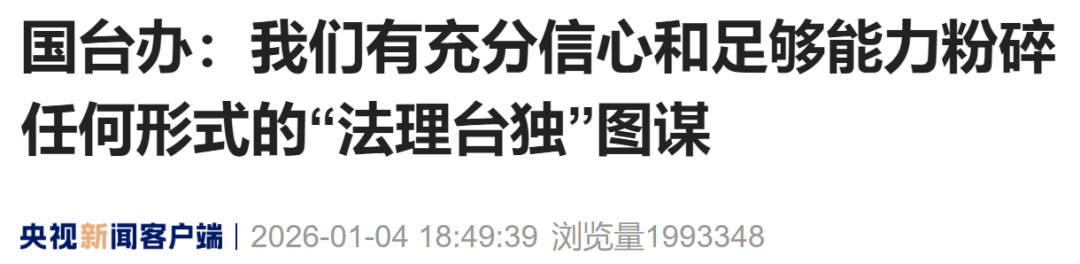
国台办:有充分信心和足够能力粉碎“法理台独”图谋
Xin Lang Cai Jing· 2026-01-04 23:12
Core Viewpoint - The recent proposal by Taiwan's ruling party to amend the "Cross-Strait Relations Act" has sparked significant criticism, with accusations of attempting to push for "de jure Taiwan independence" [1][2]. Group 1: Legislative Proposal - The proposal aims to rename the law to "Taiwan and the People's Republic of China Relations Act" and remove references to "national unification" and "regional" terminology [1]. - The proposal is seen as a significant international statement to define the relationship between Taiwan and China as one between two countries [1]. Group 2: Reactions from Authorities - The spokesperson for the Taiwan Affairs Office expressed confidence in countering any attempts at "de jure Taiwan independence," labeling the proposal as a challenge to the historical and legal fact that Taiwan is part of China [2]. - The Kuomintang criticized the ruling party for diverting attention from domestic governance issues and accused them of escalating tensions across the Taiwan Strait [2]. Group 3: Historical Context and Internal Concerns - A similar legislative proposal was made in 2020 but was withdrawn due to backlash, indicating internal concerns even within the ruling party [3]. - The current political landscape shows that the ruling party no longer holds a majority in the Legislative Yuan, raising questions about the timing and effectiveness of reintroducing such a proposal [3].
民进党籍民意代表竟提案用“台湾与中华人民共和国”定位两岸关系,国台办回应
Xin Lang Cai Jing· 2026-01-04 15:54
Group 1 - The spokesperson of the Taiwan Affairs Office, Chen Binhua, expressed strong concern over a proposal by some Democratic Progressive Party (DPP) representatives to amend the current "Cross-Strait Relations Regulations" to redefine cross-strait relations as "Taiwan and the People's Republic of China" and to remove the phrase "before national reunification" [2] - Chen criticized the proposal as disregarding the mainstream public opinion in Taiwan and the well-being of Taiwanese compatriots, openly challenging the historical and legal fact that Taiwan is part of China, and attempting to alter the status quo across the Taiwan Strait [2] - The spokesperson labeled the DPP and its leader Lai Ching-te as "peace destroyers," "crisis creators," and "war instigators," asserting that any form of "de jure Taiwan independence" would lead to war and is a dead end [2] Group 2 - Chen emphasized that the historical evidence shows that pursuing "Taiwan independence" will only lead to failure and that any attempts to cross red lines will be met with decisive measures under the Anti-Secession Law [2] - The spokesperson called on the Taiwanese people to recognize the evil nature and serious harm of "Taiwan independence" activities and to stand firmly on the right side of history to oppose such activities, thereby maintaining peace and stability in the Taiwan Strait [2]

部分民进党籍民意代表提案用“台湾与中华人民共和国”定位两岸关系,国台办回应
Huan Qiu Wang· 2026-01-04 15:54
Core Viewpoint - The spokesperson of the Taiwan Affairs Office expressed strong confidence and capability to thwart any attempts of "de jure Taiwan independence," emphasizing that such actions would lead to war and instability in the Taiwan Strait [1]. Group 1: Response to Legislative Proposals - The proposal by some Democratic Progressive Party (DPP) representatives to amend the "Cross-Strait Relations Regulations" is seen as a blatant challenge to the historical and legal fact that Taiwan is part of China [1]. - The proposal aims to redefine cross-strait relations and remove references to "before national reunification," which is viewed as an attempt to escalate tensions and undermine peace in the region [1]. Group 2: Stance on Taiwan Independence - The spokesperson labeled the DPP and its leadership as "peace destroyers," "crisis creators," and "war instigators," asserting that "Taiwan independence" equates to war and is a dead end [1]. - There is a clear warning that any attempts to push for "de jure Taiwan independence" will be met with decisive measures under the Anti-Secession Law, indicating a readiness to respond forcefully to any perceived threats [1]. Group 3: Call to Taiwanese People - The spokesperson urged the Taiwanese public to recognize the evil nature and serious dangers of "Taiwan independence," encouraging them to stand on the right side of history and oppose separatist activities [1]. - The message emphasizes the importance of maintaining peace and stability in the Taiwan Strait and protecting the shared homeland of the Chinese nation [1].
民进党籍民代提案修改两岸有关条例 国台办:用心险恶、性质恶劣
Xin Lang Cai Jing· 2026-01-04 14:56
Core Viewpoint - The proposal by some Democratic Progressive Party (DPP) representatives to amend Taiwan's cross-strait regulations is seen as a blatant push for "de jure Taiwan independence," which intentionally escalates tensions across the Taiwan Strait and undermines peace and stability in the region [1]. Group 1 - The proposal aims to redefine cross-strait relations as "Taiwan and the People's Republic of China" and removes the phrase "before national reunification" from existing regulations, disregarding mainstream public opinion in Taiwan and challenging the historical and legal fact that Taiwan is part of China [1]. - The spokesperson emphasized that "Taiwan independence" equates to war and is a dead end, asserting confidence and capability to thwart any attempts at "de jure Taiwan independence" [1]. - Historical evidence suggests that pursuing "Taiwan independence" will lead to failure, and any attempts to cross red lines will be met with decisive measures under the Anti-Secession Law [1].
民进党民代提案删“两岸条例”涉“国家统一”表述,国台办发声
Xin Lang Cai Jing· 2026-01-04 12:49
Group 1 - The core viewpoint of the articles revolves around the proposal by Lin Yijin, a representative of the Democratic Progressive Party (DPP), to amend the "Cross-Strait Relations Act" by removing references to "national unification" and the mutual designation of "regions" between the two sides [1][2] - The proposal has garnered support from various factions within the DPP, indicating a significant political maneuvering within the party [1] - Previous attempts to amend similar provisions have faced backlash and were ultimately withdrawn, suggesting a pattern of political sensitivity surrounding such proposals [1] Group 2 - Criticism from the Kuomintang (KMT) highlights concerns that the DPP is engaging in political theatrics to solidify support from pro-independence voters, rather than addressing substantive issues [2] - The Mainland Affairs Council of Taiwan has responded cautiously, emphasizing the need for broad societal consensus on any amendments to the "Cross-Strait Relations Act" due to its political sensitivity [2] - Statements from the Taiwan Affairs Office of the State Council assert that any moves towards "Taiwan independence" will be met with strong opposition, framing such actions as detrimental to peace and stability in the Taiwan Strait [2]
国台办:“台独”分裂势力胆敢铤而走险、触碰红线,我们必将予以迎头痛击
Yang Shi Wang· 2026-01-04 12:03
Core Viewpoint - The spokesperson for the Taiwan Affairs Office of the State Council, Chen Binhua, expressed strong opposition to a proposal by some Democratic Progressive Party (DPP) representatives in Taiwan to amend the "Cross-Strait Relations Regulations," which would redefine cross-strait relations as "Taiwan and the People's Republic of China" and remove references to "before national reunification" [1] Group 1 - The proposal disregards the mainstream public opinion in Taiwan and challenges the historical and legal fact that Taiwan is part of China [1] - The DPP's actions are seen as an attempt to promote "de jure Taiwan independence," which is viewed as a direct threat to peace and stability in the Taiwan Strait and the region [1] - The spokesperson emphasized that "Taiwan independence" equates to war and is a dead end, asserting confidence in the ability to thwart any attempts at "de jure Taiwan independence" [1] Group 2 - Historical evidence suggests that pursuing "Taiwan independence" will lead to failure and negative consequences [1] - The spokesperson warned that if "Taiwan independence" forces dare to cross red lines, decisive measures will be taken in accordance with the Anti-Secession Law [1] - There is a call for the Taiwanese public to recognize the harmful nature of "Taiwan independence" and to stand against such activities to maintain peace and stability in the Taiwan Strait [1]
国台办回应民进党妄图推动法理台独
Xin Lang Cai Jing· 2026-01-04 11:43
Core Viewpoint - The article emphasizes that any attempts to promote "de jure Taiwan independence" will be met with strong opposition and that such actions are seen as a direct challenge to the historical and legal status of Taiwan as part of China [1] Group 1: Government Response - The spokesperson for the Taiwan Affairs Office, Chen Binhua, expressed strong concern over proposals by some Democratic Progressive Party (DPP) representatives to amend the "Cross-Strait Relations Act," which would redefine cross-strait relations and remove references to "before national reunification" [1] - The proposal is characterized as disregarding mainstream public opinion in Taiwan and as an attempt to escalate tensions across the Taiwan Strait, undermining peace and stability in the region [1] - The DPP and its leadership are labeled as "peace destroyers," "crisis creators," and "war instigators" for their actions [1] Group 2: Consequences of Independence Movements - The article asserts that "Taiwan independence" equates to war and is a path to destruction, indicating a firm stance against any form of independence [1] - The government claims to have the confidence and capability to thwart any attempts at "de jure Taiwan independence" and will not allow any separatist forces to divide Taiwan from China [1] - Historical evidence is cited to support the claim that pursuing "Taiwan independence" will lead to failure and negative outcomes [1] Group 3: Call to Action - The article urges the Taiwanese public to recognize the harmful nature of "Taiwan independence" and to stand against separatist activities [1] - It calls for unity in maintaining peace and stability in the Taiwan Strait and protecting the shared homeland of the Chinese nation [1]