
消费平滑

Search documents
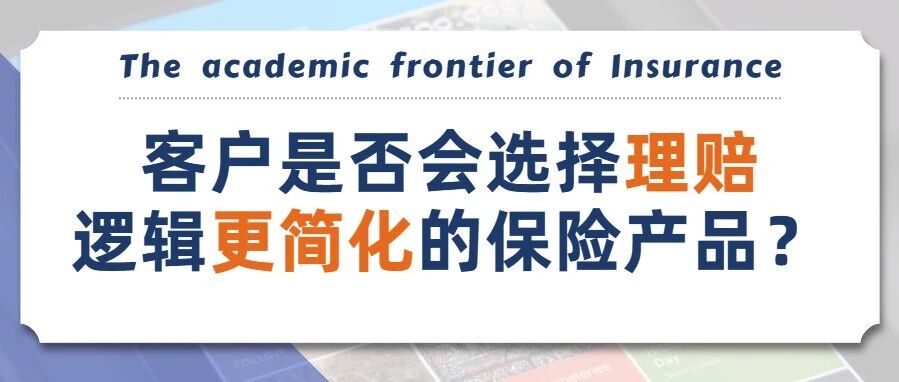
期刊Risk Management and Insurance Review 2025年28卷第4期目录及摘要|保险学术前沿
13个精算师· 2026-01-11 02:03
Core Insights - The insurance industry is facing challenges such as interconnected claims events and consumer perceptions of unfair premium pricing, which undermine market trust. Insurers must transform around the principles of resilience, risk reconceptualization, and reinvention [2][16]. Group 1: Insurance Market Challenges - Insurers are encountering difficulties due to modern risks that are human-made, globally interconnected, and unpredictable, leading to correlated claims [14][16]. - The perception of unfair pricing among consumers is increasing, which weakens trust in the insurance market [15][16]. Group 2: Simplified Loss Settlement Logic - Property and Casualty (P&C) products with simplified loss settlement logic can reduce insurers' combined ratios by up to five percentage points, benefiting from lower underwriting and claims administration costs [2][8]. - However, these products introduce basis risk for policyholders, and willingness to pay for such insurance products shows no significant difference compared to traditional indemnity insurance [7][8]. Group 3: Reserve Management and Internal Incentives - Internal tournament incentives are positively related to reserve errors, indicating that larger tournament prizes lead to more conservative loss-reserve management [5][6]. - The positive effect of these incentives on conservative reserve management is more pronounced in insurers with higher return volatility and a greater ratio of claim loss reserves to total liabilities [5][6]. Group 4: Long-Term Care Insurance Dynamics - The proportion of long-term care expenditure insured decreases with age, and individuals may sell assets to maintain consumption levels when facing health shocks [9]. - An increase in interest rates can significantly reduce insurance coverage, a factor that has been overlooked in existing literature [9]. Group 5: Mergers and Acquisitions in Insurance - There has been a notable difference in mergers and acquisitions (M&As) between life and non-life insurers in the U.S. post-2012, attributed to the low interest rates following the Fed's quantitative easing policy [10][11]. Group 6: IoT and Connected Insurance - The adoption of IoT technologies in insurance is expanding, enabling connected insurance offerings that generate observable risk data and support preventive services [12][13]. - This evolution complicates the cost-benefit structure and introduces new drivers of insurance demand, such as technology affinity and willingness to share data [12][13].

外滩年会聚焦需求不足难题 CF40支招消费投资提振路径
Sou Hu Cai Jing· 2025-10-26 16:40
Core Viewpoint - The report discusses the dynamic balance between savings and investment in industrialized countries since the mid-1980s, highlighting how despite declining labor income shares and other adverse factors, consumption rates have remained stable due to various supporting mechanisms [1][2]. Group 1: Key Factors Supporting Consumption - Household financial wealth has grown significantly, outpacing GDP and disposable income growth, which has positively influenced consumption levels [2][3]. - Social security systems have reduced private savings through "asset substitution effects," helping to smooth consumption during income shocks [3]. - Public social spending has alleviated household expenditure pressures, thereby enhancing disposable income levels [3]. Group 2: Investment Demand Drivers - The emergence of new investment opportunities has supported investment demand, with fixed asset investment rates remaining stable despite rising income and capital stock levels [4]. - The shift towards knowledge and technology-intensive service sector investments has been crucial, with new investment opportunities in information technology and intellectual property products providing significant support for planned investments [3][4]. Group 3: Interest Rates and Policy Management - The continuous decline in real interest rates has balanced savings and investment, with real rates dropping from high levels in the mid-1980s to below 1% post-2008 financial crisis, often entering negative territory [4]. - Effective counter-cyclical management policies have prevented short-term issues from becoming long-term problems, contrasting with Japan's prolonged economic stagnation due to indecisive macro policies [5]. Group 4: Implications for Developing Economies - The experiences of industrialized nations provide valuable insights for developing economies facing similar challenges, particularly regarding the balance of savings and investment [6]. - In China, the actual consumption level is believed to be underestimated, with high overall savings rates and relatively low consumption levels compared to other countries [6]. - Short-term measures to boost consumption should focus on aggressive fiscal policies and lowering real interest rates, while long-term strategies should include improving service sector offerings [7][8]. Group 5: Future Investment Directions - Public investment should prioritize urban renewal and infrastructure projects, especially in areas with significant unmet needs, to enhance overall economic activity [8]. - Investment in human resources and living conditions is essential, particularly for migrant workers facing inadequate housing [8]. - Fiscal and monetary policies will need to be more proactive, with potential increases in spending and further reductions in policy interest rates to stimulate economic growth [9].