消费电子产品

Search documents
久之洋:公司的光学镜头及光学元件、光学星体跟踪器产品未应用于Ai眼镜及消费电子产品领域
Zheng Quan Ri Bao Wang· 2025-12-26 11:43
Group 1 - The core viewpoint of the article is that Jiuziyang (300516) has clarified its product applications, stating that its optical lenses and components are primarily used for optoelectronic systems and optical star trackers, which are widely applied in various navigation platforms [1] - As of now, the company's optical lenses, optical components, and optical star tracker products have not been applied in AI glasses or consumer electronics [1]

久之洋:公司的光学镜头及光学元件、光学星体跟踪器产品未应用于AI眼镜及消费电子产品领域
Mei Ri Jing Ji Xin Wen· 2025-12-26 01:28
Group 1 - The company has confirmed that its optical lenses and optical components are primarily designed for optoelectronic systems, while the optical star trackers are widely used in various navigation platforms [2] - As of now, the company's optical lenses, optical components, and optical star trackers have not been applied in the fields of AI glasses and consumer electronics [2]

行业聚焦:全球CVD硅负极材料行业Top 5生产商市场份额及排名调查
QYResearch· 2025-11-05 02:11
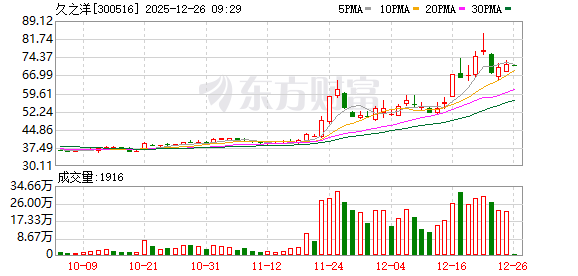
Core Viewpoint - CVD silicon anode materials, utilizing chemical vapor deposition technology, are identified as high-performance lithium battery anode materials, with silicon being the core active substance, offering a theoretical specific capacity of 4200 mAh/g, approximately ten times that of traditional graphite anodes [1][2]. Market Overview - The global CVD silicon anode materials market is projected to reach USD 160 million by 2030, with a compound annual growth rate (CAGR) of 14.7% in the coming years [2]. - The top five manufacturers are expected to hold approximately 61.1% of the market share by 2024 [3]. Product Segmentation - Polymer resin materials currently dominate the product types, accounting for about 42% of the market share [6]. - In terms of application, power batteries are the primary demand source, representing approximately 68.2% of the market [7]. Leading Companies - Group 14, founded in 2015, focuses on developing and producing next-generation lithium-ion battery anode materials, utilizing carbon nanomaterial technology to enhance energy density and charging speed [10]. - The main drivers for the development of CVD silicon anode materials include the urgent demand for high-energy-density power batteries in the electric vehicle market and the continuous pursuit of longer battery life in consumer electronics [10]. Challenges and Opportunities - Key challenges include the significant volume expansion of silicon materials during charge and discharge cycles, leading to rapid degradation of cycle life, high manufacturing costs, and compatibility issues with existing electrolytes [10]. - Opportunities lie in technological innovations such as nanostructuring and composite materials to mitigate volume expansion, the development of low-cost scalable manufacturing processes, and the potential fit with solid-state battery technologies [10].