
深度合成

Search documents
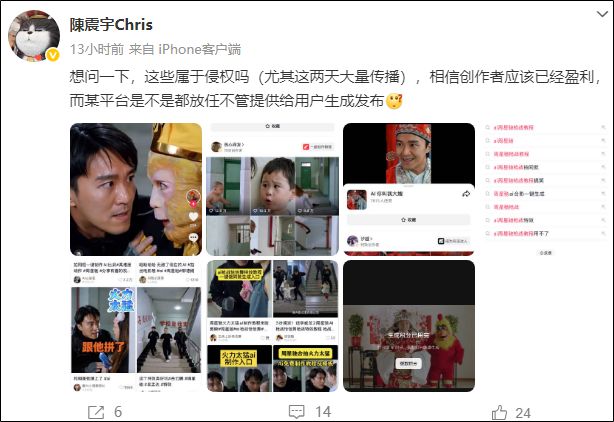
AI生成周星驰经典电影片段!专家:有法律风险
Huan Qiu Wang Zi Xun· 2026-02-11 05:29
Group 1 - The core issue revolves around the potential copyright infringement of AI-generated videos featuring classic movie clips of Stephen Chow, as raised by his agent, who questions the legality of such widespread distribution and potential profit by creators [1][2] - Many netizens believe that the AI-generated content constitutes copyright infringement, highlighting a growing concern over intellectual property rights in the digital age [3] - The emergence of AI-generated New Year greeting videos featuring celebrities and historical figures has gained popularity, raising questions about the legality and ethical implications of using such likenesses without consent [4] Group 2 - The Civil Code of the People's Republic of China explicitly protects portrait rights and voice rights, indicating that unauthorized deep synthesis of personal images and voices infringes on individual rights [6] - According to the Civil Code and regulations on deep synthesis, the unauthorized creation and dissemination of personal likenesses and voices, even for non-commercial purposes, can lead to legal accountability [8] - Experts emphasize the need for platforms to enhance content review and labeling, while users should increase awareness of copyright issues to prevent the spread of infringing content, ensuring that AI technology contributes positively to cultural celebrations [8]

市场监管总局公开征求《广告引证内容执法指南(征求意见稿)》意见
Yang Shi Wang· 2025-12-12 09:02
Group 1 - The core viewpoint of the news is the introduction of the "Advertising Citation Content Enforcement Guidelines (Draft for Public Comment)" by the State Administration for Market Regulation to enhance the regulation of advertising citation content and address issues such as misleading claims and competitive practices in the advertising market [1][2] Group 2 - The guidelines aim to provide a framework for market regulation departments to enforce advertising citation content, ensuring compliance with the Advertising Law of the People's Republic of China [2] - Advertising citation content refers to data, statistics, survey results, excerpts, and quotes from third parties that are relevant to the advertised products or services [2][3] - Advertisers are responsible for the authenticity, accuracy, and legality of all advertising content, including citation content, and must bear the burden of proof [4] Group 3 - The guidelines specify that data cited in advertisements must be obtained through experiments, measurements, or inspections conducted by qualified institutions, adhering to national standards [4] - Statistical data or survey results used in advertisements must be obtained through scientific methods, ensuring broad and reasonable sampling [5][6] - Advertisements must accurately reflect the meaning of the cited content and must clearly indicate the source of the citation [5][6] Group 4 - If the cited content has specific applicability or validity periods, this must be clearly stated in the advertisement [7][8] - Advertisements must not use misleading font sizes or colors to obscure important information about the product's features, functions, or conditions [12] - Claims regarding sales volume, revenue, or market share must be truthful, complete, and verifiable [12] Group 5 - The guidelines outline conditions under which advertising content may be deemed false or misleading, including the use of unverifiable data or failure to disclose the source of citation content [10][11] - Advertisers must ensure that their citation content aligns with widely accepted industry views and must disclose any limitations regarding the applicability of cited data [11][12] - The guidelines emphasize the importance of verifying advertising proof documents and ensuring consistency with experimental results and statistical data [13] Group 6 - Market regulation departments are tasked with enforcing these guidelines and may impose penalties for violations, including misleading advertising practices [14][15] - The enforcement actions will consider the nature and severity of the violation, as well as the intent of the advertiser [15][16]