深度残差网络

Search documents
昔日高考状元,今日AI顶尖科学家:何恺明的“开挂”人生
2 1 Shi Ji Jing Ji Bao Dao· 2025-08-09 03:27
Core Insights - The article highlights the increasing competition among tech giants, particularly Mark Zuckerberg's aggressive recruitment of AI scientists, especially those of Chinese descent, offering salaries that can reach up to $200 million [1][5]. Group 1: AI Scientist Recruitment - Mark Zuckerberg is actively seeking AI scientists, with significant financial incentives, including salary packages of $100 million to $200 million [1][5]. - The article suggests that to attract top talents like He Kaiming, companies may need to offer salaries exceeding $100 million [5]. Group 2: He Kaiming's Contributions - He Kaiming is recognized as a leading figure in AI, particularly for his work on deep residual networks (ResNets), which has become the most cited paper in the AI field [2][3]. - The paper "Deep Residual Learning for Image Recognition," co-authored by He Kaiming, ranks as the highest cited paper of the 21st century according to Nature [3]. - He Kaiming's academic journey includes a PhD from the Chinese University of Hong Kong and significant roles at Microsoft Research Asia and Facebook AI Research [4]. Group 3: Academic and Professional Achievements - He Kaiming has received notable awards, including the Future Science Prize in Mathematics and Computer Science, with a monetary award of $333,000 [4]. - In 2024, He Kaiming joined the Massachusetts Institute of Technology (MIT) as a tenured professor and also took a part-time position at Google DeepMind [4].
MIT终身教授何恺明,入职谷歌了
量子位· 2025-06-26 02:11
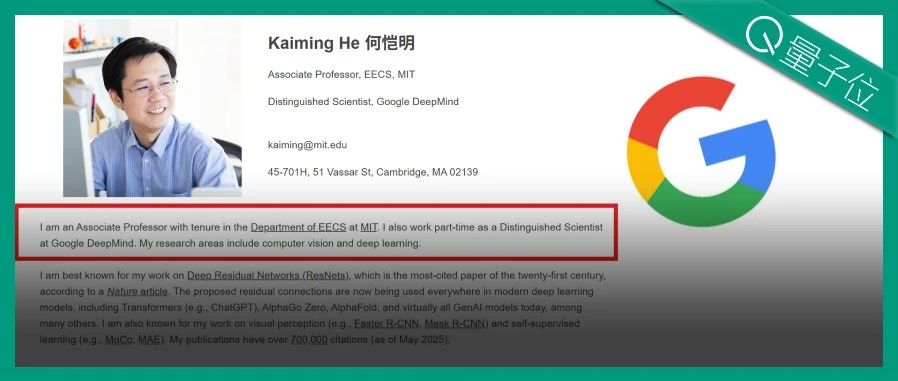
Core Viewpoint - Kaiming He, a prominent figure in computer vision, has recently joined Google DeepMind as a part-time distinguished scientist after obtaining tenure at MIT, indicating a strategic collaboration between academia and industry in AI research [1][2][5][7]. Group 1: Kaiming He's Career and Achievements - Kaiming He is recognized as a legendary figure in the computer vision field, having received his undergraduate degree from Tsinghua University and his PhD from the Chinese University of Hong Kong under the supervision of Xiaodong Wu [9][10]. - He co-authored the award-winning paper "Single Image Haze Removal Using Dark Channel Prior" in 2009, marking a significant achievement for Asian researchers in the CVPR conference [10]. - After completing his PhD in 2011, he worked at Microsoft Research Asia and later joined Facebook AI Research (FAIR), where he developed the influential ResNet architecture, which has been cited over 280,000 times [11][12][15]. - His research contributions include notable works like Faster R-CNN and Mask R-CNN, the latter winning the best paper award at ICCV 2017 [15][18]. Group 2: Recent Developments and Collaborations - Kaiming He joined MIT's EECS department in 2023, marking a return to academia after a significant tenure in the industry, which garnered attention and speculation about Meta's loss [16][18]. - His recent research focuses on model performance optimization, including advancements in image generation techniques and the development of highly compressed tokenizers for text generation [20]. - He has collaborated with Google DeepMind on various projects, including the paper "Fractal Generative Models," which introduced a new paradigm for generating high-resolution images [22][23]. - The collaboration with DeepMind has been ongoing, with previous joint efforts addressing challenges in visual autoregressive models and proposing solutions for scaling these models [25][27].