深度运营

Search documents
守正出奇,保利商旅的运营新启示
Xin Lang Cai Jing· 2026-02-12 12:13
Core Insights - The retail industry in China is facing significant challenges, including a saturated commercial space nearing 700 million square meters and an average vacancy rate exceeding 15%, leading to a shift towards "operation as king" [2][32] - Major players like China Resources, New City Holdings, and Longfor Group are focusing on "deep operation" strategies to enhance operational quality and asset value, aiming for a balance between scale and efficiency [2][32] - Poly Commercial Travel exemplifies the strategy of "stabilizing the foundation while innovating," aligning with industry leaders through its core actions of "merchant symbiosis, marketing breakthroughs, and regional deepening" [2][32] Part 1: From "Managing Merchants" to "Symbiotic Partners" - The core competitiveness of retail commercial properties has shifted from traditional space leasing to deep operational empowerment of the merchant ecosystem [2][32] - Poly Commercial Travel has introduced the "GROW Merchant Symbiosis Model," which evolves the role from "landlord" to "operating partner" and ultimately to "strategic partner," creating a symbiotic commercial ecosystem [3][33] - The GROW model is tailored to different project characteristics, demonstrating its effectiveness through successful collaborations, such as the "One Piece Pop-up Exhibition" in Guangzhou, which saw a 50% increase in traffic and a 30% rise in sales [5][35] Part 2: Precision Marketing Breakthroughs - The marketing landscape is transitioning from single large promotional events to more frequent, refined long-term activities, reflecting a shift in consumer behavior towards emotional and experiential consumption [8][39] - Poly Commercial Travel's "Good Times Appointment" campaign involved 105 events across 18 cities, resulting in a 29% increase in foot traffic and an 18% rise in sales [9][39] - The company emphasizes emotional value in marketing, moving from mere product transactions to creating emotional resonance with consumers [10][40] Part 3: Market Deepening Strategies - The retail commercial property sector is entering a new development cycle focused on deep-rooted and refined operations [21][51] - Poly Commercial Travel is committed to deepening its presence in high-energy urban areas, particularly in the Greater Bay Area and Yangtze River Delta, to create brand effects and market penetration [21][51] - The company has successfully established a product brand system called "Time Series," which includes various projects that have gained market recognition and consumer trust [21][51]


领雁科技深度运营叠加AI创新助力商业银行打造数智化营销运营体系
Cai Fu Zai Xian· 2025-08-13 10:13
Core Insights - The report highlights a significant shift in the Chinese banking sector, where large banks' share of new loans increased from 34.79% in 2018 to 52.18% by the end of 2024, while small and medium-sized banks' share decreased from 53.74% to 37.61% [1] - This trend reflects the deepening development of inclusive finance and a low-interest-rate environment, prompting large banks to transition from scale expansion to deep operational strategies [1][2] - The competition landscape is being reshaped as large banks leverage technology and resources to penetrate markets traditionally served by smaller banks, creating challenges for the latter [3][4] Group 1: Challenges for Small and Medium-Sized Banks - The operational shift of large banks towards deep operations is driven by inclusive finance policies and economic pressures, which are squeezing the traditional profit models of smaller banks [5][6] - Small banks face difficulties in customer retention and profitability due to a narrowing interest margin and increased competition from larger banks [6][7] - Digital capabilities are lacking in small banks, leading to customer attrition as larger banks utilize advanced technology to enhance service delivery and customer experience [4][8] Group 2: Strategies for Marketing Transformation - Small banks need to enhance their digital capabilities while leveraging local advantages to redefine their value creation logic [6][9] - Understanding customer needs through localized insights and continuous engagement is crucial for small banks to maintain competitiveness [8][10] - A dual-channel marketing system that integrates online and offline strategies is essential for small banks to optimize customer interactions and service delivery [9][11] Group 3: Role of Technology and Innovation - The integration of AI and big data is pivotal for small banks to enhance their marketing strategies and operational efficiency [10][12] - Companies like Lingyan Technology are leading the way in providing digital marketing solutions that empower banks to build intelligent marketing systems [10][13] - The development of customer models and marketing strategies based on data-driven insights is critical for small banks to adapt to changing market dynamics [12][14] Group 4: Case Studies and Practical Applications - Successful implementations of intelligent marketing platforms have been observed in various banks, showcasing the effectiveness of technology in enhancing operational capabilities [20][21] - Collaborative efforts between banks and technology firms have resulted in the creation of comprehensive marketing systems that facilitate seamless customer engagement [24][25] - The adoption of AI-driven tools has significantly improved the productivity of bank staff, demonstrating the transformative potential of technology in the banking sector [26][27]
核心商务区净吸纳量同比增三成,武汉优质写字楼市场加速回暖
Chang Jiang Ri Bao· 2025-07-15 10:20
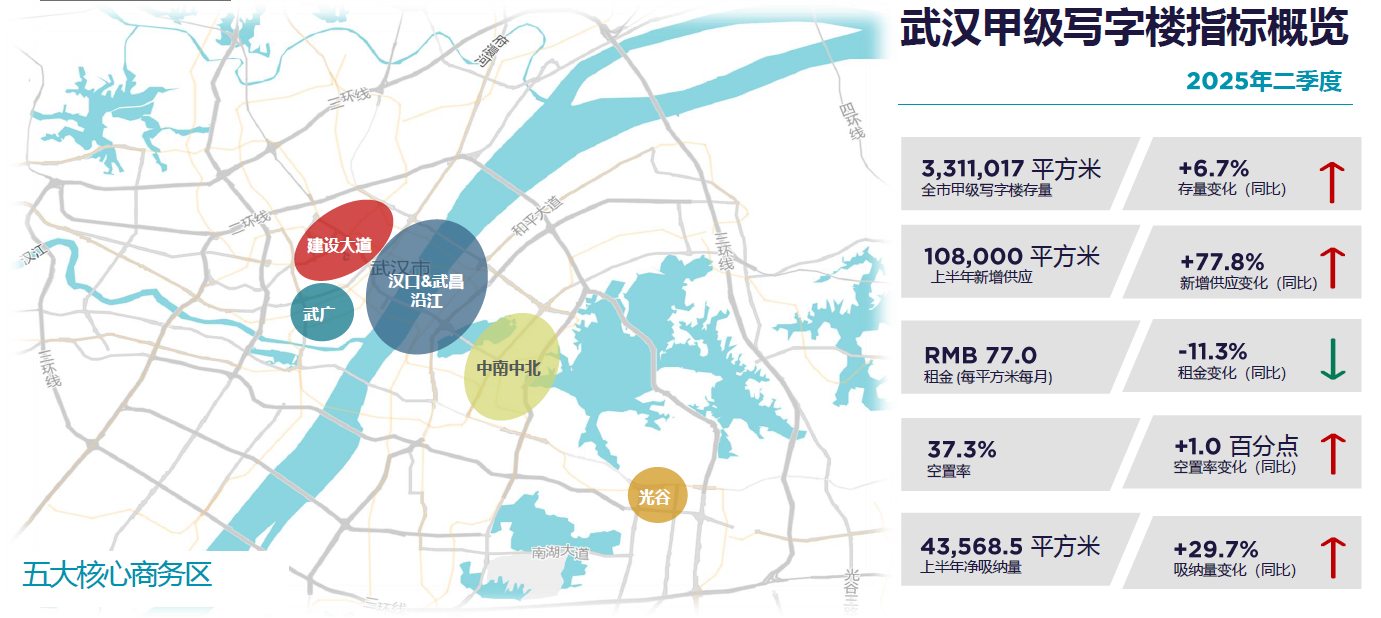
Core Insights - The core viewpoint of the article highlights the significant growth in the Wuhan Grade A office market, driven by high-tech enterprises and a shift towards "deep operation" strategies in response to market changes [1][6]. Market Performance - In the first half of 2023, the net absorption of Grade A office space in Wuhan's core business district reached 44,000 square meters, marking a year-on-year increase of nearly 30% [1][6]. - The total stock of Grade A office space in the core business district rose to 3.311 million square meters, with new supply amounting to 108,000 square meters [6]. Demand Drivers - The main driver for transactions in the market is relocation, accounting for 65.8% of the demand [6]. - The share of TMT (Technology, Media, and Telecommunications) companies in new leasing demand has increased significantly, from 14.6% in 2021 to 39.2% in the first half of 2023 [6]. Industry Trends - The Wuhan Grade A office market is transitioning from a strategy of "price for volume" to "operational empowerment," necessitating owners to adapt to market changes and evolving customer needs through smart operations and service upgrades [6].