
AI+营销

Search documents
春节动销“冰与火”:控库存过冬,拓场景迎春
Sou Hu Cai Jing· 2026-02-12 09:42
Core Viewpoint - The Chinese liquor market, particularly for baijiu, is experiencing a unique and competitive landscape this Spring Festival, characterized by a delayed peak in sales and a significant divide between leading brands and smaller ones [1][3]. Group 1: Market Dynamics - The sales peak for baijiu is expected to occur closer to the Spring Festival, with major brands like Moutai seeing a resurgence in sales and price increases, while smaller brands struggle [1][3]. - Moutai's price has shown a strong upward trend, with recent sales prices reaching between 1,800 and 1,900 yuan per bottle, reflecting a significant increase from previous months [1][3]. - The overall market is witnessing a two-tiered recovery, with leading brands like Moutai and Wuliangye performing better than smaller brands, which are facing challenges in inventory management and consumer demand [3][11]. Group 2: Consumer Behavior and Sales Strategies - Consumer purchasing behavior is shifting towards on-demand buying rather than stockpiling, leading to a cautious approach from distributors regarding inventory [3][4]. - Companies are focusing on promotional activities to stimulate sales, with various marketing campaigns aimed at enhancing consumer engagement and encouraging product consumption [5][6]. - The emphasis on creating consumption scenarios, particularly during family gatherings and social events, is becoming a key strategy for brands to drive sales [5][6]. Group 3: Evolving Sales Channels - The rise of instant retail is reshaping the sales landscape, allowing companies to reach younger consumers and cater to immediate consumption needs [8][10]. - Partnerships with platforms like Meituan are being leveraged by companies such as Moutai and Xijiu to enhance distribution and promotional efforts during the festive season [8][10]. - The integration of technology and innovative marketing strategies is essential for companies to adapt to changing consumer preferences and improve sales performance [10][11]. Group 4: Industry Outlook - Analysts predict a gradual recovery in the baijiu market, with expectations for stable sales performance during the Spring Festival and throughout the year [11]. - The capital market has shown signs of improvement, with a notable rebound in the baijiu sector, driven by favorable macroeconomic policies and strong sales from leading brands [11]. - The industry is expected to continue facing challenges, particularly for mid-tier brands, while high-end products maintain stable demand and pricing [11].


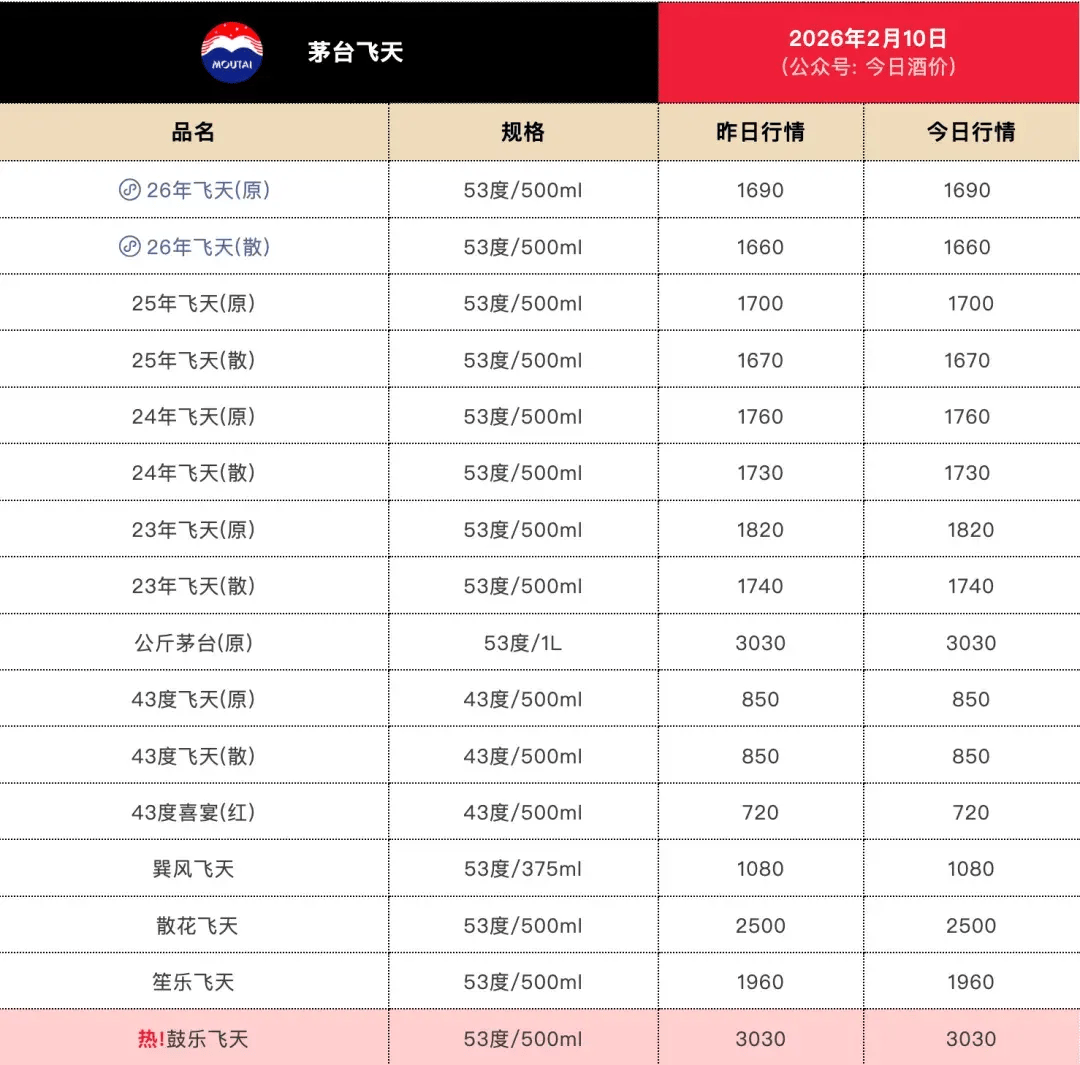
春潮启市白酒春节旺季价格带“分化而行”
Bei Jing Shang Bao· 2026-02-11 12:21
Core Viewpoint - The Chinese liquor market is experiencing a shift in consumer preferences, with a notable increase in demand for products priced around 300 yuan, contrasting with previous years where high-end products priced at 1,000 yuan were more popular. This indicates a transition from scale expansion to competition within existing market shares as the industry adapts to changing consumer behavior [1][2][7]. Market Trends - Consumers are increasingly opting for mid-range liquor products, with many shifting from high-end options to those around 300 yuan due to better cost-performance ratios [2][3]. - The sales of products priced at 300 yuan have become the main focus in retail markets, while products priced above 800 yuan have also seen slight growth during the festive season [2][3]. - The overall market is witnessing a bifurcation, with both low-end (under 100 yuan) and high-end (over 800 yuan) segments gaining market share, while mid-range products face pressure [3][7]. Marketing Strategies - Major liquor companies are implementing various promotional activities to stimulate market activity, including gift card promotions and cash rewards for consumers [4][5]. - The focus has shifted from merely increasing cash flow to enhancing actual sales and reducing inventory through innovative marketing strategies [5][6]. Consumer Behavior - The upcoming Spring Festival is anticipated to boost liquor sales, with expectations of increased consumer gatherings and spending due to an extended holiday period [6][7]. - There is a notable trend of consumers prioritizing value for money, leading to a preference for products that meet both family and business gathering needs [2][6]. Industry Outlook - The liquor industry is undergoing a transformation, moving towards a dual competition model involving both channel-owned and manufacturer-owned products, which is expected to diversify the competitive landscape [7][8]. - The integration of new technologies and innovative retail channels is becoming crucial for liquor companies to adapt to evolving consumer demands and enhance sales effectiveness [8].




易观分析:中国AI+营销趋势洞察报告2026
Sou Hu Cai Jing· 2026-01-23 10:54
Core Insights - AI is fundamentally reshaping the marketing landscape, transitioning from technology exploration to value-driven scalable development, with ten core trends identified in the report [1][5][6]. Group 1: Investment and Market Growth - AI marketing investment has entered a scalable phase, with ROI becoming the core measurement standard; the market size for AI marketing SaaS/Agent is projected to reach 47.1 billion yuan by 2025 and 174.7 billion yuan by 2030 [1][6][7]. - Companies are increasingly favoring industry vertical models and full-link intelligent agents that provide quick results and strong adaptability [6][7]. Group 2: Evolution of AI in Marketing - AI's role has evolved from a content generation tool to a full-link automated intelligent agent covering insights, strategy, creativity, execution, user interaction, sales conversion, and customer service [1][5][8]. - The marketing focus is shifting from static "precise reach" to dynamic "personalized interaction and journey management," leveraging AI's real-time insights and predictive capabilities [1][10][11]. Group 3: Content and Engagement Strategies - High-quality, low-cost AI video generation technology is maturing, transforming video content from a one-way communication medium to an interactive and customizable core marketing vehicle, with 2026 expected to be the "year of interactive video marketing" [1][12][13]. - Content marketing strategy has gained unprecedented importance, with owned media becoming the "trust center" and content assets recognized as core business assets [1][20][21]. Group 4: New Social Interaction Models - New social platforms based on AI agents and natural language interaction are emerging, creating a triadic social structure of "human-AI-human," focusing on connection quality and value exchange [1][17][18]. Group 5: Marketing Software Transformation - AI is transforming marketing software from functional tools to a "service as software" model, emphasizing the delivery of business results rather than just functionalities [1][24][25]. Group 6: Trust and Transparency in Marketing - As AI deeply integrates into marketing, transparency, explainability, and the authenticity of generated content are becoming foundational for building trustworthy brand experiences [1][28].

“GEO”概念引爆二级市场,AI时代的革命性营销工具来了?
Jin Rong Jie· 2026-01-22 04:11
Core Insights - The concept of Generative Engine Optimization (GEO) is gaining traction in the secondary market, with companies like BlueFocus, ZhiDeMai, and YiDianKeJi experiencing significant stock price surges as it replaces traditional Search Engine Marketing (SEM) as a new marketing strategy [1][2] - GEO focuses on enhancing content visibility across large language models, shifting the emphasis from click-based rankings to "answer share," indicating a broader market potential than SEM [2][3] Market Potential and Timing - GEO is expected to cover the entire SEM market, which is projected to be worth several billion dollars, and its market space is anticipated to be larger than that of SEM [2][3] - The window for companies to adopt GEO is estimated to be within the next one to two years, with potential changes in interface richness and content quality standards [3] Competitive Landscape - Companies with foundational large models (e.g., DeepSeek, Doubao) hold the most significant advantages, while platforms with large user bases (e.g., Baidu, WeChat, Douyin) have substantial traffic distribution capabilities [5][6] - Brand owners must prioritize the accuracy of their structured knowledge bases to ensure reliable information is presented in GEO outputs [6] Content Creation and Quality - The rise of GEO will alter content creation strategies, emphasizing evidence-based content and the reliability of information sources over stylistic originality [8][9] - The impact on originality may be dual-faceted, potentially diminishing creative expression while simultaneously promoting the use of reliable data and sources [8][9] Regulatory Considerations - The emergence of GEO may lead to issues such as AI data pollution and misinformation, prompting the need for regulatory frameworks similar to those for traditional search engines [11][12] - Future regulations may focus on content traceability and accountability for platforms distributing information, ensuring compliance with safety and accuracy standards [12] Brand Strategy and Marketing Implications - Brands should focus on brand safety and accurate public relations management in the early stages of GEO adoption, with an emphasis on defensive strategies against misinformation [13] - The integration of AI in marketing is expected to enhance personalization and data-driven decision-making, transforming the marketing landscape into a more intelligent ecosystem [14][15]
港股异动 | 微盟集团(02013)早盘涨超6% 淘宝闪购接入千问 多家微盟商户已产生实际订单
智通财经网· 2026-01-20 02:04
Core Viewpoint - Weimob Group (02013) has seen a significant stock price increase, attributed to its collaboration with Alibaba's AI application "Qianwen" and the launch of its new GEO solution, indicating strong market potential and a strategic focus on AI integration [1] Group 1: Stock Performance - Weimob Group's stock rose over 6% in early trading, currently up 4.8% at HKD 2.4, with a trading volume of HKD 156 million [1] Group 2: Strategic Partnerships - The collaboration between Alibaba's "Qianwen" and Weimob Group has achieved deep integration with Taobao Flash Purchase, creating a full-cycle loop from AI search to product recommendation to transaction conversion [1] - Several Weimob merchants have already generated transaction orders on the Taobao Flash Purchase platform, validating the new business model's market expectations and commercial potential [1] Group 3: Technological Advancements - Weimob Group has launched the Weimob Star Initiation Generative Engine Optimization (GEO) solution, which utilizes self-developed generative engine optimization technology to enhance brand visibility in AI searches, including "Qianwen" [1] - The company is continuously strengthening its "All in AI" strategy by improving both front-end traffic and back-end technology through the integration of AI and marketing [1]
微盟集团早盘涨超6% 淘宝闪购接入千问 多家微盟商户已产生实际订单
Zhi Tong Cai Jing· 2026-01-20 02:04
Core Viewpoint - Weimob Group (02013) has seen a significant stock price increase, attributed to its collaboration with Alibaba's AI application "Qianwen" and the launch of its new GEO solution, enhancing its AI-driven marketing strategy [1] Group 1: Stock Performance - Weimob Group's stock rose over 6% in early trading, currently up 4.8% at HKD 2.4, with a trading volume of HKD 156 million [1] Group 2: Strategic Partnerships - The partnership with Alibaba's "Qianwen" and Taobao Flash Purchase has created a full-loop integration of "AI search - product recommendation - transaction conversion," indicating strong market potential [1] Group 3: Technological Advancements - Weimob Group has launched its self-developed GEO solution, which utilizes generative optimization technology to enhance brand visibility in AI searches, including "Qianwen" [1] - The company is reinforcing its "All in AI" strategy by improving both front-end traffic and back-end technology through its "AI + marketing" framework [1]
2025年中国营销智能体研究报告
艾瑞咨询· 2026-01-20 00:07
Core Insights - The article emphasizes the rapid evolution of marketing intelligence agents, which are transforming from mere tools into autonomous decision-making systems in marketing, driven by advancements in AI technology [1][4][11]. Market Trends and Global Dynamics - Three major changes are identified: accelerated changes in platform advertising environments, rising privacy requirements, and increased digital marketing investments by companies [2]. Emergence of Global Marketing Intelligence Agents - The application of computer technology in marketing is undergoing a profound transformation, evolving from data analysis and decision support to full-chain marketing automation systems [4][11]. Challenges for Chinese Enterprises in Overseas Marketing - Chinese companies face significant challenges in overseas marketing, including cultural differences, complex channels, privacy and compliance issues, and cross-border payment difficulties [6]. Opportunities for Chinese Enterprises in Overseas Marketing - Marketing intelligence agents provide crucial support in content creation, compliance checks, and localization for Chinese enterprises venturing abroad, leveraging the rapid iteration of open-source large language models [8]. Definition of Marketing Intelligence Agents - Marketing intelligence agents are defined as products based on generative AI or machine learning algorithms that can autonomously or semi-autonomously execute marketing-related tasks, assisting or replacing human marketing efforts [9]. Transition from Marketing Tools to Autonomous Agents - The development of marketing technology is transitioning from "tools" to "agents," with these agents now capable of real-time optimization across multiple channels [11][13]. Key Capabilities of Marketing Intelligence Agents - The four core capability areas of marketing intelligence agents include market insights, content generation, campaign optimization, and evaluation report generation, enabling full-chain automated marketing and continuous optimization [15]. Future Technology Trends - The collaboration of multiple agents forms a closed-loop system, combining creative, deployment, and analytical agents to achieve a cycle of creative generation, advertising deployment, data feedback, and strategy adjustment [17]. Challenges in AI + SaaS Models - The monetization of AI within SaaS companies faces challenges, with a consensus emerging that AI will integrate seamlessly into daily tools rather than creating significant revenue streams [19]. Global and Chinese AI Marketing Market Environment - The AI + marketing market is rapidly evolving, driven by technological innovation, regulatory policies, and changes in business models, with both international and Chinese markets showing a shift from "tool-based" to "intelligent" approaches [22]. Commercial Model Analysis of Marketing Intelligence Agents - The commercial model of marketing intelligence agents is evolving from a "single software subscription" to a "multi-dimensional revenue system," encompassing SaaS subscriptions, advertising revenue sharing, and value-added services [31]. Market Size and Forecast for China's Intelligent Marketing Agents - The market for intelligent marketing agents in China is expected to exceed 100 billion yuan by 2030, driven by the integration of AI technologies and the digital transformation of the advertising industry [34]. Digital Marketing Penetration in China - China's digital economy is growing rapidly, with a growth rate of 7.39%, and the digital marketing sector is entering a phase of accelerated penetration due to advancements in AI technologies [36]. Policy Framework for AI + Marketing in China - China is establishing a multi-layered policy framework to support and regulate the integration of AI in marketing, covering strategic guidance, technological research, industry applications, and compliance [38][41]. Global Opportunities for Chinese Enterprises - Chinese marketing intelligence products have the potential to challenge established giants by offering next-generation, AI-native automated infrastructure, leveraging unique business and talent structures [45][48].

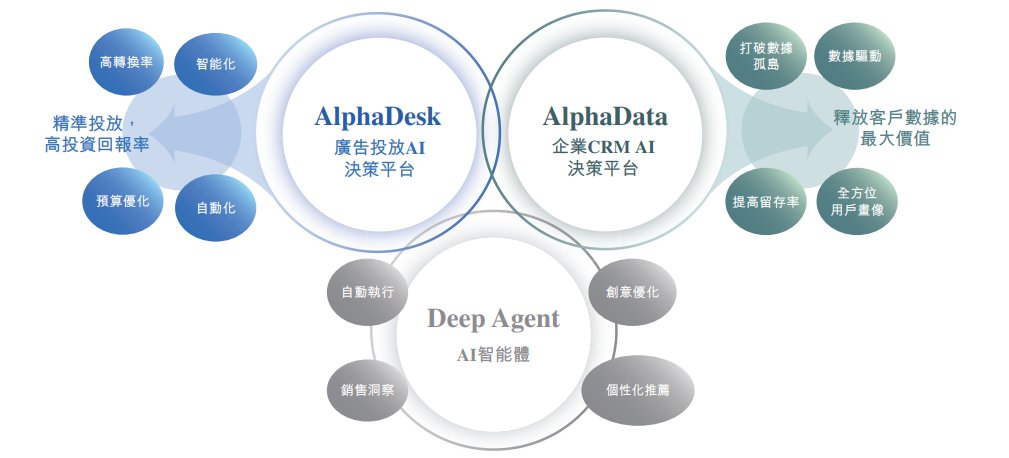
新股前瞻 | AI营销赛道激战正酣,业绩大幅波动的深演智能龙头地位或受挑战?
智通财经网· 2026-01-14 10:28
Core Insights - The rapid rise of AI applications in various sectors, driven by major companies like ByteDance and Alibaba, has positioned AI as a central theme in the capital market, with significant stock price increases for leading firms in a short period [1] - The shift in market expectations from "computing power infrastructure" to "application realization" indicates a changing investment logic, paving the way for companies to capitalize on AI applications [1] - Beijing Deepen Intelligent Technology Co., Ltd. (Deepen Intelligent) is actively pursuing its capital market ambitions, having submitted its second listing application to the Hong Kong Stock Exchange [2] Company Overview - Deepen Intelligent is recognized as the leading player in China's marketing and sales decision AI application market, holding a market share of 2.6% based on 2024 revenue [2] - The company has experienced significant revenue fluctuations, with reported revenues of approximately 543 million, 611 million, and 538 million RMB for the years 2022 to 2024, respectively [2] - In the first half of 2025, Deepen Intelligent reported a revenue of 277 million RMB, reflecting a year-on-year growth of 5.73% [2] Business Structure and Revenue Sources - Deepen Intelligent's revenue is primarily derived from intelligent advertising and data management, with 2024 revenue contributions of 84.6% and 14.5%, respectively [6] - The company has served around 530 clients, including 89 Fortune Global 500 companies, with significant revenue contributions from sectors such as FMCG, retail, and beauty [6] - The revenue from the top five clients has increased from 51.1% in 2022 to 70.2% in the first half of 2025, indicating a growing dependency on a limited client base [11] Market Challenges and Competitive Landscape - The marketing and sales decision AI application market is highly fragmented, with Deepen Intelligent holding only a 2.6% market share, facing competition from over a hundred players [9] - The company's reliance on a few major clients poses a risk, as any changes in their strategies could lead to significant revenue declines [11] - Deepen Intelligent's R&D expenditure has been relatively low, accounting for only 8.4% of total revenue in the first half of 2025, which may hinder its ability to innovate and maintain competitive advantages [11] Future Outlook - The marketing and sales decision AI application market is projected to grow from 203 billion RMB in 2024 to 944 billion RMB by 2029, with a compound annual growth rate (CAGR) of 36.5% [15] - Deepen Intelligent faces the challenge of converting market opportunities into growth momentum, requiring strategic adjustments to optimize its business structure and reduce client concentration [15][16] - The company's ability to address these challenges will significantly impact its valuation and market perception as a leader in marketing decision AI [16]
GEO解决方案推动微盟集团股价暴涨超20%
Zhong Guo Jing Ying Bao· 2026-01-13 14:49
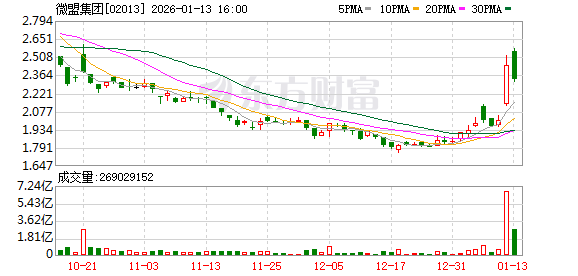
Core Viewpoint - Weimob Group launched its Generative Engine Optimization (GEO) solution "Weimob Xingqi" on January 12, 2026, leading to a 21.39% surge in stock price, the largest single-day increase in nearly a year, driven by strong investor interest in the "AI + Marketing" sector [2][4] Group 1: Market Reaction and Stock Performance - Following the launch of "Weimob Xingqi," the stock price initially surged over 20%, reflecting market excitement around the "AI + Marketing" concept [4][5] - However, the stock experienced a decline the next day, attributed to the thin liquidity in the Hong Kong market and investors' tendency to take profits after significant gains [2][5] - The market's reaction is characterized by a conflict between high interest in the GEO concept and the lack of concrete performance metrics, leading to volatility in stock prices [2][6] Group 2: Industry Context and Challenges - Gartner predicts that by 2028, 50% of search engine traffic will be captured by AI searches, indicating a significant shift in consumer behavior and a potential survival crisis for brands not visible in AI-generated answers [3][4] - Weimob's GEO solution aims to address the challenge of brand visibility in an AI-dominated information distribution system, utilizing AI-driven data monitoring, content generation, and distribution strategies [3][4] - Despite the innovative nature of GEO, its commercialization is still in the early stages, with unclear revenue models and market potential [4][6] Group 3: Business Development and Future Outlook - Weimob has expanded the GEO solution across various industries, including consumer goods and software applications, marking a strategic move in the "AI + Marketing" landscape [4][6] - The company is positioning itself to leverage advancements in AI marketing technology, aiming to transform from content production tools to foundational infrastructure for information distribution [6][7] - The GEO business has the potential to become a new growth curve for Weimob, but its success hinges on the validation of its business model and the regulatory environment surrounding generative AI [7]
软件ETF(515230)大涨超8%,春季躁动进行时,AI应用迎来高潮
Mei Ri Jing Ji Xin Wen· 2026-01-12 05:55
Group 1 - The software ETF (515230) surged over 8% on January 12, indicating a strong market response to AI applications and the ongoing spring rally [1] - The GEO concept is gaining traction, potentially transforming the business models of advertising agencies, with AI and marketing expected to reshape the core of the advertising industry [1] - ChatGPT has launched health services that provide real-time and accurate health assistance, highlighting the growing role of AI in healthcare [1] Group 2 - AI is anticipated to remain a key technological theme, with a shift from hardware to software being inevitable, though the timing remains uncertain [1] - Significant investments in AI infrastructure must resonate on the software side to ensure the sustainability of long-term investments [1] - There is a performance gap between North American AI models and domestic AI models, but alleviation of domestic computing power supply bottlenecks may lead to rapid performance improvements for domestic model providers [1] Group 3 - The software ETF (515230) tracks the software index (H30202), which selects securities from companies involved in software development, sales, and related services, characterized by technological leadership and strong innovation capabilities [1] - As a representative index of the information technology sector, it reflects the overall performance and development trends of the software industry [1]