
港口智慧绿色转型

Search documents
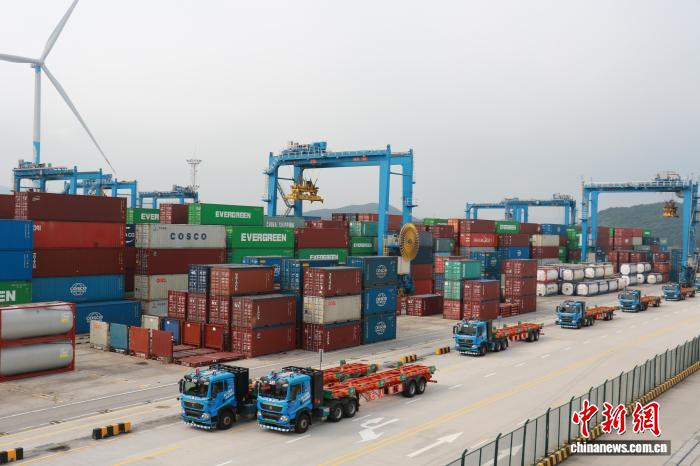
梅山港区的智慧绿色转型:从远控桥吊到无人集卡
Zhong Guo Xin Wen Wang· 2025-08-05 09:29
Core Insights - The article discusses the smart and green transformation of the Meishan Port area, part of the Ningbo-Zhoushan Port, which is the largest port in the world. The port has implemented remote-controlled automated equipment to enhance operational efficiency and sustainability [1][3]. Group 1: Automation and Technology - The Meishan Port area has developed the world's largest cluster of remote-controlled equipment, including 36 remote-controlled bridge cranes, with a remote control ratio of 72%. Additionally, there are 116 remote-controlled gantry cranes and 102 unmanned container trucks operating in the port [1]. - The port's operations are managed by a "dual-core brain" system, which includes n-TOS and iECS, providing complete autonomy and reducing reliance on foreign software. This system collaborates with the port's power management system to minimize empty truck mileage and improve gantry crane accuracy [3][4]. Group 2: Environmental Impact and Efficiency - The electrification rate of container trucks in the port has reached 53%, and the electrification coverage of large equipment is 100%. This transition supports the port's green transformation and reduces greenhouse gas emissions associated with international shipping, which accounts for approximately 3% of global emissions [3][4]. - The smart green transformation of ports is deemed necessary to overcome limitations related to space saturation and energy dependence, address climate crisis and compliance pressures, and enhance the efficiency of logistics as a core component of the economic cycle [4].

6月9日晚间央视新闻联播要闻集锦
Yang Shi Xin Wen Ke Hu Duan· 2025-06-09 14:12
Group 1 - The Chinese government emphasizes the importance of cultural exchange and mutual learning as a driving force for human civilization progress and world peace [1][2] - The State Council, led by Premier Li Qiang, conducted a special study on deepening the reform of the technology achievement transformation mechanism to promote the integration of technological innovation and industrial innovation [3] - The Central Committee and the State Council issued opinions aimed at further ensuring and improving people's livelihoods, focusing on addressing urgent issues faced by the public [4] Group 2 - In the first five months of the year, China's goods trade import and export maintained a stable growth, with a year-on-year increase of 2.5% [5] - The consumer price index (CPI) in May showed a slight year-on-year decline of 0.1%, while the core CPI, excluding food and energy, increased by 0.6%, marking an expansion in growth [7] - The consumption goods industry in China is accelerating its intelligent transformation, with significant growth in smart, green, and healthy products, supported by policies aimed at boosting consumption and upgrading industries [8] Group 3 - Chinese ports are accelerating their transition to smart and green development, with the number of automated terminals built and under construction ranking first in the world [9] - The summer harvest and planting activities are progressing smoothly across the country, leveraging technology to ensure a bountiful grain harvest [10] - Hunan province is advancing the large-scale application of Beidou technology across multiple fields, transforming technological advantages into industrial strengths for high-quality development [11]
业界专家:推进港口智慧绿色转型 政策层面将继续加码
Zhong Guo Xin Wen Wang· 2025-05-27 15:39
Core Insights - The National Port Technology Innovation Conference highlighted significant advancements in China's port industry, particularly in automation, intelligent scheduling systems, and green technologies, leading to improved operational efficiency and safety [1][2] Group 1: Technological Advancements - China's port industry has achieved remarkable results in technological innovation, with automated terminals leading globally and widespread application of intelligent scheduling systems [1] - The Ningbo-Zhoushan Port has entered the "world-leading" category in the global port rankings, alongside Singapore and Shanghai, as per the "World-Class Port Comprehensive Evaluation Report (2025)" [1] - Zhejiang Port Group has established a leading global remote-controlled automated equipment cluster, achieving full-process automation in port operations [1] Group 2: Industry Collaboration and Challenges - The port industry is increasingly focusing on the synergy between production and operational management, leveraging AI and digital infrastructure to connect logistics elements [2] - Despite advancements, challenges remain in the integration of industry, academia, and research, with some ports lacking strong technological innovation capabilities [2] - Recommendations include increasing R&D investment and forming collaborative innovation bodies to tackle key technological challenges [2] Group 3: Policy and Future Directions - The Ministry of Transport is accelerating the development of policies to support the integration of AI in transportation, with goals set for 2030 and beyond [2] - The port association is leading efforts to consolidate automation technologies for container terminals, promoting cooperation in technology, safety, and sustainability among ports [3]
