
滚动市盈率分位

Search documents
机构称市场有望震荡上行,A500ETF易方达(159361)助力布局A股核心资产
Sou Hu Cai Jing· 2026-02-27 11:50
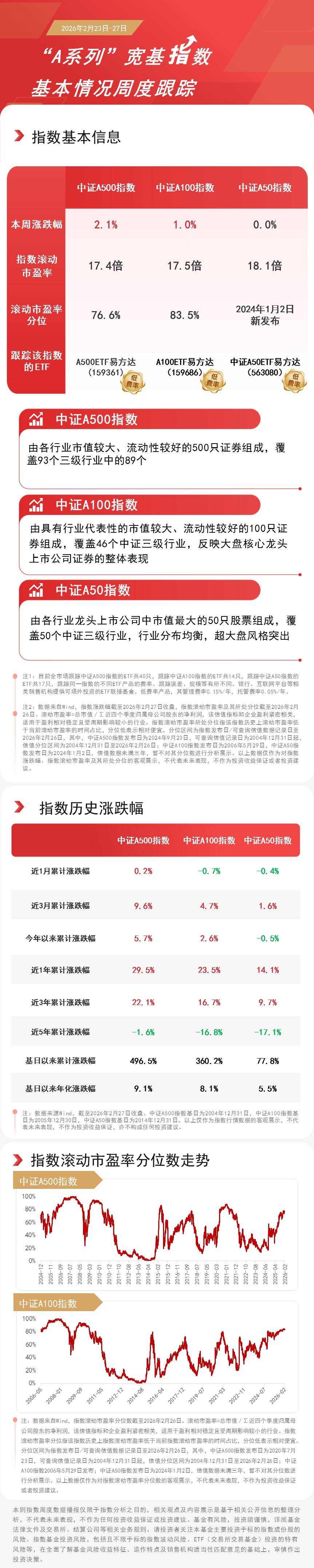
Market Performance - The CSI A500 index increased by 2.1% this week, while the CSI A100 index rose by 1.0%, and the CSI A50 index remained nearly flat [1][3]. - Historical data from 2012 to 2025 indicates a high probability of the CSI A indices rising in the 20 trading days following the Spring Festival, with average returns significantly higher than those in the 20 trading days prior to the festival from 2010 to 2024 [1]. Index Composition - The CSI A500 index consists of 500 securities with large market capitalization and good liquidity, covering 89 out of 93 sub-industries [4]. - The CSI A100 index includes 100 representative securities with large market capitalization and good liquidity, covering 46 sub-industries, reflecting the overall performance of core leading companies [4]. - The CSI A50 index is made up of the 50 largest stocks from leading companies across 50 sub-industries, showcasing a balanced industry distribution with a focus on large-cap stocks [4]. ETF Tracking - There are currently 40 ETFs tracking the CSI A500 index, 14 ETFs for the CSI A100 index, and 17 ETFs for the CSI A50 index, with variations in fee rates, tracking errors, and sizes among different ETFs [4]. Valuation Metrics - The rolling price-to-earnings (P/E) ratios for the indices are as follows: CSI A500 at 17.4x, CSI A100 at 17.5x, and CSI A50 at 18.1x [3]. - The percentile rankings for the rolling P/E ratios indicate that the CSI A500 is at 76.6%, the CSI A100 at 83.5%, and the CSI A50's percentile ranking is not yet available as of January 2, 2024 [3]. Historical Performance - Over the past month, the CSI A500 index has a cumulative return of 0.2%, while the CSI A100 and CSI A50 indices have returns of -0.7% and -0.4%, respectively [6]. - In the last three months, the cumulative returns are 9.6% for the CSI A500, 4.7% for the CSI A100, and 1.6% for the CSI A50 [7]. - Year-to-date returns show the CSI A500 at 5.7%, the CSI A100 at 2.6%, and the CSI A50 at -0.5% [7]. - Over the past year, the CSI A500 has returned 29.5%, the CSI A100 23.5%, and the CSI A50 14.1% [7]. - Since their base dates, the CSI A500 has increased by 496.5%, the CSI A100 by 360.2%, and the CSI A50 by 77.8% [7].

港股科技板块回调引资金关注,恒生科技ETF易方达(513010)连续多日“吸金”
Mei Ri Jing Ji Xin Wen· 2025-10-17 13:50
Market Overview - The Hong Kong stock market experienced overall fluctuations and corrections this week, with southbound funds accumulating a net purchase of over 45 billion HKD [1] - The CSI Hong Kong Stock Connect Consumer Theme Index fell by 3.5%, the CSI Hong Kong Stock Connect Healthcare Comprehensive Index decreased by 5.7%, the CSI Hong Kong Stock Connect Internet Index dropped by 7.6%, the Hang Seng Hong Kong Stock Connect New Economy Index declined by 7.8%, and the Hang Seng Technology Index fell by 8% [1][3] ETF Inflows - Recent data indicates a significant inflow into related ETFs, with the Hang Seng Technology ETF (513010) attracting over 2.5 billion HKD in nine consecutive trading days [1] - The inflow into ETFs reflects a growing interest from investors in technology and new economy sectors despite the overall market downturn [1] Index Performance - The performance of various indices over the past month shows a decline, with the Hang Seng New Economy Index down by 8.8%, the Hang Seng Technology Index down by 8.1%, and the CSI Hong Kong Stock Connect Healthcare Comprehensive Index down by 9.7% [8] - Year-to-date performance indicates a strong recovery for some indices, with the CSI Hong Kong Stock Connect Healthcare Comprehensive Index up by 78.9% and the Hang Seng New Economy Index up by 35.2% [8] Valuation Metrics - The rolling price-to-earnings (P/E) ratios for the indices are as follows: Hang Seng New Economy Index at 24.8x, Hang Seng Technology Index at 22.9x, and CSI Hong Kong Stock Connect Healthcare Comprehensive Index at 30.0x [3][7] - The rolling P/E ratio percentiles indicate that the Hang Seng New Economy Index is at a 55.3% percentile, suggesting it is relatively expensive compared to historical levels, while the Hang Seng Technology Index is at 28.8%, indicating it is relatively cheaper [3][11]
