玉米市场价格走势

Search documents
元旦后玉米维持微涨走势 基层货源流转成远期关键变量
Xin Lang Cai Jing· 2026-01-16 02:44
Core Viewpoint - After New Year's Day 2026, domestic corn prices continue a slight upward trend, with expectations of increased trading volume before the Spring Festival and a small price increase anticipated [15][26]. Group 1: Price Trends - As of January 13, 2026, the national average corn price is 2241.00 yuan/ton, up 6.16 yuan/ton from 2234.84 yuan/ton at the end of December 2025 [15][26]. - The price trend shows a narrow upward movement since December 2025, influenced by several conflicting factors [15][26]. Group 2: Farmer and Trader Dynamics - There is a conflict between farmers and traders, with farmers holding back on sales due to a reluctance to sell at low prices, while traders face rising procurement costs [5][17]. - The sales resistance from farmers and the increased costs for traders create a situation where low prices are hard to procure, and high prices are difficult to sell, leading to decreased trading enthusiasm [5][17]. Group 3: Downstream Demand and Inventory - Downstream enterprises are entering a pre-holiday stocking phase, but the demand boost is not significant due to rising costs and competition from imported substitutes like sorghum and barley [22][24]. - The logistics issues in the fourth quarter of 2025 have led to higher inventories for downstream enterprises, which may reduce the urgency for pre-holiday purchases [22][24]. Group 4: Market Inventory and Trading Activity - The stability of market prices is influenced by the inventory levels in the intermediate market; a relatively ample inventory can lead to stronger price competition [24][26]. - The trading activity in the intermediate market has increased due to rising prices and the need to alleviate financial pressure as the year-end approaches [26]. Group 5: Future Price Expectations - The overall trading volume is expected to increase before the Spring Festival, with prices anticipated to remain in the range of 2250-2260 yuan/ton, reflecting a slight increase of less than 1% from mid-January [26]. - Post-Spring Festival price trends will depend on the changes in farmer selling progress and the accumulation of inventory in the intermediate market [26].


供应压力逐步提升 东南沿海10月玉米价格或逐步下跌、南北港价差料收窄
Xin Hua Cai Jing· 2025-10-11 09:15
Core Viewpoint - The corn market in Southeast coastal regions is expected to experience a price decline in October due to increasing supply pressures and stable demand conditions, with prices projected to drop by approximately 20 yuan/ton in the early part of the month [1][7]. Price Trends - In September, the corn prices in Southeast coastal regions initially rose to 50-60 yuan/ton before stabilizing, with prices at Shekou Port reaching around 2410 yuan/ton by September 26, an increase of 60 yuan/ton from the beginning of the month [1]. - Northern ports saw a different trend, with prices at 2280 yuan/ton by September 26, a decrease of 5 yuan/ton from the start of the month and 30 yuan/ton from September 10 [1]. - The theoretical trade margin between northern and southern ports averaged 9.5 yuan/ton in September, reflecting an increase of 72.5 yuan/ton month-on-month [1]. Supply and Inventory - The inventory of corn in southern ports decreased, with approximately 330,000 tons reported by September 25, indicating a higher turnover compared to the previous year [3]. - Northern port inventories have been declining since Q2, with a total of about 1.5 million tons by the end of September, which is slightly lower than the previous year [4]. Demand Factors - The demand for corn in the Southeast coastal region has been relatively stable, with downstream enterprises maintaining corn inventories at around 25 days, consistent with historical levels [5]. - The expectation for October is that demand will not significantly increase, as enterprises are likely to transition between old and new stocks without raising inventory levels [5]. Future Outlook - The corn market is anticipated to transition to new season corn in October, with limited supply in the early part of the month and potential price drops to between 2380-2400 yuan/ton [7]. - By mid to late October, increased supply pressures and competitive trading conditions may lead to further price declines, with projections of prices falling to between 2330-2350 yuan/ton [7].
新季玉米集中上市在即 主流价格形成尚需时日
Qi Huo Ri Bao· 2025-09-11 00:42
Core Insights - The domestic corn market is entering a new phase with the large-scale listing of 2025 spring corn and the upcoming harvest of summer corn in various regions, raising concerns about price alignment and future demand [2][12] Planting Area and Production - The corn planting area in China has shown a steady increase, with a notable growth expected in 2025, supported by favorable policies and high farmer enthusiasm [3][4] - From 2020 to 2024, the cumulative growth of corn planting area was 8.4%, and production increased by 13.1%, indicating a positive supply trend [4] - Regional disparities in corn growth are evident, with stable production in Northeast China and significant increases in Xinjiang and Southwest regions due to policy support [4][7] Weather Impact on Growth - The corn growth in southern regions, particularly in Henan, is adversely affected by prolonged drought conditions, with expected yield reductions of over 30% in some areas [5][6] - Conversely, Northeast China has experienced favorable weather conditions, leading to expectations of stable or slightly increased yields compared to the previous year [6][7] Consumption Trends - Corn consumption in China has seen significant growth since 2000, with total demand projected to continue rising in 2025, primarily driven by feed consumption [8][9] - The structure of corn consumption remains stable, with feed and industrial uses accounting for approximately 90% of total consumption [8] Market Dynamics and Pricing - The corn market is characterized by a "north strong, south weak" pricing pattern, with new season corn entering the market alongside inventory pressures [12][14] - Traditional trading strategies are becoming less effective, with market prices showing more volatility and transparency due to the involvement of larger trading entities [10][11] - The pricing of new season corn varies significantly across regions, with some areas experiencing lower prices despite good quality [11] Future Outlook - The corn market is expected to face multiple uncertainties as the new season corn enters the market, with potential regional price fluctuations due to supply-demand imbalances [13][14] - The strength of feed consumption is supported by stable livestock numbers, but any downturn in pig prices could impact demand [13][14]
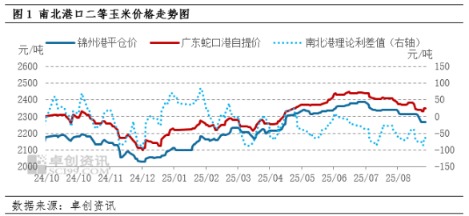
9月东南沿海玉米市场基本面对价格或有提振 但最终仍将向新作价格过渡
Xin Hua Cai Jing· 2025-09-03 07:32
Core Insights - The corn market in the southeastern coastal region of China showed a downward trend in August 2025, with two price rebounds occurring mid-month and at the end of the month, while some trading companies began pre-selling new crop corn [1][4][6] Price Trends - As of August 29, the price of second-grade corn at Shekou Port was approximately 2350 CNY/ton, down by 50 CNY/ton from the beginning of the month [1] - Northern ports also experienced a price decline, with the mainstream settlement price at 2260 CNY/ton, reflecting a similar decrease of 50 CNY/ton [3] - The average theoretical trade differential between southern and northern ports was -63.10 CNY/ton, a decrease of 18.32 CNY/ton from the previous month [3] Supply and Demand Dynamics - The market sentiment remained bearish due to continuous supply from northeastern grain auctions and a lack of corresponding purchasing increases from the demand side [3][6] - By the end of August, total corn inventory at southern and northern ports was 2.7656 million tons, similar to the previous year, while Guangdong's foreign trade grain inventory decreased by 17.8% year-on-year [8] Future Outlook - In September, the corn market will officially enter a transitional phase, with expectations of stable prices around 2350 CNY/ton, although demand may decrease due to cautious purchasing behavior from downstream enterprises [8] - If the new crop's market entry is delayed, prices may see a short-term increase of 20-40 CNY/ton, but will likely revert to around 2300 CNY/ton thereafter [9]