玉米市场供需关系

Search documents
东南沿海12月贸易利差收窄 1月供需双增博弈持续
Xin Lang Cai Jing· 2026-01-07 03:08
Core Viewpoint - The corn market in Southeast coastal regions is expected to experience fluctuations in prices, with a trend of rising and falling prices observed in December 2025. The market sentiment is weakening, but cost factors still provide support for prices, leading to low trading activity. January 2026 may see an increase in both supply and demand, making it difficult for prices to form a unilateral trend, with expectations of a range-bound market [3][16]. Price Trends - In early December 2025, corn prices in the southern coastal regions continued the upward trend from November, with the reference price for second-class corn at Shekou Port around 2460 yuan/ton, an increase of 60 yuan/ton from the end of November. Prices then fell to 2380 yuan/ton by December 26, a decrease of 80 yuan/ton from the peak and 20 yuan/ton from the beginning of the month. By December 30, prices rebounded to 2410 yuan/ton, a recovery of 30 yuan/ton from the low and a 10 yuan/ton increase from the start of the month [3][16]. Trade Dynamics - The trade differential between northern and southern ports has narrowed to near breakeven levels, with the theoretical trade differential at approximately -5 yuan/ton as of December 26. The average monthly profit decreased by 18 yuan/ton compared to November, while the real-time trade differential averaged 25.13 yuan/ton, an increase of 1.63 yuan/ton from November [4][17]. Cost Factors - Cost support for southern coastal prices has weakened, with market sentiment shifting. The influence of northern port costs on southern prices has transitioned from a boosting effect to a supportive one. The ongoing sentiment of farmers holding back on sales and rising prices in production areas have kept trade prices strong, but the decline in futures prices has reduced the purchasing enthusiasm of northern port traders [6][19]. Market Sentiment - The sentiment in December was influenced by national factors, with farmers in production areas reluctant to sell at low prices. The purchasing demand from feed enterprises decreased as they faced high costs, leading to an increase in inventory levels in the sales areas. Despite a temporary decline in demand, farmers' reluctance to sell at low prices persisted, and by the end of the month, purchasing enthusiasm from processing enterprises increased, providing a boost to prices [7][20]. Demand and Inventory - Demand in December had a weak impact on prices, as downstream enterprises executed contracts leading to inventory accumulation. The average daily shipment volume at Shekou Port remained stable between 55,000 to 65,000 tons. Both northern and southern port inventories increased, with northern ports reaching 1.7974 million tons, a 14.6% increase from November, but a 69.06% decrease year-on-year. Southern ports had an inventory of 658,000 tons, a 37.95% increase from November, but a 54.93% decrease year-on-year [9][22]. January Outlook - In January 2026, the Southeast coastal corn market may enter a phase of increased supply and demand due to pre-holiday stocking by downstream enterprises. The northern port purchasing price is expected to remain supported by cost factors, with a year-on-year increase of approximately 250 yuan/ton. However, high costs are impacting the profitability of the breeding sector, which may affect purchasing enthusiasm. The presence of imported grains with price advantages may also divert some purchasing volume away from corn [12][24]. Price Forecast - Overall, the corn market in Southeast coastal regions is expected to experience price support from cost factors and temporary demand boosts, but will also face constraints from poor terminal profitability and the price advantages of substitutes. The forecast for January indicates a price range of 2380 to 2440 yuan/ton, with no significant supply-demand contradictions anticipated [13][25].


9月东南沿海玉米市场基本面对价格或有提振 但最终仍将向新作价格过渡
Xin Hua Cai Jing· 2025-09-03 07:32
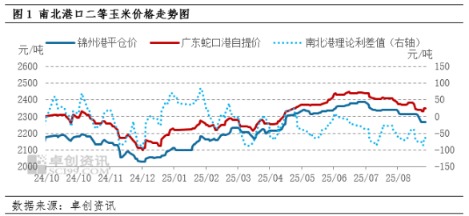
Core Insights - The corn market in the southeastern coastal region of China showed a downward trend in August 2025, with two price rebounds occurring mid-month and at the end of the month, while some trading companies began pre-selling new crop corn [1][4][6] Price Trends - As of August 29, the price of second-grade corn at Shekou Port was approximately 2350 CNY/ton, down by 50 CNY/ton from the beginning of the month [1] - Northern ports also experienced a price decline, with the mainstream settlement price at 2260 CNY/ton, reflecting a similar decrease of 50 CNY/ton [3] - The average theoretical trade differential between southern and northern ports was -63.10 CNY/ton, a decrease of 18.32 CNY/ton from the previous month [3] Supply and Demand Dynamics - The market sentiment remained bearish due to continuous supply from northeastern grain auctions and a lack of corresponding purchasing increases from the demand side [3][6] - By the end of August, total corn inventory at southern and northern ports was 2.7656 million tons, similar to the previous year, while Guangdong's foreign trade grain inventory decreased by 17.8% year-on-year [8] Future Outlook - In September, the corn market will officially enter a transitional phase, with expectations of stable prices around 2350 CNY/ton, although demand may decrease due to cautious purchasing behavior from downstream enterprises [8] - If the new crop's market entry is delayed, prices may see a short-term increase of 20-40 CNY/ton, but will likely revert to around 2300 CNY/ton thereafter [9]
卓创资讯:贸易环节出货积极性提升 华北市场粮源供应增加
Xin Hua Cai Jing· 2025-07-08 03:45
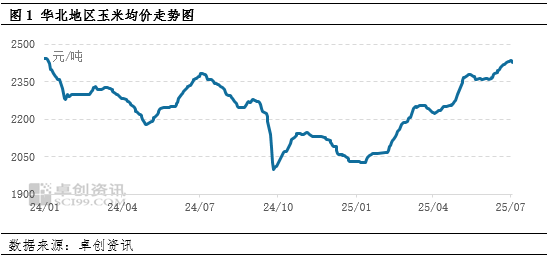
Core Viewpoint - The corn prices in the North China market have shifted from rising to falling since July 4, primarily due to increased supply from traders and stable demand, leading to a slight decrease in prices [1][3]. Group 1: Price Trends - As of July 4, the average corn price in North China was 2427.85 yuan/ton, reflecting a week-on-week decline of 0.26% and a year-on-year increase of 1.86% [1]. - The price drop is attributed to enhanced shipment activities by traders, resulting in a temporary increase in corn supply [1][3]. Group 2: Trader Behavior - Traders have been actively selling corn to lock in profits, with reported outflow profits around 300 yuan/ton as of late June and early July [3]. - Concerns over increased auction volumes of imported corn have led traders to anticipate limited price increases, prompting them to boost their selling activities [3][4]. Group 3: Supply Dynamics - The onset of the rainy season and the introduction of imported genetically modified corn have diversified the factors affecting the corn market [4]. - The auction of imported corn is expected to influence market sentiment and supply dynamics, potentially limiting price increases [4][5]. Group 4: Future Outlook - In the short term, corn prices in North China are expected to remain weak due to increased supply, but may strengthen later in July as concentrated shipments decrease [5]. - The overall supply-demand relationship in the corn market is relatively loose, with expectations of price adjustments depending on auction volumes and transaction conditions [5].