现代治理

Search documents
浙江第三座万亿GDP城市来了
Sou Hu Cai Jing· 2026-01-29 05:31
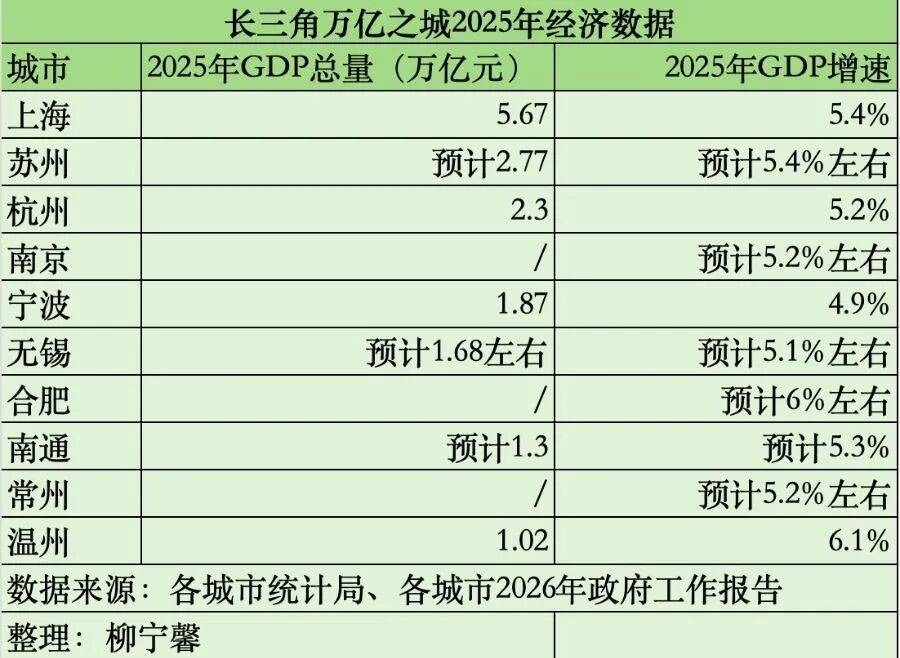
Core Viewpoint - The economic landscape of the Yangtze River Delta is evolving, with the number of cities achieving a GDP of over 1 trillion yuan increasing to 10 by 2025, highlighting a shift from mere scale to quality and sustainability in urban development [1][3][4]. Economic Data Summary - Shanghai's GDP is projected to reach 5.67 trillion yuan with a growth rate of 5.4% [1][5]. - Suzhou is expected to have a GDP of 2.77 trillion yuan, also with a growth rate around 5.4% [1][3]. - Hangzhou's GDP is anticipated to be 2.3 trillion yuan, growing at 5.2% [1][5]. - Nanjing is nearing the 2 trillion yuan mark with an estimated growth rate of 5.2% [1][3]. - Ningbo's GDP is projected at 1.87 trillion yuan, with a growth rate of 4.9% [1][6]. - Wuxi is expected to reach approximately 1.68 trillion yuan, with a growth rate around 5.1% [1][3]. - Hefei and Changzhou are both projected to have GDPs of 1 trillion yuan, with Hefei expected to grow at around 6% [1]. - Nantong's GDP is estimated at 1.3 trillion yuan, with a growth rate of 5.3% [1][3]. - Wenzhou has achieved a historic milestone with a GDP of 1.02139 trillion yuan, growing at 6.1% [1][7]. Industry Trends and Shifts - The focus is shifting from GDP scale to the quality of development, emphasizing industrial structure and innovation capabilities [4][8]. - Shanghai is advancing towards a high-end industrial cluster, with significant growth in sectors like integrated circuits and artificial intelligence [5][9]. - Hangzhou is leveraging its digital economy, with notable growth in sectors like new energy vehicles and industrial robotics [6][12]. - Wenzhou's economic growth is driven by its manufacturing sector, with strategic emerging industries showing robust growth [7][9]. - Cities are increasingly focusing on sustainable development and innovation as key factors for long-term competitiveness [8][13]. Future Industry Planning - Shanghai's "14th Five-Year Plan" aims to build a modern industrial system with a focus on advanced manufacturing and emerging industries [9][10]. - Suzhou is transitioning from traditional manufacturing to a modern industrial powerhouse, emphasizing biomedicine and high-end manufacturing [10][11]. - Hangzhou's planning includes developing advanced manufacturing clusters in artificial intelligence and visual intelligence [12]. - Nanjing and Wuxi are targeting future industries such as quantum technology and synthetic biology to enhance their economic growth [12][13].