
玻璃基封装载板

Search documents
马年投资风向标,公募调研路线图出炉,三大主线蓄势待发!
Xin Lang Cai Jing· 2026-02-25 09:13
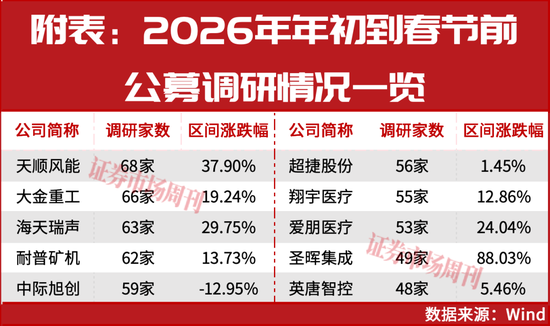
Core Viewpoint - The Chinese stock market is experiencing a new wave of interest in technology stocks following a strong performance before the Spring Festival, with public funds focusing on specific companies for potential investment opportunities [1][13]. Group 1: Public Fund Research - From the beginning of the year to the Spring Festival, 10 public fund companies conducted over 100 research sessions, with the top three being Bosera Fund (176 sessions), Huaxia Fund (142 sessions), and E Fund (134 sessions) [1][13]. - The companies most frequently researched by these funds include Tiensun Wind Power, Daikin Heavy Industries, and Haitan Ruisheng [1][13]. Group 2: Individual Fund Manager Insights - Notable fund managers such as Xiao Nan from E Fund and Zhao Feng from Ruiyuan Fund participated in these research sessions, indicating their interest in building positions in the companies they researched [1][13]. - Xiao Nan's funds have achieved a total scale of approximately 27.26 billion yuan, with a best-term return of 307.89% [2][15]. Group 3: Company Performance and Projections - Lunyu Co., a company in the specialty chemicals sector, is projected to achieve a net profit of 60 million to 70 million yuan for 2025, representing a year-on-year growth of 181.05% to 227.89% [5][17]. - The company has also indicated plans to enhance its supply chain and production capabilities, focusing on key intermediates to ensure raw material supply [4][16]. Group 4: Semiconductor Sector Interest - Zhao Feng conducted a research session on BOE Technology Group, a leader in the semiconductor display sector, focusing on its innovative business developments and future growth strategies [6][18]. - BOE plans to enhance shareholder returns through stock buybacks and dividends, with a cash dividend of approximately 1.87 billion yuan planned for 2024 [9][20]. Group 5: AI and Data-Driven Companies - Haitan Ruisheng has attracted significant attention from public funds, with a focus on AI-related sectors, indicating a strategic shift towards "AI + industry" applications [10][21]. - The company is developing a specialized team for embodied intelligence data, which is seen as a high-growth area, and is actively engaging with local governments and tech firms to establish training data solutions [11][23].

京东方A(000725) - 030-2025年11月21日投资者关系活动记录表
2025-11-24 00:16
Group 1: LCD Market Insights - The demand for TV products is stimulated by national subsidies and export incentives, leading to an expected increase in annual shipment volume and area, despite fluctuations in demand throughout the year [1] - IT product shipments are anticipated to grow rapidly due to replacement demand, while MNT product shipments are expected to remain flat [1] - The average utilization rate in the LCD industry improved in Q3 but is projected to drop below 80% in Q4, leading to a slight price adjustment for TV products and stable pricing for IT products [2] Group 2: OLED Market Dynamics - The OLED market is experiencing an oversupply despite increased shipments in Q3 and Q4, with a notable rise in low-end Ramless product shipments and heightened competition in the domestic market [3] - The company plans to invest in an 8.6 generation AMOLED production line to enhance its competitiveness in high-end IT products, such as laptops and tablets [4] Group 3: Technology and Competitive Edge - The company has chosen the LTPO backplane technology for OLED, which has been validated in the sixth generation line, supporting high-end applications with comprehensive capabilities [5] - The penetration rate of OLED in high-end IT products remains below 10%, indicating limited market impact from capacity supply in the medium to long term [5] Group 4: MLED Business Development - The MLED business is a key component of the company's "1+4+N" ecosystem, focusing on Mini/Micro LED technology to drive rapid growth [6] Group 5: Financial Outlook and Capital Expenditure - Capital expenditures are expected to peak in 2025 due to significant investments in the 8.6 generation OLED production line, with a decline anticipated from 2027 onwards [8] - The company plans to allocate at least 35% of annual net profit to cash dividends and a minimum of RMB 1.5 billion for share repurchases each year from 2025 to 2027 [10] Group 6: Shareholder Engagement - The company is considering repurchasing minority shareholder equity as a key use of cash flow, particularly as capital expenditures decrease and cash flow improves [9] - A new shareholder return plan aims to establish a stable and predictable return mechanism, reflecting the company's commitment to sharing growth benefits with shareholders [12]

京东方A(000725) - 028-2025年11月4日投资者关系活动记录表
2025-11-05 00:48
Group 1: Industry and Market Overview - In 2025, the total shipment volume and area of LCD products are expected to see slight year-on-year growth, driven by demand for small-sized TVs in emerging markets, while large-sized TV growth may slow temporarily [1][2] - IT product shipments, particularly for notebooks (NB) and tablet PCs (TPC), are projected to experience rapid growth due to replacement demand [2] - The average utilization rate in the industry is expected to rise in Q3 but fall below 80% in Q4, leading to a differentiated pricing outlook for LCD products [2] Group 2: Product Performance and Trends - For the first three quarters of 2025, the revenue structure of display devices is as follows: TV products (28%), IT products (37%), LCD mobile and other products (12%), and OLED products (23%) [5] - The global shipment volume of OLED products is anticipated to grow in 2025, although the overall market remains oversupplied [3][4] Group 3: Future Outlook and Capital Expenditure - The capital expenditure is expected to decline after peaking in 2025 due to significant investments in the Chengdu 8.6 generation OLED production line, with further spending focused on maintenance and innovative projects from 2027 onwards [6] - The company plans to utilize cash flow for minority shareholder equity buybacks, particularly in the context of improving cash flow and decreasing capital expenditures [7]